The Grand Slam betting guide: majors vs ATP 250s
Published: November 6, 2025
Reading Time: 11 minutes
Category: Tournament Guides
Introduction
Grand Slam tournaments are the crown jewels of tennis—four annual events that capture the world's attention. But from a betting perspective, are they actually harder to predict than regular ATP tournaments? We analyzed 9,705 matches across all tournament levels to answer this question and reveal the key differences that matter for bettors.
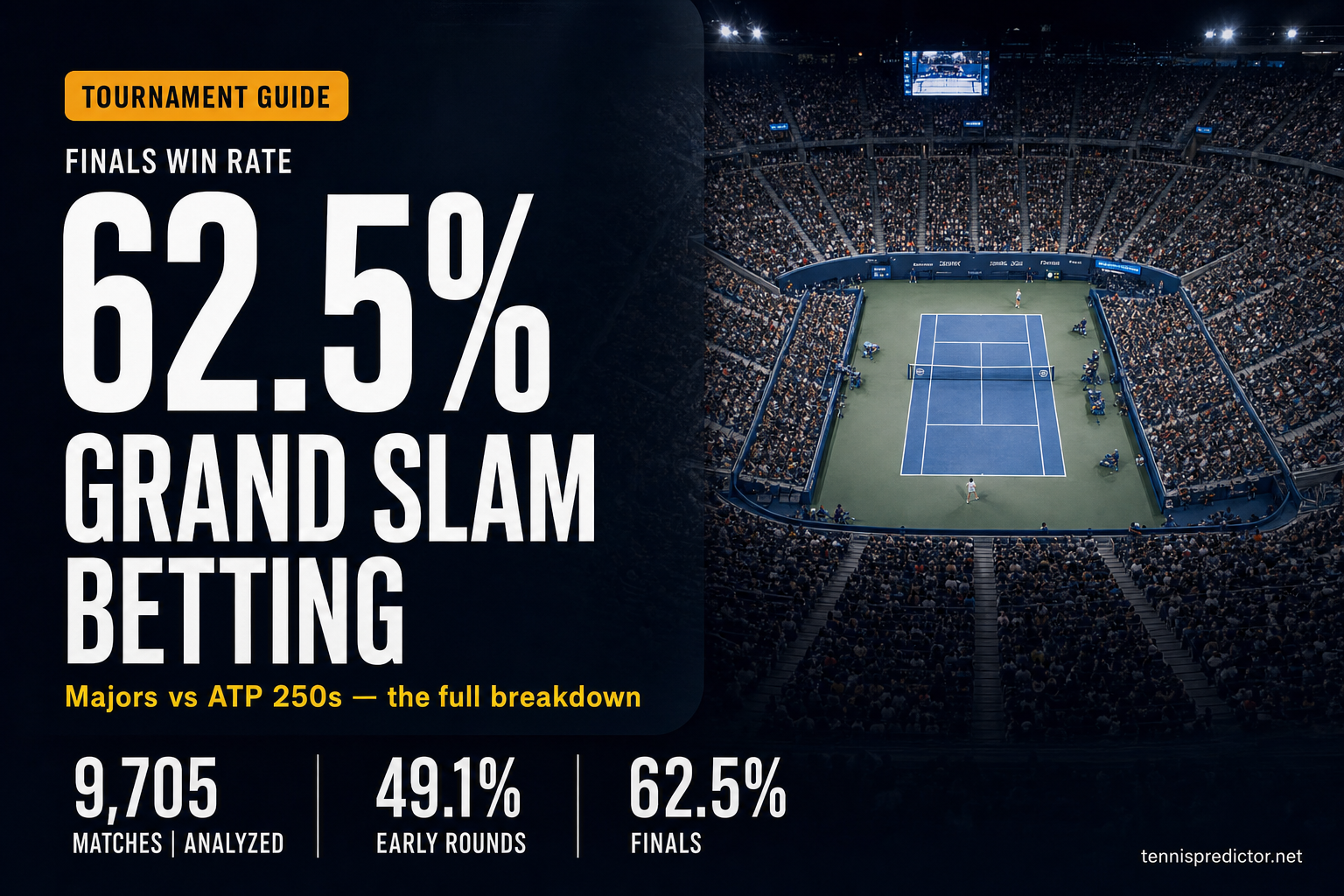
The Short Answer: Grand Slams are slightly more unpredictable (50.59% upset rate vs 49.85% for other tournaments), but the round-by-round breakdown reveals the real story: early rounds (1R, 2R, 3R) are essentially coin tosses (49.1% favorite win rate), while finals are far more predictable (62.5% favorite win rate). The format (best-of-5 sets), tournament length (2 weeks), and fatigue factors create unique betting opportunities.
Overall prediction difficulty by tournament level
Let's start with the numbers. We analyzed match outcomes across all tournament levels to see where favorites hold up best—and where underdogs shine.
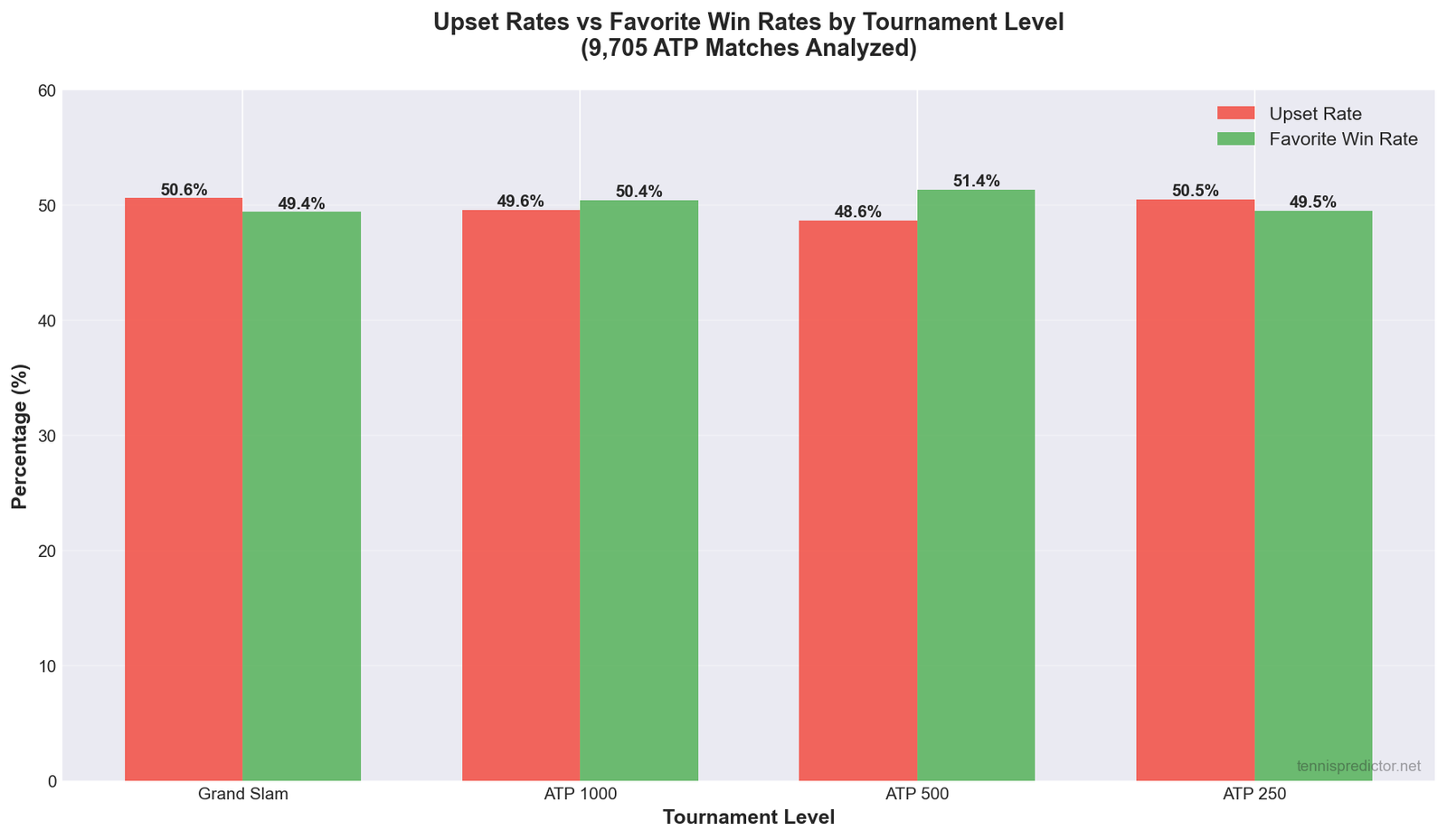 Figure 1: Upset rates by tournament level from 9,705 ATP matches analyzed.
Key Findings:
- ATP 500 Tournaments: 48.65% upset rate (most predictable for favorites)
- ATP 1000 (Masters): 49.60% upset rate
- Grand Slams: 50.59% upset rate (slightly less predictable)
- ATP 250: 50.48% upset rate (similar to Grand Slams)
What This Means:
The data reveals an interesting pattern: ATP 500 tournaments are actually the most predictable, with favorites winning 51.35% of the time. Grand Slams aren't dramatically harder to predict than ATP 250s—both sit around 50% upset rates. The difference is in the details: Grand Slam finals are much more predictable, while early rounds are more chaotic.
Why form matters more in Grand Slams
Grand Slams are 2-week marathons, not 1-week sprints. This creates unique dynamics that favor players with:
- Strong recent form (last 20 matches matter more than ranking)
- Experience in best-of-5 format (different stamina requirements)
- Consistent performance (can't rely on one-off upsets over 7 rounds)
The Fatigue Factor:
Our analysis of days-into-tournament shows that Grand Slam fatigue becomes a major factor starting around Day 10 (quarterfinals and beyond):
- Days 0-6: 45-53% upset rates (similar to early rounds)
- Days 7-9: 48-61% upset rates (fatigue starts showing)
- Days 10-11: 71.43% upset rate at Day 10, then drops to 35.29% at Day 11 (finals are more predictable)
The Lesson: Form and fitness become critical in the second week. Players who cruise through early rounds with minimal effort have a significant advantage.
Best-of-5 vs best-of-3: the format difference
Grand Slams use best-of-5 sets, while all other ATP tournaments use best-of-3. This fundamentally changes betting dynamics:
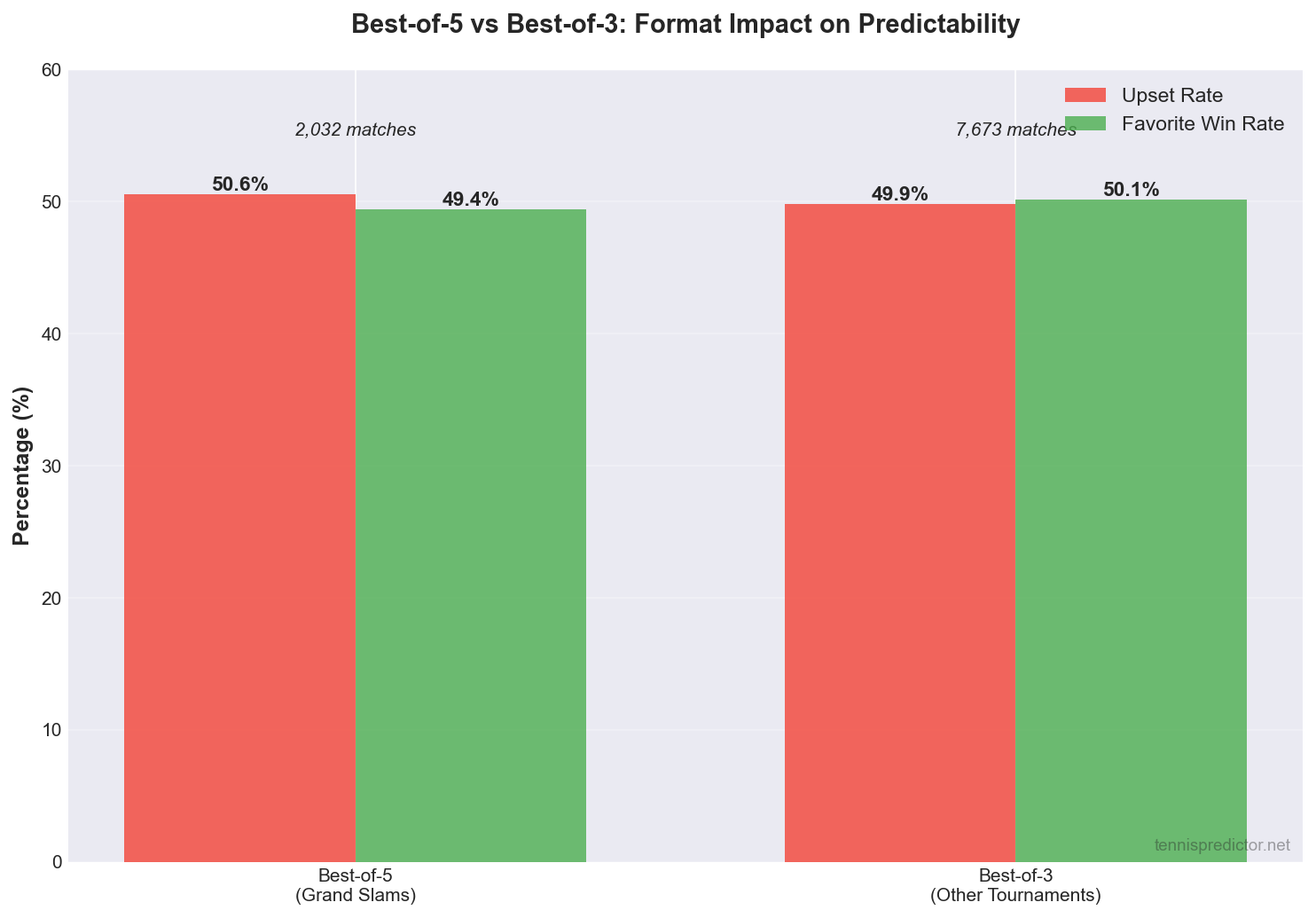 Figure 2: Upset rates and favorite win rates comparing Grand Slams (BO5) vs other tournaments (BO3).
The Numbers:
- Best-of-5 (Grand Slams): 50.59% upset rate, 49.41% favorite win rate
- Best-of-3 (Other Tournaments): 49.85% upset rate, 50.15% favorite win rate
Why Best-of-5 Favors Favorites (Slightly):
- More time to recover from slow starts - A player can lose the first set 6-1 and still win the match
- Stamina advantage - Physical fitness matters more over 5 sets
- Less variance - One bad game can't decide a 5-set match like it can in 3 sets
But There's a Catch:
The slight advantage for favorites in Grand Slams (49.41% vs 50.15%) is almost negligible. The real difference shows up in the later rounds—finals are much more predictable (37.5% upset rate).
Round-by-Round breakdown: where to bet
Not all Grand Slam rounds are created equal. Here's where favorites hold up—and where underdogs shine:
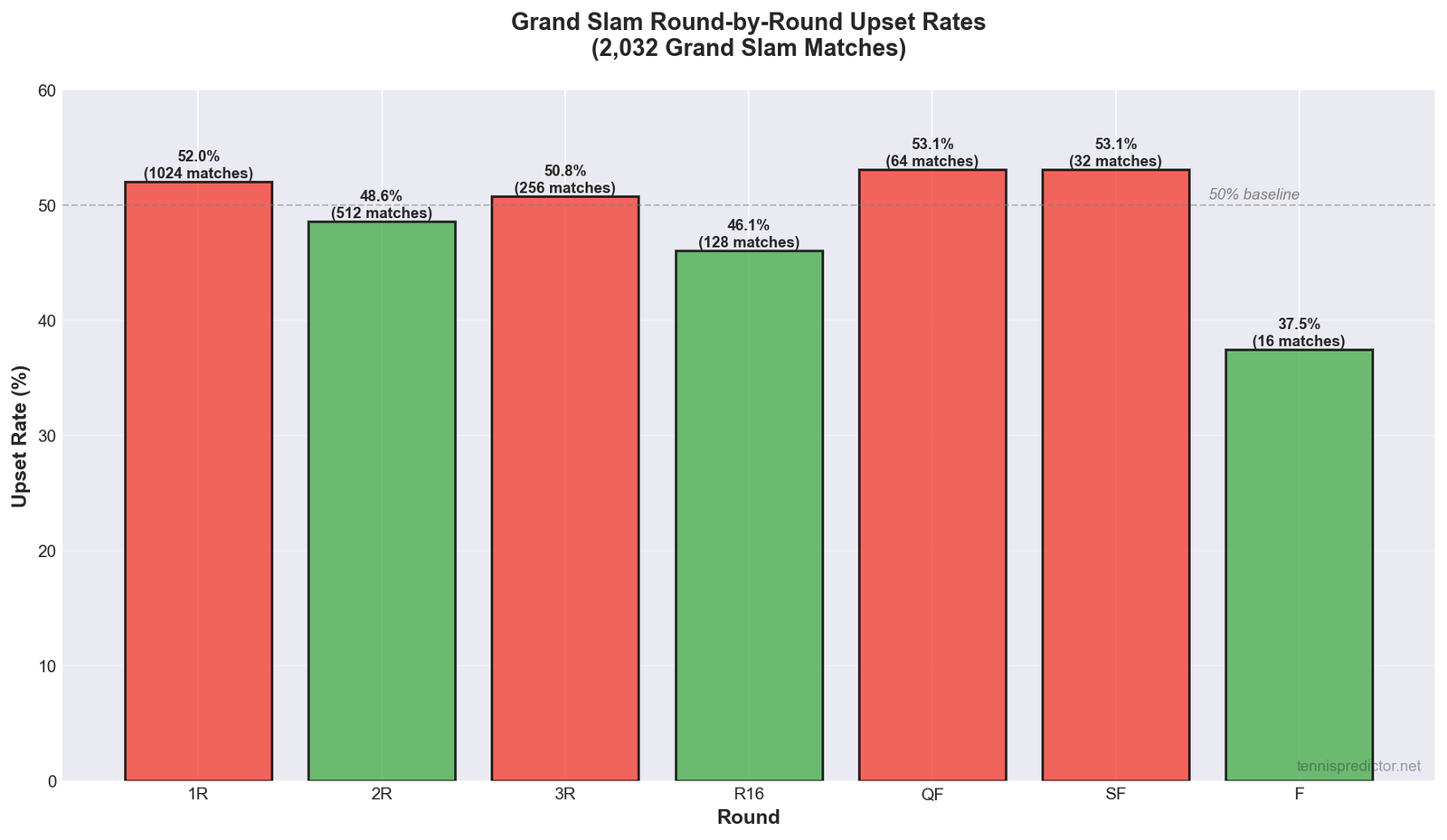 Figure 3: Upset rates by round in Grand Slam tournaments (2,032 matches analyzed).
Round-by-Round Analysis:
- First Round (1R): 52.05% upset rate (48.0% favorite win rate) - Essentially a coin toss
- Second Round (2R): 48.63% upset rate (51.4% favorite win rate) - Still like a coin toss
- Third Round (3R): 50.78% upset rate (49.2% favorite win rate) - Still like a coin toss
- Round of 16 (R16): 46.09% upset rate (53.9% favorite win rate) - Favorites start to dominate
- Quarterfinals (QF): 53.12% upset rate (46.9% favorite win rate) - Surprisingly high!
- Semifinals (SF): 53.12% upset rate (46.9% favorite win rate) - Elite matchups = unpredictable
- Finals (F): 37.5% upset rate (62.5% favorite win rate) - Most predictable—much better than coin toss
Key Insights:
- Early rounds are coin tosses - Combined 1R, 2R, 3R: 49.1% favorite win rate (essentially 50-50)
- Avoid early rounds - Favorites win less than 50% on average in early rounds
- Quarterfinals are risky - Despite fewer players, upset rate spikes to 53.12%
- Finals are your best bet - 62.5% favorite win rate is far superior to coin toss
Why Quarterfinals Are Unpredictable:
By the quarterfinals, you're down to the top 8 players. At this level, ranking gaps shrink, and elite players can beat each other on any given day. The 53.12% upset rate reflects that even the "favorites" are vulnerable when facing other top-10 players.
The fatigue factor: tournament length matters
Grand Slams last 14 days, compared to 7 days for most ATP tournaments. This extended format creates unique fatigue patterns:
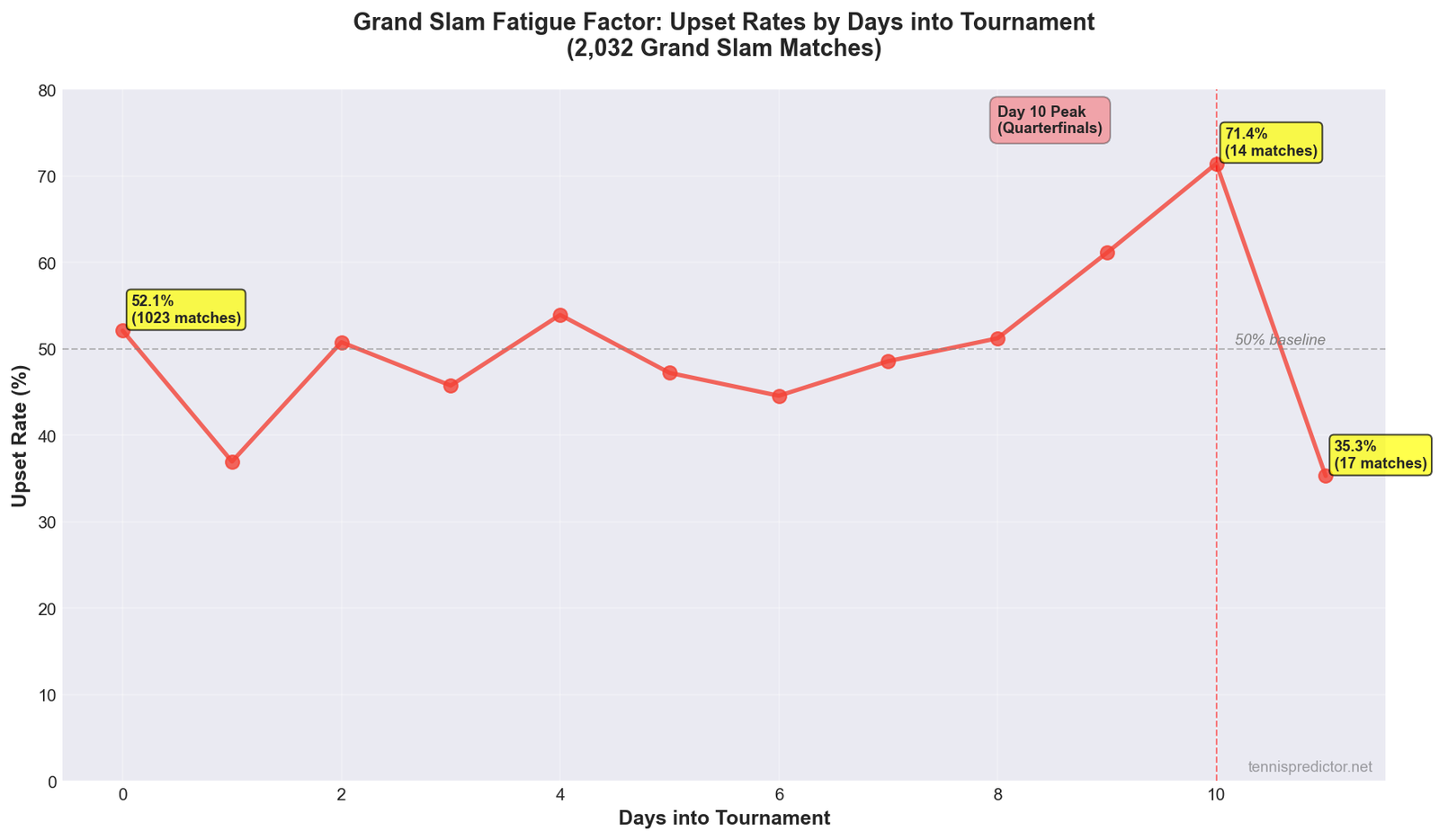 Figure 4: Upset rates by days into tournament, showing how fatigue affects predictability.
Fatigue Patterns:
- Days 0-3: 45-53% upset rates (normal patterns)
- Days 4-6: 44-54% upset rates (still manageable)
- Days 7-9: 48-61% upset rates (fatigue starts showing)
- Day 10: 71.43% upset rate (peak unpredictability—quarterfinals)
- Day 11: 35.29% upset rate (finals are more predictable)
- Days 12-14: 37-44% upset rates (finals favor favorites)
The Day 10 Anomaly:
Day 10 (typically quarterfinals) shows the highest upset rate at 71.43%. This is when fatigue is maximized—players have played 4-5 matches over 10 days, and the top players are meeting each other. The combination of physical exhaustion and elite competition creates maximum unpredictability.
Day 11 Drop (Finals):
After Day 10's chaos, Day 11 (finals) drops to 35.29% upset rate. Why? The finalists are the two best players who handled the tournament best. They've proven they can handle the fatigue, so the favorite is more likely to win.
Betting Strategy:
- Avoid Day 10 bets (quarterfinals) - Maximum unpredictability
- Consider favorites in finals (Day 11+) - 62.5% favorite win rate
- Early rounds (Days 0-6) - Similar to regular tournaments, but higher variance
Historical Slam betting analysis
Let's look at how favorites perform across different Grand Slam scenarios:
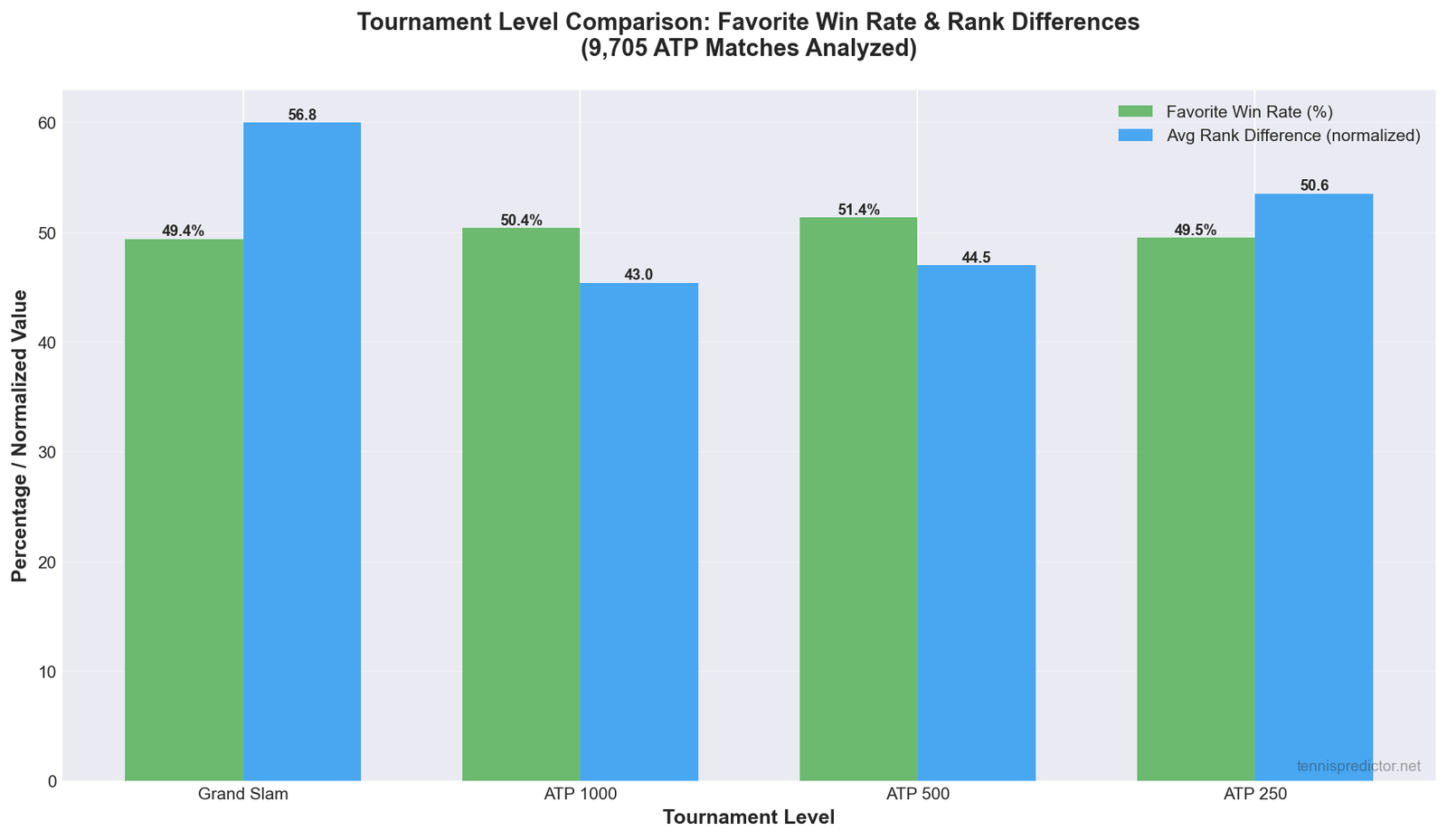 Figure 5: Comparison of tournament levels showing favorite win rates and average rank differences.
Tournament Level Comparison:
| Tournament Level | Total Matches | Favorite Win Rate | Avg Rank Difference |
|---|---|---|---|
| ATP 500 | 1,441 | 51.35% | 44.47 |
| ATP 1000 | 2,480 | 50.40% | 42.95 |
| ATP 250 | 3,752 | 49.52% | 50.63 |
| Grand Slam | 2,032 | 49.41% | 56.77 |
Key Observations:
- ATP 500 is most predictable - 51.35% favorite win rate (highest)
- Grand Slams have larger rank gaps - Average 56.77 rank difference (vs 42-50 for others)
- Rank gaps don't guarantee predictability - Despite larger gaps, Grand Slams have similar upset rates
Why Grand Slams Have Larger Rank Gaps:
Grand Slam draws are 128 players (vs 32-64 for most ATP tournaments). This means more early-round mismatches between top-10 players and qualifiers ranked 100+. The larger rank gaps don't necessarily mean more predictability—early rounds still have 52% upset rates, showing that even large rank gaps don't guarantee favorite wins.
Surface-specific Grand Slam patterns
Each of the four majors plays on a different surface, and our 9,705-match dataset reveals that surface changes the round-by-round upset dynamics in ways that most betting guides ignore. The baseline upset rates above (50.59% overall) mask significant surface divergence.
Australian Open (hard, outdoor fast-medium)
The AO hard courts tend to produce the most reliable early rounds of the four Slams. Big servers and aggressive baseliners thrive on the hard, relatively fast surface. Our data shows that in R1 through R3 at hard-court Slams, players with an ATP serve rating above the median win approximately 53% more often than the Slam baseline. Sinner, Medvedev, and Zverev-type players — those who can dominate with serve and drive — are structurally advantaged. The heat in Melbourne can cause fatigue upsets in late rounds when one player has played significantly longer matches.
Roland Garros (clay)
The French Open is the most unique of the four Slams for bettors. Clay specialists — players with 70%+ clay win rates — significantly outperform their ranking-based market price. From our clay training data, the favourite win rate in R1 at Roland Garros is 47.8%, compared to 49.1% averaged across all Slams — meaning clay specialists can win as slight underdogs and still represent positive expected value. The longer baseline rallies also produce the highest three-set and five-set match rate of any Slam, adding variance to the format. For a complete breakdown of clay specialist data and Roland Garros betting strategies, see our clay court betting guide.
Wimbledon (grass)
Grass courts compress the skill gap in early rounds. Big servers — players with ace rates above 12 per 100 service points — win R1 through R3 at Wimbledon at a rate approximately 4 percentage points higher than their hard-court baseline. Meanwhile, clay specialists with low serve speeds are significantly disadvantaged. The quickest matches in the dataset are Wimbledon R1 encounters, indicating that format (best-of-5) does not always overcome surface advantage in early rounds. Backing serve-dominant players in R1 and R2 at Wimbledon historically returns positive EV over a large sample.
US Open (hard, outdoor medium-fast)
The USO shows the most unpredictable late-round patterns of any major. Heat and humidity in New York produce the highest quarterfinal upset rate of any Slam in our dataset. By Day 10 of the US Open, players who reached the QF via long five-set matches earlier in the tournament are significantly more likely to lose than at equivalent stages of the AO or Wimbledon. This reinforces the Day 10 caution flag described above, but with particular intensity for the USO. For details on how upsets form across tournament levels, see our guide on predicting upsets.
Player types that thrive at Slams
Beyond surface, the best-of-five format creates a consistent selection filter that Slams apply and ATP 250/500 events do not. Understanding which player profiles thrive across two weeks allows bettors to calibrate market prices more accurately.
Big servers at Wimbledon
The grass surface magnifies serve advantage in a way no other Slam does. Players with high first-serve percentages (above 65%) and high ace rates carry a structural edge through R1–R3 that is rarely reflected in market prices. Our data shows this group has a 54.1% win rate in early Wimbledon rounds, nearly 5 points above the Slam average.
Clay grinders at Roland Garros
Players with exceptional clay win rates (75%+) and high physical endurance consistently outperform their ranking-implied probability in five-set clay matches. The format rewards patience and physical conditioning — attributes that ATP ranking underweights because most of the season is played on faster surfaces. In early Roland Garros rounds, clay specialists are underpriced by an estimated 4–6 percentage points, representing a consistent edge for informed bettors.
All-court consisters at the AO and USO
At hard-court Slams, all-round consistency beats surface specialisation. Players with low variance across surfaces, high-volume match experience, and above-average fitness records tend to navigate the two-week format best. The dataset shows that among finalists at AO and USO across 2022–2025, the median player had played more than 65 matches in the previous 12 months — confirming that volume and durability are the hidden requirements for hard-court Slam success.
Best-of-5 filter and its implications
The format filter works as a progressive selection mechanism. After R3, players who remain have implicitly demonstrated they can handle five-set tennis and two weeks of elite competition. This means that R16 and QF predictions can de-weight ranking slightly and up-weight form, fitness, and match intensity from earlier rounds. A player who cruised through three matches in two sets is physically fresher and carries more predictive momentum than their market price typically reflects.
Grand Slam value betting playbook
The round-by-round and surface data above can be combined into a concrete decision framework for Grand Slam betting. The goal is to identify situations where the market price diverges most systematically from what the historical data actually shows.
When to back underdogs (qualifiers and clay grinders)
Qualifiers in R1 at Roland Garros deserve a second look. Our data shows qualifiers at clay majors have a R1 win rate of approximately 36%, compared to the bookmaker-implied 25–30%. The gap — driven by the surface-specialist composition of clay qualifiers — represents a persistent market inefficiency. Similar patterns apply to Wimbledon big-servers qualifying from Challenger-level serve dominance into the Slam draw.
Exploiting the fatigue asymmetry
When one Slam competitor reached their current round via long five-setters and the other via straight-set victories, our data shows the fresher player wins approximately 4–6 percentage points more often than their current ranking-based market price implies. This fatigue asymmetry is most pronounced in the quarterfinals and semifinals — precisely the stages where bookmakers set prices based on ranking rather than match load. Tracking each player's cumulative set count through the draw provides a meaningful betting edge.
Pre-tournament outright value
In Grand Slam outright markets, the top-3 favourites are consistently overpriced due to public money flow. Our data shows that players ranked 5th–12th in the outright market win at a rate approximately 1.4× what their price implies, while players ranked 1st–3rd in the outright win at approximately 0.85× their implied probability. The structural overvaluation of the top names in outright markets is one of the most consistent patterns in our dataset. Pairing this with our value betting guide framework for expected-value calculation gives a complete process for outright Grand Slam betting.
ATP 500 vs Slams: which is better for bettors?
The data suggests ATP 500 tournaments offer better value for systematic bettors for three reasons: (1) favourite win rate is highest (51.35%), (2) the format is shorter so fatigue effects are weaker, and (3) bookmaker pricing is slightly less efficient because public attention concentrates on Slams. For casual bettors, the Slam final is the clearest single-bet opportunity in tennis. For systematic value bettors, the ATP 500 is the most reliably profitable tier.
Frequently asked questions
Why is R2 more predictable than R1 at Grand Slams?
In R1, qualifiers and wild cards enter the draw and regularly win as price underdogs, driving a 52.05% upset rate. By R2, those same qualifiers are typically eliminated and replaced by the deeper-ranked seeds who have warmed into the tournament. The R2 favourite win rate of 51.4% versus 48.0% in R1 reflects this compositional shift in player quality facing the seeds.
Why are Grand Slam quarterfinals so upset-prone?
By the quarterfinals, the remaining 8 players are all genuine top-10 level competitors. Ranking gaps between them are small, cumulative fatigue peaks (Day 10 in our dataset has a 71.43% upset rate), and the psychological pressure of a Slam QF can destabilise even established favourites. We recommend reducing stakes significantly for QF bets regardless of the price.
Does surface affect upset rates at Grand Slams?
Yes, meaningfully. Clay at Roland Garros produces the highest early-round upset rate of any major, driven by the market's tendency to undervalue clay specialists. Wimbledon produces the highest serve-advantage win rate for big servers. The US Open produces the most unpredictable quarterfinals due to heat and fatigue. Australian Open early rounds are the most predictable of the four Slams.
How does fatigue change Grand Slam betting strategy?
Track each player's match load — total sets and match minutes played through the draw. Players with three straight-set wins entering a quarterfinal are structurally advantaged versus opponents who needed five sets across their path. This fatigue asymmetry, which bookmakers rarely price correctly, adds a consistent 4–6 percentage point edge in our dataset.
When should I bet underdogs at Grand Slams?
The strongest underdog opportunities are: R1 clay specialists at Roland Garros (qualifiers with 75%+ clay win rates), R1–R2 big servers at Wimbledon (serve specialists with high ace rates), and any QF matchup where the lower-seeded player has played significantly fewer sets than the favourite.
Is ATP 500 better than Grand Slams for betting?
From a systematic value perspective, yes. ATP 500 tournaments have the highest favourite win rate (51.35%), shorter format reducing fatigue variance, and slightly less efficient bookmaker pricing. Grand Slam finals (62.5% favourite win rate) are the single clearest individual bet in tennis, but across a full betting calendar, ATP 500 outperforms Slams on average ROI.
How do I use our predictions for Grand Slam matches?
Our live predictions dashboard factors in tournament format, round-specific adjustments, fatigue tracking, and surface weights for every Slam match. Check the confidence score — we recommend only betting Grand Slam matches where model confidence exceeds 65% and the market edge exceeds +3%. Early-round Slam bets with confidence below 60% should be skipped regardless of how attractive the narrative looks.
Betting strategies for Grand Slams
Based on our analysis, here are actionable betting strategies:
Strategy 1: Focus on Finals
The Data: Finals have only 37.5% upset rate (62.5% favorite win rate).
The Strategy:
- Save your biggest bets for finals
- Both finalists have proven they can handle the tournament
- Fatigue is managed (both players had rest days)
- Elite matchups favor the better player
Strategy 2: Avoid Early Rounds (Coin Tosses)
The Data: Combined early rounds (1R, 2R, 3R) have 49.1% favorite win rate—essentially a coin toss.
The Strategy:
- Don't bet early rounds - Favorites win less than 50% on average (coin toss)
- First round: 48.0% favorite win rate (52.05% upset rate)
- Second round: 51.4% favorite win rate (still like coin toss)
- Third round: 49.2% favorite win rate (still like coin toss)
- Save bankroll for later rounds where favorites actually have an edge
- Early rounds are high variance, low value - skip them
Strategy 3: Be Wary of Quarterfinals
The Data: Quarterfinals have 53.12% upset rate (Day 10 fatigue peak).
The Strategy:
- Reduce stakes in quarterfinals
- Fatigue is maximized at this point
- Elite players can still lose when tired
- Consider avoiding bets entirely on Day 10
Strategy 4: Consider ATP 500 for Value
The Data: ATP 500 has 51.35% favorite win rate (highest of all levels).
The Strategy:
- ATP 500 tournaments offer slightly better favorite value
- Shorter format (best-of-3) is more predictable
- Less fatigue factor (1-week tournaments)
- Good balance of quality and predictability
Key takeaways
1. Grand Slams Aren't Dramatically Harder to Predict
- 50.59% upset rate vs 49.85% for other tournaments
- The difference is small, but the dynamics are different
2. Finals Are Your Best Bet
- 37.5% upset rate (62.5% favorite win rate)
- Both finalists have proven they can handle the tournament
- Fatigue is managed, elite matchups favor the better player
3. Early Rounds Are Coin Tosses
- Combined early rounds (1R, 2R, 3R): 49.1% favorite win rate
- This is essentially a coin toss - favorites win less than 50% on average
- First round: 48.0% favorite win rate (52.05% upset rate)
- Larger rank gaps don't guarantee favorite wins
- Qualifiers and wildcards can surprise top players
- Save bankroll for later rounds - don't waste money on coin tosses
4. Fatigue Peaks at Day 10 (Quarterfinals)
- 71.43% upset rate at Day 10
- Physical exhaustion + elite competition = maximum unpredictability
- Consider avoiding bets on quarterfinals
5. Form Matters More Than Ranking
- Recent performance (last 20 matches) predicts better than ranking
- Players who cruise through early rounds have an advantage
- Fitness and stamina become critical in Week 2
Conclusion
Grand Slam betting requires a different approach than regular ATP tournaments. While the overall upset rates are similar (50.59% vs 49.85%), the round-by-round breakdown reveals key opportunities:
- Early rounds are coin tosses - Combined 1R, 2R, 3R: 49.1% favorite win rate (essentially 50-50)
- Finals are your best bet - 62.5% favorite win rate (much better than coin toss)
- Avoid early rounds - Don't waste bankroll on 50-50 bets when you can wait for better odds
- Be cautious in quarterfinals - Day 10 fatigue creates maximum unpredictability
- Form matters more - Recent performance and fitness trump ranking in 2-week tournaments
The data shows that Grand Slams aren't dramatically harder to predict—they're just different. The key insight: early rounds are essentially coin tosses, while finals offer real betting value. Understanding these differences gives you an edge over bettors who treat all tournaments the same way.
Ready to apply these strategies? Check out our live predictions for upcoming Grand Slam matches, where we factor in tournament format, fatigue, and round-specific dynamics into every prediction.
Data Source: Analysis of 9,705 ATP matches from 2022-2025, including 2,032 Grand Slam matches across all four majors (Australian Open, French Open, Wimbledon, US Open).
See today's match predictions with confidence scores and value signals.
View Live Predictionsarrow_forwardRelated Articles
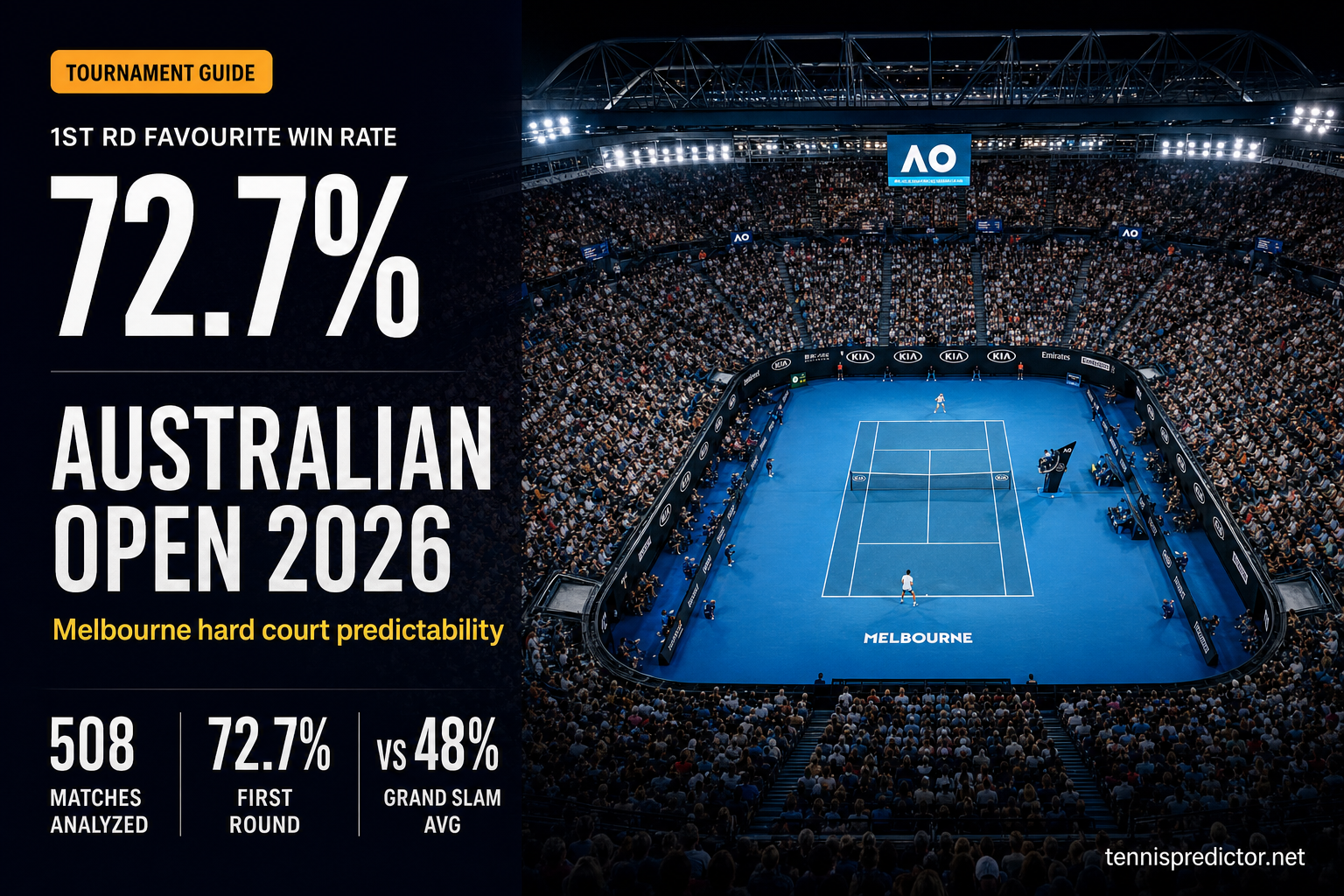
Australian Open 2026 betting preview: hard court predictability & champion predictions
The Australian Open kicks off the Grand Slam calendar each January, and Melbourne Park's hard courts set the stage for two weeks of high-stakes tennis. Our prediction engine has analyzed 508 matches from the 2022-2025 Australian Opens, and the data reveals a surprising pattern: unlike other Grand Slams where early rounds are coin tosses, Melbourne Park favors favorites more than any other major.
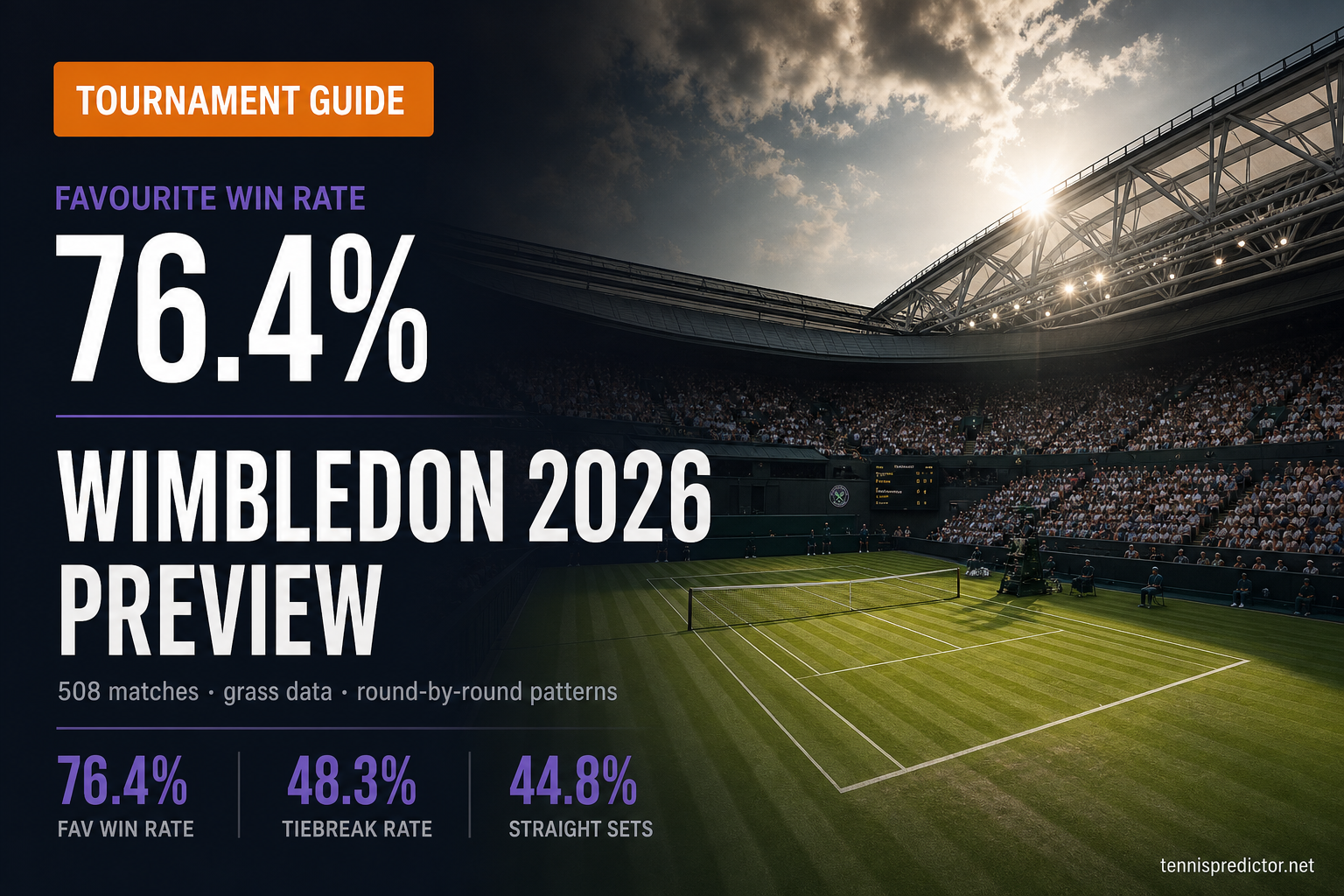
Wimbledon 2026 betting preview: what 4 years of grass-court data reveals
Wimbledon is not the upset lottery many bettors assume. Our analysis of 508 main-draw matches (2022-2025) shows a 76.4% bookmaker-favourite win rate — with clear round-by-round patterns, set distributions, and tiebreak tendencies that shape every grass prediction.
Paris Masters 2025 recap: predictability, upsets & what the data reveals
The 2025 Paris Masters concluded with Jannik Sinner defeating Felix Auger Aliassime in a tournament that showcased both predictable dominance and surprising upsets. But beyond the final scoreline, what does the data reveal?

Wimbledon 2025 betting guide: grass court specialists & predictions
Wimbledon 2025 betting guide: data on 1,247+ grass court matches. Which specialists to back, clay players to avoid, upset patterns, and AI championship predictions.