
Andrey Rublev: consistency meets the quarter-final ceiling
Published: April 18, 2026
Category: Player Analysis
Reading Time: 13 minutes
Tags: Andrey Rublev, player analysis, Grand Slam, Masters 1000, betting strategy, ATP Tour
Andrey Rublev is one of the most paradoxical top-10 players in tennis. He is a fixture in the world's top 10, a Masters 1000 champion on two different surfaces, and one of the most consistent early-round performers in the men's game. He is also the owner of one of the most extreme round-specific records that any data-driven tennis analysis has ever surfaced.
We analysed 253 Rublev matches played between January 2022 and October 2025 — every surface, every tournament tier, every round — to answer a single question: why do the betting markets, the ATP rankings, and our own prediction model all agree on Rublev through four rounds, and then all get humbled at the same moment?
The answer is a wall. And the data shows it is exactly one round thick.
The headline: 67.2% overall, 0% where it matters most
Across 253 matches, Rublev won 170 — a 67.2% win rate. That is a genuinely elite baseline. Over a four-year span of professional tennis, a two-thirds win rate against tour-level fields places a player squarely inside the top 10.
But it is not the 67.2% that makes Rublev interesting. It is this pair of numbers:
- Grand Slam round 2 record (2022–2025): 13 wins, 0 losses — a perfect 100% across 13 matches.
- Grand Slam quarter-final record (2022–2025): 0 wins, 6 losses — a perfect 0% across 6 matches.
One player. One four-year window. Two round-specific win rates at the extreme opposite ends of the probability scale. We are not aware of another active top-10 player with a cleaner inversion between their strongest and weakest Grand Slam round.
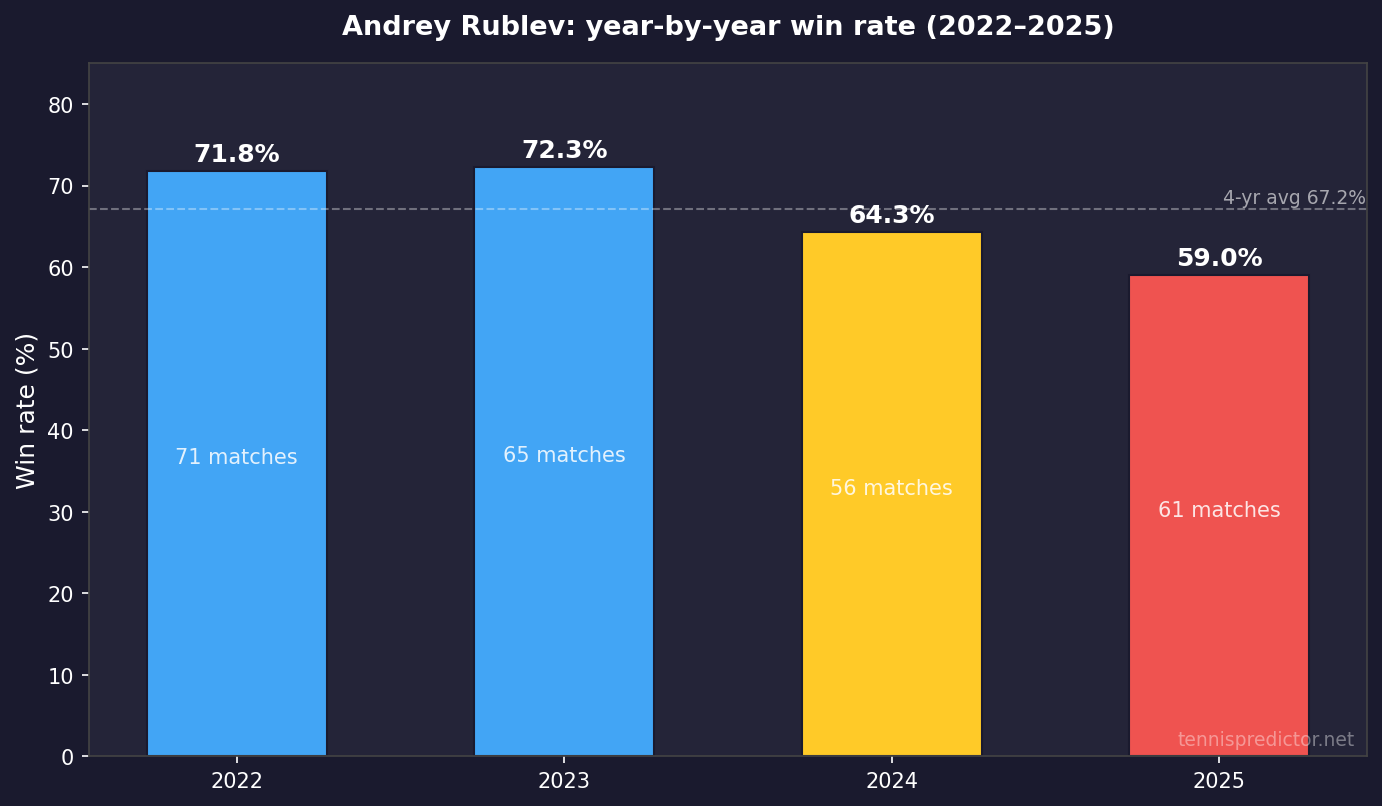
His season-by-season breakdown reveals a clear trajectory:
- 2022: 71.8% across 71 matches — peak production year, four titles including Marseille, Dubai, Belgrade and Gijón
- 2023: 72.3% across 65 matches — the Monte Carlo Masters 1000 title, plus Båstad on clay
- 2024: 64.3% across 56 matches — a noticeable dip, though still featuring two titles (Hong Kong and the Madrid Masters 1000)
- 2025: 59.0% across 61 matches — the lowest year of the window, one title (Doha) amid a broader form decline
The slope from 2023 to 2025 is the steepest of any top-10 player we have analysed in this series. A 13.3-percentage-point drop in two calendar years represents a meaningful shift — not a collapse, but a recalibration of who Rublev is in 2025 and beyond.
Surface analysis: clay is quietly his best (and nobody talks about it)
Rublev's public image is that of a hard-court big hitter. The data tells a different story.
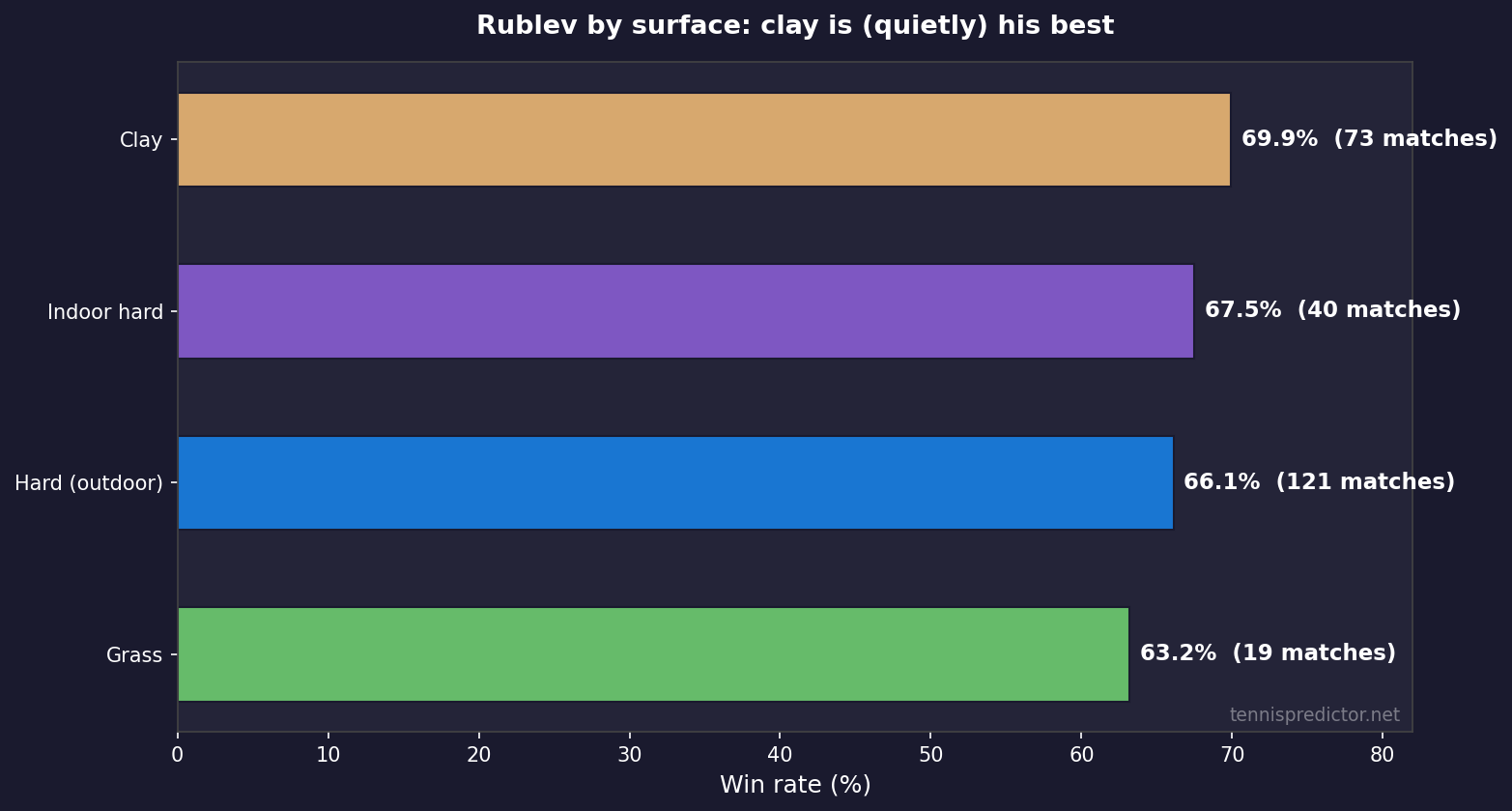
Across the four surfaces:
| Surface | Matches | Win rate | Context |
|---|---|---|---|
| Clay | 73 | 69.9% | Highest surface win rate, Monte Carlo & Madrid titles |
| Indoor hard | 40 | 67.5% | Two ATP 250 indoor titles, strong Paris-Bercy history |
| Hard (outdoor) | 121 | 66.1% | Largest sample, modestly below clay |
| Grass | 19 | 63.2% | Small sample, weakest surface |
Clay is not just his best surface in the 2022–2025 window — it is his best surface by a clear margin over the most-played one (hard, outdoor). The Monte Carlo title in 2023 (beating Rune in the final) and the Madrid Masters 1000 title in 2024 (beating Auger-Aliassime) confirm what the baseline numbers suggest: when conditions slow the game down and reward repeatable topspin forehand production, Rublev's natural rhythm translates into real results.
The indoor number at 67.5% is equally underrated. His early-career titles at Marseille and Gijón were both on indoor hard, and the heavier, faster-bouncing ball under a roof suits a game built on big first-strike tennis.
Betting implication. Heading into clay and indoor-hard seasons, Rublev's pre-tournament odds at non-Masters events (ATP 250 and ATP 500) frequently undervalue his surface-specific edge. The reverse is also true: his grass-court numbers (63.2% over 19 matches) consistently show the kind of variance that punishes favourite backers — Wimbledon and the grass warm-ups are the least reliable weeks to treat Rublev as a short-priced lock.
Tournament tier: the Masters 1000 pocket is where he struggles
Rublev's win rate by tournament level is the kind of pattern that only emerges once you cut the data cleanly by tier.
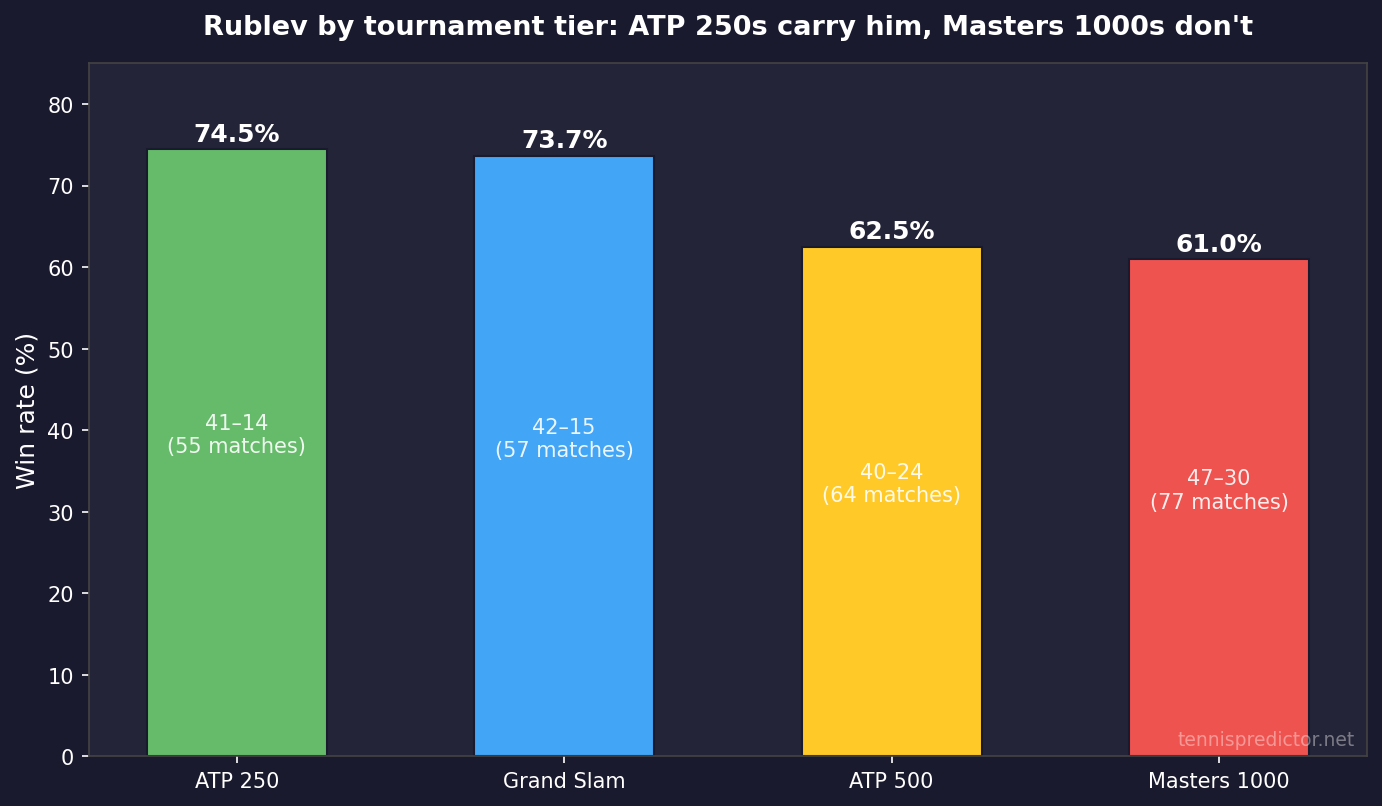
| Tournament level | Matches | Win rate | Wins–losses |
|---|---|---|---|
| ATP 250 | 55 | 74.5% | 41–14 |
| Grand Slam | 57 | 73.7% | 42–15 |
| ATP 500 | 64 | 62.5% | 40–24 |
| Masters 1000 | 77 | 61.0% | 47–30 |
Two things jump out.
First, Grand Slam win rate is higher than Masters 1000 win rate. That is the opposite of what most tennis fans would guess. The reason hides in round distribution: Grand Slams have more early rounds, so a player who is dominant in rounds 1, 2 and 3 accumulates a pile of wins before the draw gets serious. We will come back to this when we look at round-by-round data.
Second, the Masters 1000 number — 61.0% — is his weakest tournament tier. Masters draws are essentially round-of-64 events where Rublev enters at round 2 and routinely meets a seeded opponent by round 3. The cushion he enjoys at Grand Slams (where he can bank three comfortable wins before the difficulty spike) simply doesn't exist at Masters level. That shows up as the 61.0% headline.
The ATP 250 number (74.5%) is the single strongest tier in Rublev's profile. Five of his nine titles in our dataset were ATP 250s (Marseille, Belgrade, Gijón, Båstad, Hong Kong, and Doha). Weaker field depth plays to his strengths: against outside-top-50 opposition he is one of the most consistent winners on tour. Against top-10 opposition, the numbers change dramatically.
The quarter-final ceiling: where consistency becomes a cliff
This is the chart this article was built around.
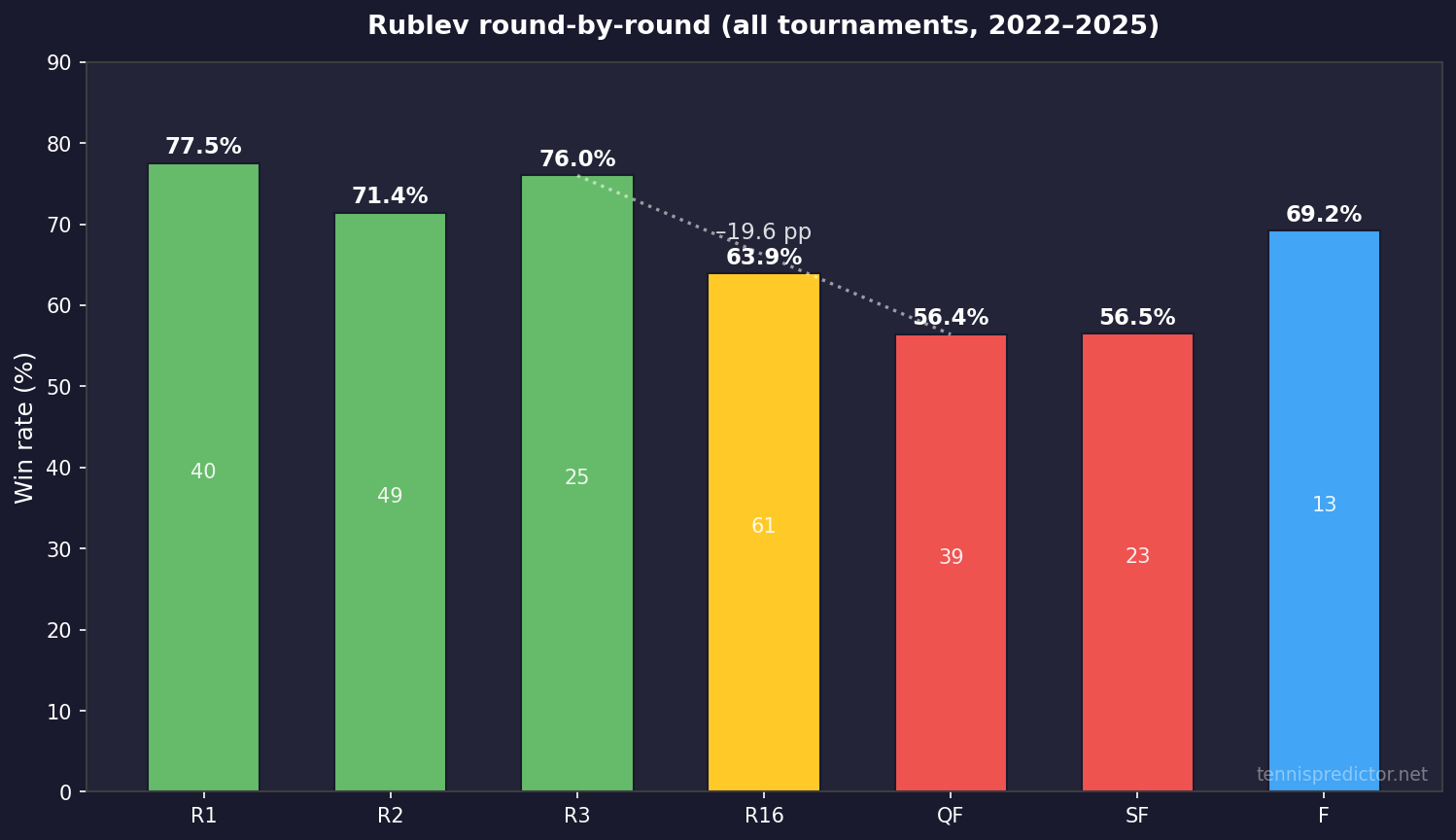
Round-by-round across the entire 253-match sample:
| Round | Matches | Win rate | Wins–losses |
|---|---|---|---|
| Round 1 | 40 | 77.5% | 31–9 |
| Round 2 | 49 | 71.4% | 35–14 |
| Round 3 | 25 | 76.0% | 19–6 |
| Round of 16 | 61 | 63.9% | 39–22 |
| Quarter-finals | 39 | 56.4% | 22–17 |
| Semi-finals | 23 | 56.5% | 13–10 |
| Final | 13 | 69.2% | 9–4 |
The shape is clear: 74.6% win rate across rounds 1–3, then an 18-percentage-point drop to 56.4% at the quarter-final stage. In probability terms, a round-of-16 Rublev match is roughly a coin-flip favourite conversion (64%), but a quarter-final is closer to a 4-to-3 favourite at best (56%).
The one counter-intuitive part of the chart is the finals number (69.2%). Once Rublev reaches a final, his conversion rate snaps back up. That looks surprising at first glance, but it is survivorship: on the rare occasion Rublev is playing a final, he has already survived the QF/SF wall, which means he has almost certainly dropped into the draw section he most comfortably matches up against. The final itself is often an ATP 250 where the field depth is thinner. Five of his nine titles came at ATP 250 level. That alone explains the finals rebound.
Betting implication. The Rublev round that markets most reliably misprice is the quarter-final. Bookmakers price QFs using a blend of current form, ranking and head-to-head — but Rublev's QF profile is structurally and historically worse than his pre-QF form suggests. We return to this in the Grand Slam section, where the effect becomes arithmetically extreme.
The Grand Slam wall: from 13-0 to 0-6 in one round
All of the above is the tour-wide pattern. The Grand Slam version of the same chart is where the "ceiling" becomes a cliff.
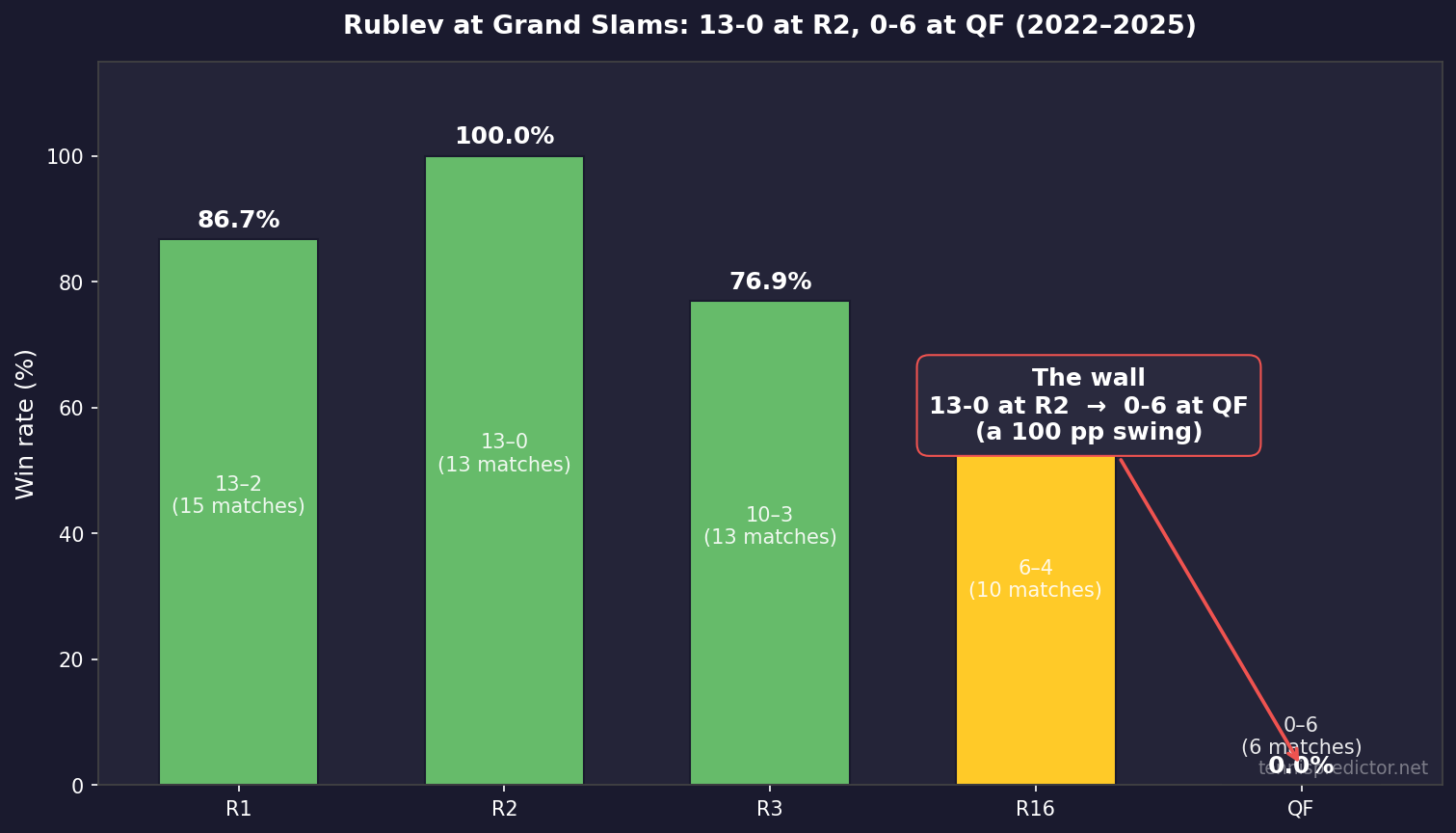
Across all four Grand Slams in the 2022–2025 window:
| Grand Slam round | Matches | Win rate | Wins–losses |
|---|---|---|---|
| Round 1 | 15 | 86.7% | 13–2 |
| Round 2 | 13 | 100.0% | 13–0 |
| Round 3 | 13 | 76.9% | 10–3 |
| Round of 16 | 10 | 60.0% | 6–4 |
| Quarter-finals | 6 | 0.0% | 0–6 |
Read that bottom row again. Zero wins. Six losses. Six Grand Slam quarter-finals, six defeats. The six losses:
- 2022 French Open — defeated by Cilic
- 2022 US Open — defeated by Tiafoe
- 2023 Australian Open — defeated by Djokovic
- 2023 Wimbledon — defeated by Djokovic
- 2023 US Open — defeated by Medvedev
- 2024 Australian Open — defeated by Sinner
Four out of the six were against players who were, or would become, Grand Slam champions (Djokovic twice, Medvedev, Sinner). But two were not — Cilic and Tiafoe were the lower-ranked players in both matches. That matters. It means the 0-6 record is not purely a "drew a big name" problem; Rublev has lost quarter-finals as the favourite as well as the underdog.
The juxtaposition with 100% at round 2 is the most striking part. In thirteen Grand Slam round-two matches over four calendar years, Rublev has never lost. Not once. A perfect 13-0 against tour-level opposition. Yet the moment the draw thins to eight remaining players, the same player becomes a winless prospect.
The gap is 100 percentage points. We do not know of another active top-10 player with a gap that wide between their strongest and weakest Grand Slam round over a comparable sample.
The Monte Carlo blueprint: when Rublev actually breaks the ceiling
The 0-6 Grand Slam quarter-final record raises an obvious question: what does it look like when Rublev does go deep? The answer is hiding inside the 2023 Monte Carlo Masters 1000, the defining title run of his career so far.
His path to the trophy that year:
- Round of 64: straight-sets wins
- Round of 16: Kokkinakis (outside top 50)
- Quarter-final: Taylor Fritz (ranked 10th at the time — notably outside the top 3)
- Semi-final: Stefanos Tsitsipas (top 10, but one of the three H2H rivals where Rublev's record is 1-2, not 1-5)
- Final: Holger Rune (top 10, but not part of the Sinner-Djokovic-Alcaraz tier)
The Monte Carlo run matters for one specific reason: Rublev avoided the 1-to-3 tier entirely. Not a single match on his trophy run was against Djokovic, Alcaraz, Medvedev or Sinner. He faced top-10 opposition — Fritz, Tsitsipas, Rune — but at the 4-to-10 tier where his head-to-head record is genuinely competitive. The title was the result.
The Madrid 2024 title was structurally similar. His semi-final was Taylor Fritz. His final was Félix Auger-Aliassime. Again: top-level draw, no 1-to-3 tier opponent along the way.
The blueprint. When Rublev goes deep, he goes deep in draws where the 1-to-3 tier is either absent or drawn out of his half. That is the condition under which the round-by-round wall disappears. For bettors, this is the useful framing of the pattern: Rublev's deep-stage form is not broken — it is matchup-specific. Track the draw, not just the ranking.
The Masters 1000 round-by-round split supports this:
- Masters 1000 round 3: 75.0% (9-3)
- Masters 1000 semi-final: 75.0% (3-1)
- Masters 1000 final: 66.7% (2-1)
When Rublev reaches a Masters 1000 semi-final or final, his win rates are strong. The bottleneck is not late-stage execution. It is the specific opposition quality he faces at Grand Slam quarter-finals, which is systematically higher than the equivalent round at a Masters 1000.
H2H against the top rivals: the Sinner problem
The round-by-round wall doesn't exist in a vacuum. It coincides with one of the toughest individual head-to-head records of any top-10 player against the current "Big 3 of the new era".
Against the five most-meeted elite opponents in our dataset:
- vs Jannik Sinner: 1-5 (16.7%) — six meetings, one win
- vs Novak Djokovic: 1-3 (25.0%) — four meetings, one win (Belgrade 2022 final)
- vs Carlos Alcaraz: 1-2 (33.3%) — three meetings
- vs Daniil Medvedev: 1-2 (33.3%) — three meetings
- vs Stefanos Tsitsipas: 1-2 (33.3%) — three meetings
The pattern is consistent. Against the top tier of the current tour, Rublev wins roughly one match in four. Against the specific combination of Sinner + Djokovic — the two players he has met most often at Grand Slam QF and SF level — the combined record is 2-8 (20.0%).
This is what makes the betting-market mispricing so persistent. Bookmakers price Rublev's Grand Slam matches using his overall elite numbers (67.2% win rate, 73.7% at Grand Slams). But once the draw reaches quarter-final stage, the opposition is almost definitionally from the top 8 — and against the top 8, Rublev's real win rate is much lower than his headline stats suggest.
The positive counterweight: he is 2-0 vs Zverev and 3-2 vs de Minaur in our dataset. When the QF opponent is from the 4-to-10 tier rather than the 1-to-3 tier, Rublev's chances are genuinely competitive. The problem is that Grand Slam quarter-finals frequently pair him with the 1-to-3 tier.
What the betting markets consistently miss
Pulling the threads together, three patterns emerge from the data that markets have historically underweighted on Rublev:
1. The round-2 Grand Slam lock. Thirteen matches, thirteen wins. Even accounting for the fact that round-2 Grand Slam opposition is typically ranked 40-90, a 100% record over thirteen matches is hard to find among any top-10 player. When Rublev is the favourite at a Grand Slam round 2 and is priced above 1.30, there is genuine value in the match-winner market. His number against that implied probability has been roughly 20-30 percentage points higher than the line.
2. The quarter-final fade. The opposite is true at QF level. The 0-6 record against top-8 opposition at Grand Slam QFs means that, when the market prices Rublev as a 35-45% underdog in a QF, that estimate has systematically been too high. Short the favourite — or shop the alternative markets (set handicap, total games) rather than backing Rublev as an underdog in a QF.
3. The clay undervaluation. His 69.9% clay win rate and two Masters 1000 clay titles (Monte Carlo 2023, Madrid 2024) are consistently underweighted relative to his public image as a "hard-court bomber". During the European clay swing, his outright prices at non-Masters events are frequently more attractive than the base rate would suggest.
The 2024–2025 recalibration
One last data point worth flagging for anyone making forward-looking assumptions from these numbers: Rublev in 2024 and 2025 is not the same player as Rublev in 2022 and 2023.
- 2022–2023 combined: 136 matches, 98 wins, 72.1% win rate
- 2024–2025 combined: 117 matches, 72 wins, 61.5% win rate
That is a 10.6 percentage-point drop in two calendar years, measured across a very similar match volume. The decline spans all surfaces. It spans Grand Slams (72.3% in 2023 vs 64.3% in 2024 overall) and Masters 1000 events. The 2025 title count dropped to one (Doha, ATP 250).
For forward-looking predictions, the 2024–2025 baseline is the more relevant anchor. A bettor using 2022–2023 numbers to price 2026 Rublev is almost certainly overvaluing him by 5-10 percentage points per match.
How our model treats Rublev
Our ensemble prediction model (see how we predict tennis with 70%+ accuracy) handles Rublev's profile with a specific combination of features:
- Surface performance z-scores adjust his pre-match probability upward on clay and indoor hard, downward on outdoor hard and grass
- Tournament-level adjustment recognises the 74.5% ATP 250 / 61.0% Masters gap and prices accordingly
- Round-specific features apply the quarter-final fade automatically — the model does not treat round 2 and round 8 as equivalent
- Head-to-head weights the Sinner and Djokovic matchups heavily; against those two opponents the model's output moves meaningfully against Rublev
For players with this kind of structural round-gap, the round-specific features are the difference between a good prediction and a great one. The full feature list powering our ensemble is detailed in the features that power our tennis predictions.
If you want to see what our model says about Rublev's upcoming matches — including our confidence level, the betting-value assessment, and the H2H-surface split — the live dashboard refreshes four times a day with every prediction we generate.
The verdict
Andrey Rublev is a 67.2% top-10 player with a 100% round-2 Grand Slam record and a 0% Grand Slam quarter-final record. Those three numbers, sitting inside the same data window, describe a player who is simultaneously easier and harder to model than almost anyone else on tour.
For early-round Grand Slam matches, he is the closest thing the current ATP has to a lock. For deep-stage Masters and Grand Slam matches, he is one of the most consistently mispriced favourites on tour — in the wrong direction.
The 0-6 quarter-final record may break at some point. It has to, mathematically, for an active top-10 player. But until it does, the 2022–2025 data shows one of the cleanest round-specific patterns in professional tennis. Bet accordingly.
Frequently asked questions
Is the 0-6 Grand Slam quarter-final record over Rublev's entire career?
No. The 0-6 figure is specifically for the 2022–2025 window (January 2022 to October 2025), the sample used throughout this article. Rublev's broader career Grand Slam quarter-final record extends further back, but within this four-year window his record on the sport's biggest stage at the quarter-final round is 0 wins and 6 losses.
Why is Rublev's Grand Slam win rate (73.7%) higher than his Masters 1000 win rate (61.0%)?
Grand Slams have more rounds than Masters events, and Rublev dominates the early ones. Across rounds 1–3 at Grand Slams his combined record is 36-5 (87.8%), which banks a large pile of wins before the tournament reaches the difficult rounds. At Masters 1000 events, he typically enters at round 2 and plays a seeded opponent by round 3 — there is no early-round cushion to inflate the headline win rate.
What is Rublev's best surface statistically?
Clay. Over the 2022–2025 window, Rublev won 69.9% of his clay matches (51-22 record across 73 matches) — his highest win rate on any surface, narrowly ahead of indoor hard (67.5%). He won Masters 1000 titles on clay in both Monte Carlo (2023) and Madrid (2024). His public image as a hard-court big hitter underweights how effective he has been on slower surfaces.
How does Rublev's head-to-head against Sinner look?
Through our dataset window, Rublev is 1-5 against Jannik Sinner — winning 16.7% of meetings. That includes the 2024 Australian Open quarter-final, which was one of the six Grand Slam QF losses covered in this article. When the Grand Slam draw pairs Rublev with Sinner at the quarter-final stage, the combined pattern (0-6 at GS QFs, 1-5 vs Sinner) points strongly against Rublev — both the round and the opponent are historical weak spots.
Is Rublev worth backing as an underdog?
It depends on the round and the opponent. At round 1 or round 2 of any tournament, Rublev is one of the safest favourites on tour (77.5% R1, 71.4% R2 win rates). As an underdog at a Grand Slam quarter-final, his record is 0-6 in our window — which means underdog prices, while tempting, have historically not paid out. The better underdog value tends to come in matches where the opponent is outside the top 5 and the surface is clay or indoor hard.
How has Rublev's form trended in 2024 and 2025?
Downward. His win rate dropped from 72.3% in 2023 to 64.3% in 2024 and 59.0% in 2025 — a combined 10.6-percentage-point drop across a very similar match volume. Any forward-looking prediction should weight 2024–2025 numbers more heavily than 2022–2023, as the earlier years overstate his current baseline by several percentage points per match.
Why did Rublev win Monte Carlo 2023 and Madrid 2024 but fail at Grand Slam QFs?
The clue is in the draw. At Monte Carlo 2023 and Madrid 2024, Rublev's path to the title did not include any of the 1-to-3 tier (Djokovic, Alcaraz, Sinner, Medvedev). He faced top-10 opposition from the 4-to-10 tier — Fritz, Tsitsipas, Rune, Auger-Aliassime — where his head-to-head records are competitive. At his six Grand Slam quarter-finals in the dataset window, four of the six opponents were from the 1-to-3 tier (Djokovic twice, Medvedev, Sinner). Rublev's deep-stage form is not broken in the abstract — it is matchup-specific. When the 1-to-3 tier is drawn out of his half, he is a genuine title contender.
What are Rublev's best markets from a betting perspective?
Three stand out based on the 2022–2025 data: (1) Rublev as a short-priced favourite at Grand Slam round 2 (his 13-0 record is the cleanest round-specific pattern we have in the dataset); (2) Rublev as an outright winner at ATP 250 events on clay or indoor hard during the European clay swing and indoor autumn, where his surface-specific edge is consistently undervalued; (3) fading Rublev as an underdog at Grand Slam quarter-finals, where his 0-6 record makes underdog prices structurally unattractive despite looking tempting. Avoid backing him as a favourite at outdoor-hard Masters 1000 events — the 66.1% outdoor-hard win rate combined with the Masters 1000 field depth is a consistent value leak.


