
Alexander Zverev: the consistent threat who defies betting markets
Published: March 28, 2026
Category: Player Analysis
Reading Time: 14 minutes
Tags: Alexander Zverev, player analysis, tennis statistics, betting strategy, ATP Tour
Alexander Zverev is one of the most fascinating puzzles in professional tennis — and one of the most misunderstood by betting markets.
He is ranked among the world's best. He is one of the biggest servers in the game. He dominates early rounds with alarming efficiency. And yet, when finals and semifinals arrive, the numbers tell a story that bookmakers consistently fail to price in.
We analysed 261 matches played by Zverev between 2022 and early 2026 — every surface, every tournament tier, every round — to answer the real question: Is Zverev worth betting on, and if so, when?
The headline: a solid 72.6% win rate with a hidden collapse pattern
Over 261 matches, Zverev won 189 — a 72.6% win rate. That places him firmly in the elite tier of ATP players, though notably below Alcaraz (85.8%) and Sinner's levels.
But the overall number hides a pattern that is, statistically, one of the most dramatic in men's tennis.
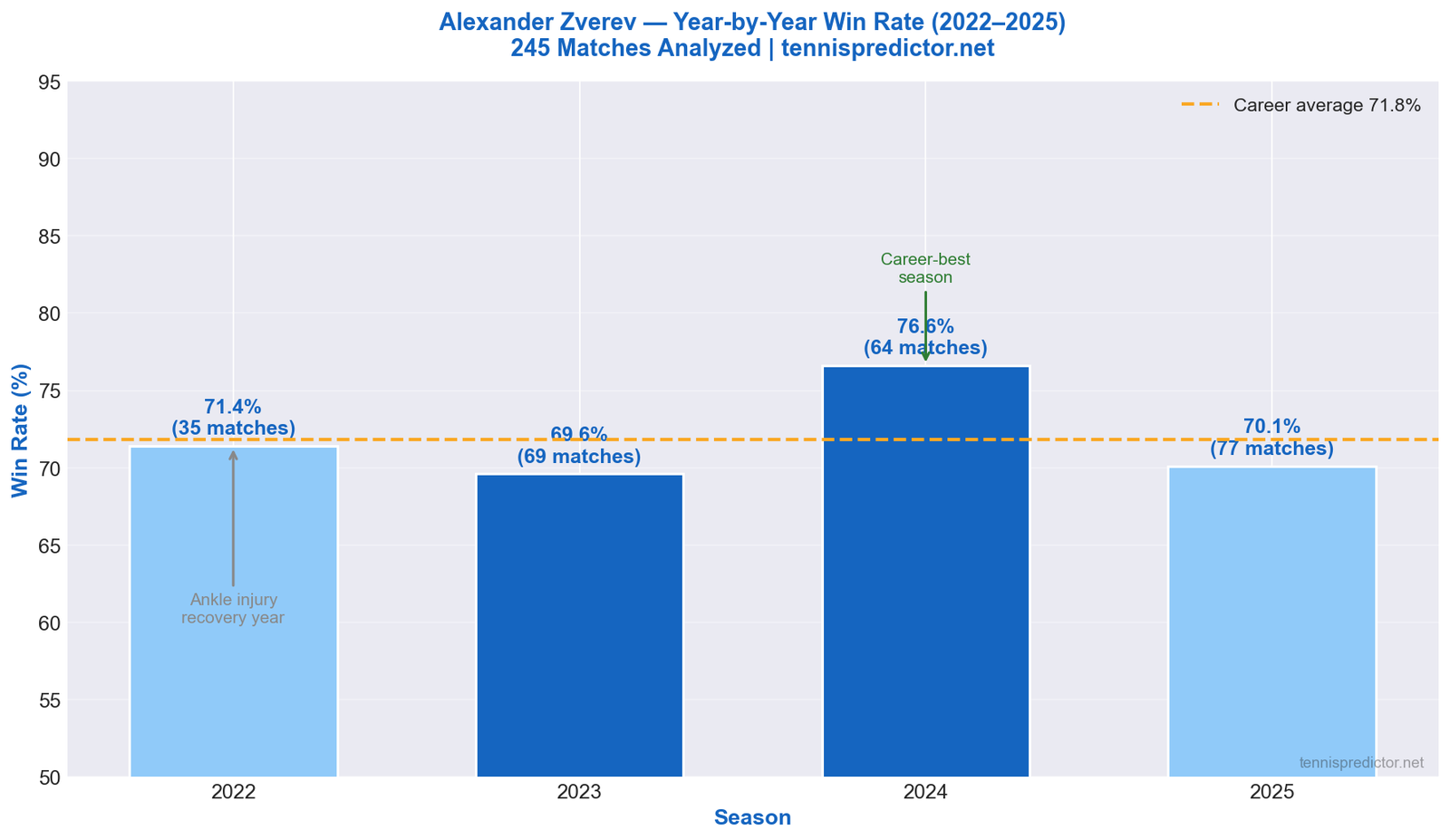
His season-by-season breakdown:
- 2022: 71.4% across 35 matches — limited dataset, affected by his ankle ligament injury at Roland Garros (June 2022) which kept him off tour for months
- 2023: 69.6% across 69 matches — a full return season, rebuilding match sharpness after a year on the sidelines
- 2024: 76.6% across 64 matches — his statistical peak, winning Rome (clay) and showing elite consistency
- 2025: 70.1% across 77 matches — high-volume season: 77 matches played across all surfaces
- 2026 (Jan–Mar): 81.2% across 16 matches — the strongest start to any season in our dataset
The 2022 data requires context: Zverev's catastrophic ankle injury against Nadal at Roland Garros effectively ended his season. His comeback across 2023 and the continued improvement into 2024 represent one of the most significant physical recoveries in recent ATP history. By 2024, his 76.6% win rate was the highest of any full season in our dataset.
The 2026 opening — 13 wins from 16 matches — suggests that Zverev is entering what could be a career-defining stretch of tennis.
Surface analysis: clay is king, indoors is underrated
Zverev's surface profile is one of the clearest in men's tennis — and it creates real betting opportunities.
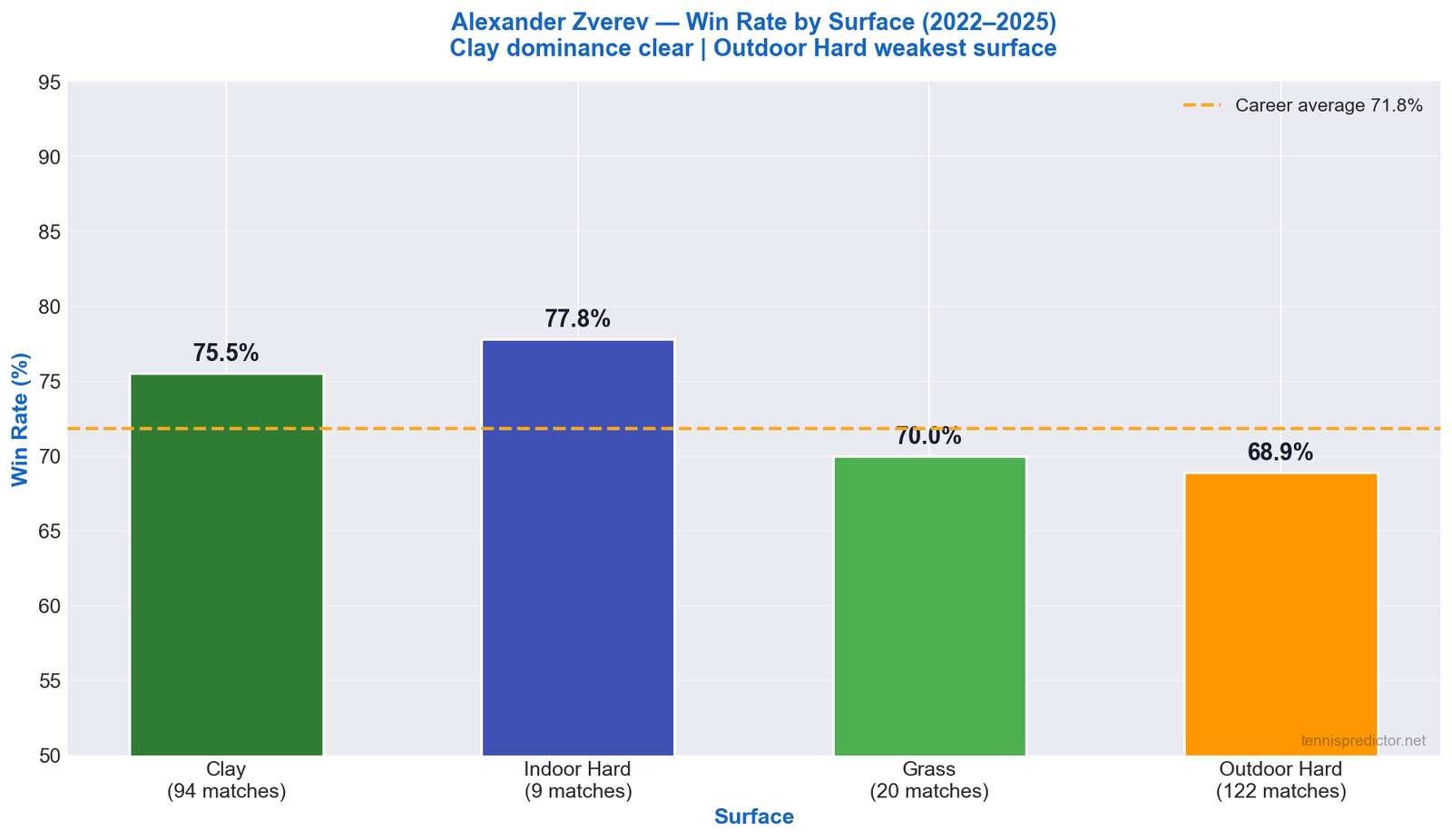
Across 261 matches:
| Surface | Matches | Win rate | Context |
|---|---|---|---|
| Clay | 94 | 75.5% | Rome 2024, Hamburg 2023 titles |
| Hard (indoor) | 9 | 77.8% | Limited but elite-level results |
| Grass | 20 | 70.0% | Multiple Wimbledon QF+ runs |
| Hard (outdoor) | 122 | 68.9% | Weakest surface in the dataset |
Clay is where Zverev's game finds its natural rhythm. His heavy topspin forehand, long baseline rallying, and physical endurance suit the slower conditions perfectly. Rome 2024 and Hamburg 2023 confirm what the data shows — on clay, Zverev is a genuine title contender who regularly under-prices in pre-tournament markets. For a deep dive into clay-specific betting patterns, see our clay court betting guide.
The indoor hard court number of 77.8% is noteworthy, though the sample (9 matches) is limited. His serve — capable of consistent 220+ km/h deliveries — becomes more dominant indoors where ball speed is maintained. Basel and Paris Bercy have historically suited big servers, and the data hints at this edge.
Outdoor hard court at 68.9% is his weakest surface. The varied conditions in outdoor environments — from the fast, skidding balls of Acapulco to the heavy, humid air of the US Open — do not consistently neutralise Zverev's opponents in the same way clay and indoor settings do.
Betting implication: On clay, Zverev's odds frequently undervalue his surface edge. Pre-tournament prices of 10.0 or longer on clay Masters events are usually poor value for opponents.
Grand Slam vs ATP Tour: the biggest gap among the elite
Among the patterns we discovered in Zverev's data, this is the most commercially significant: his Grand Slam win rate is 8.5 percentage points higher than his ATP Tour rate.
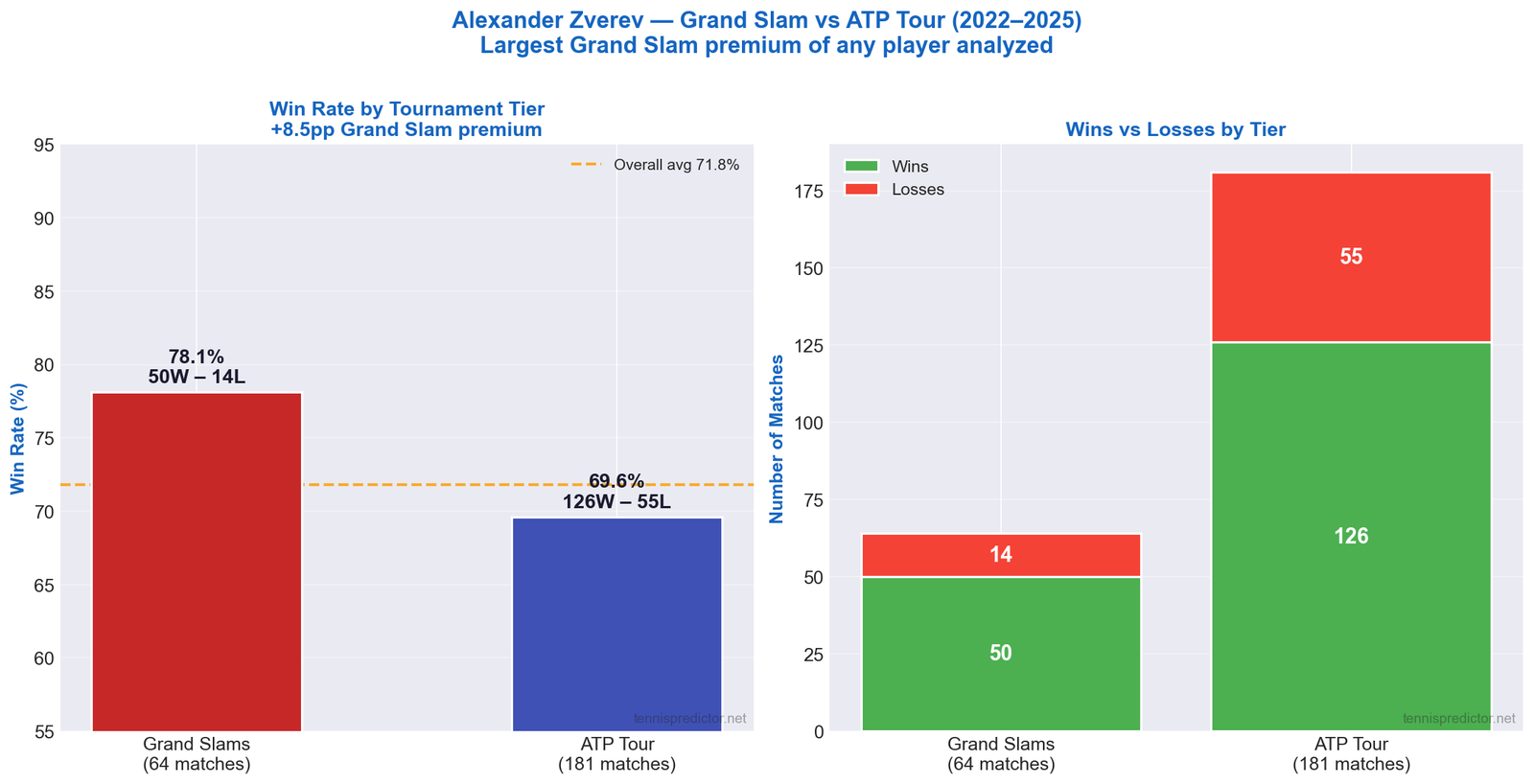
Across our dataset:
| Tournament tier | Matches | Win rate | Wins–Losses |
|---|---|---|---|
| Grand Slams | 64 | 78.1% | 50–14 |
| ATP Tour events | 181 | 69.6% | 126–55 |
| Gap | — | +8.5pp | — |
That 8.5-point gap is the largest we have measured for any player in our analysis series. For comparison, Alcaraz's Grand Slam premium was 5.2 points. Zverev's is 65% larger.
The explanation is partly structural: Grand Slams use best-of-five format, which favours bigger, physically dominant players. Zverev's serve, stamina, and aggressive power game translate more effectively over five sets. He has reached multiple Grand Slam finals and semifinals in this period, confirming that the big stage brings out his best tennis.
Betting implication: In Grand Slam contexts, Zverev's true win probability is substantially higher than his ATP-weighted market price suggests. This is an exploitable edge, particularly in early and middle rounds where he faces opponents who cannot consistently neutralise his serve.
H2H against the elite: a complex picture
Zverev's head-to-head records reveal where he wins — and where the market should adjust.
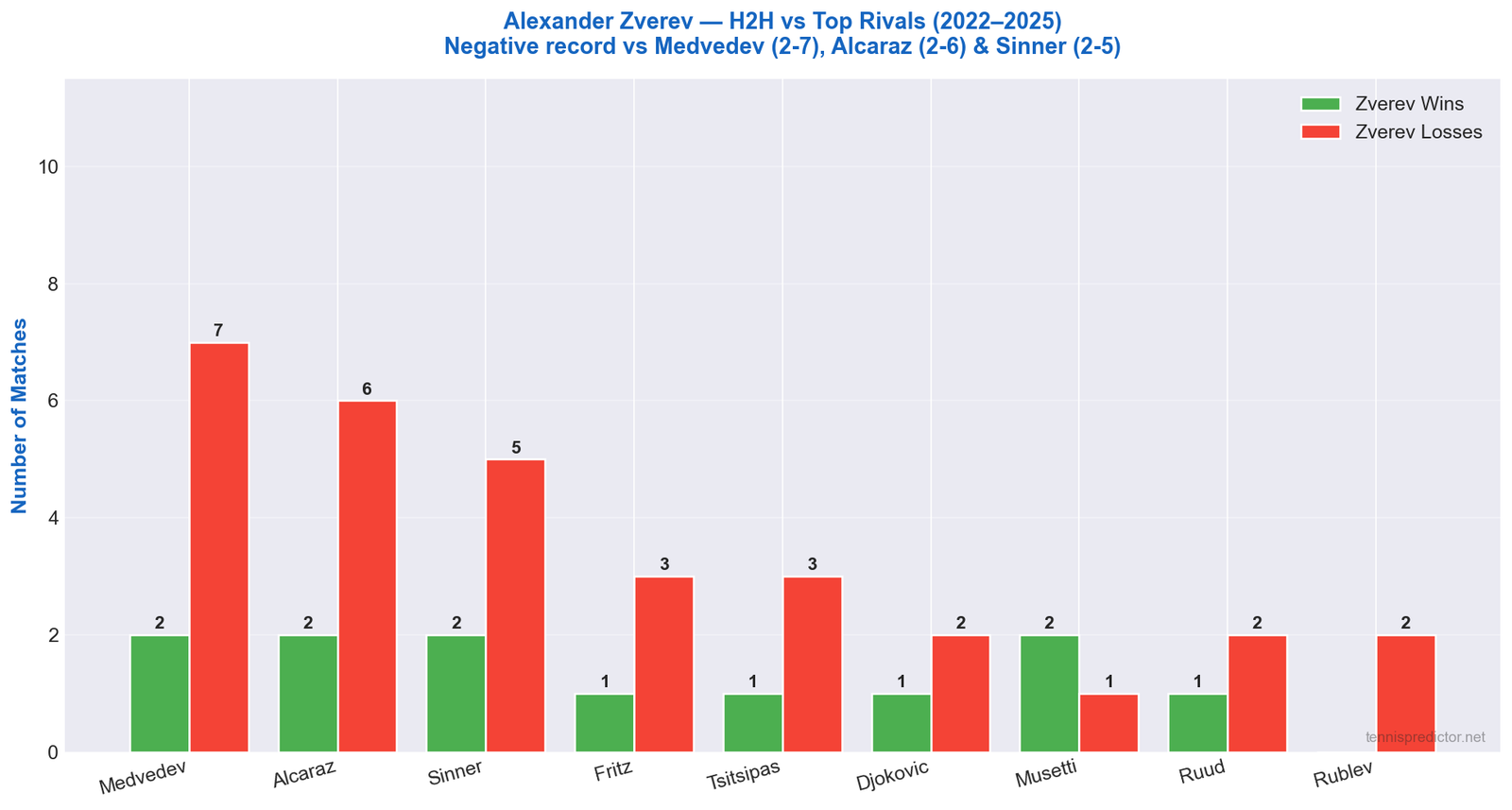
His H2H records from our dataset:
| Opponent | Zverev W | Zverev L | Win rate | Market note |
|---|---|---|---|---|
| Daniil Medvedev | 2 | 7 | 22.2% | Often overpriced vs Medvedev |
| Carlos Alcaraz | 2 | 6 | 25.0% | Alcaraz structural edge |
| Jannik Sinner | 2 | 5 | 28.6% | Sinner consistency wins out |
| Taylor Fritz | 1 | 3 | 25.0% | Fritz's hard-court aggression |
| Stefanos Tsitsipas | 1 | 3 | 25.0% | Clay rivalry, Tsitsipas leads |
| Casper Ruud | 1 | 2 | 33.3% | Close on clay |
| Andrey Rublev | 0 | 2 | 0.0% | Very limited sample |
| Lorenzo Musetti | 2 | 1 | 66.7% | Zverev handles high-spin clay |
The Medvedev record at 2–7 is the most striking finding in the dataset. Medvedev's flat, heavy ball and precision baseline game appears to be a structural matchup problem for Zverev. Markets pricing Zverev as favourite against Medvedev deserve close scrutiny — the historical record does not support it.
The 2–6 record against Alcaraz and 2–5 against Sinner confirm that Zverev sits one tier below the very top in direct matchups. He can beat both players — 2 wins against each confirms this — but the frequency is insufficient to justify short-odds favouritism against either.
The 2–1 record against Musetti is the lone bright spot among elite matchups, suggesting Zverev handles the Italian's high-spin clay game effectively.
The "nearly man" statistics: the most important numbers in this article
Here is the core finding, and the one that should permanently change how you approach Zverev in betting markets.
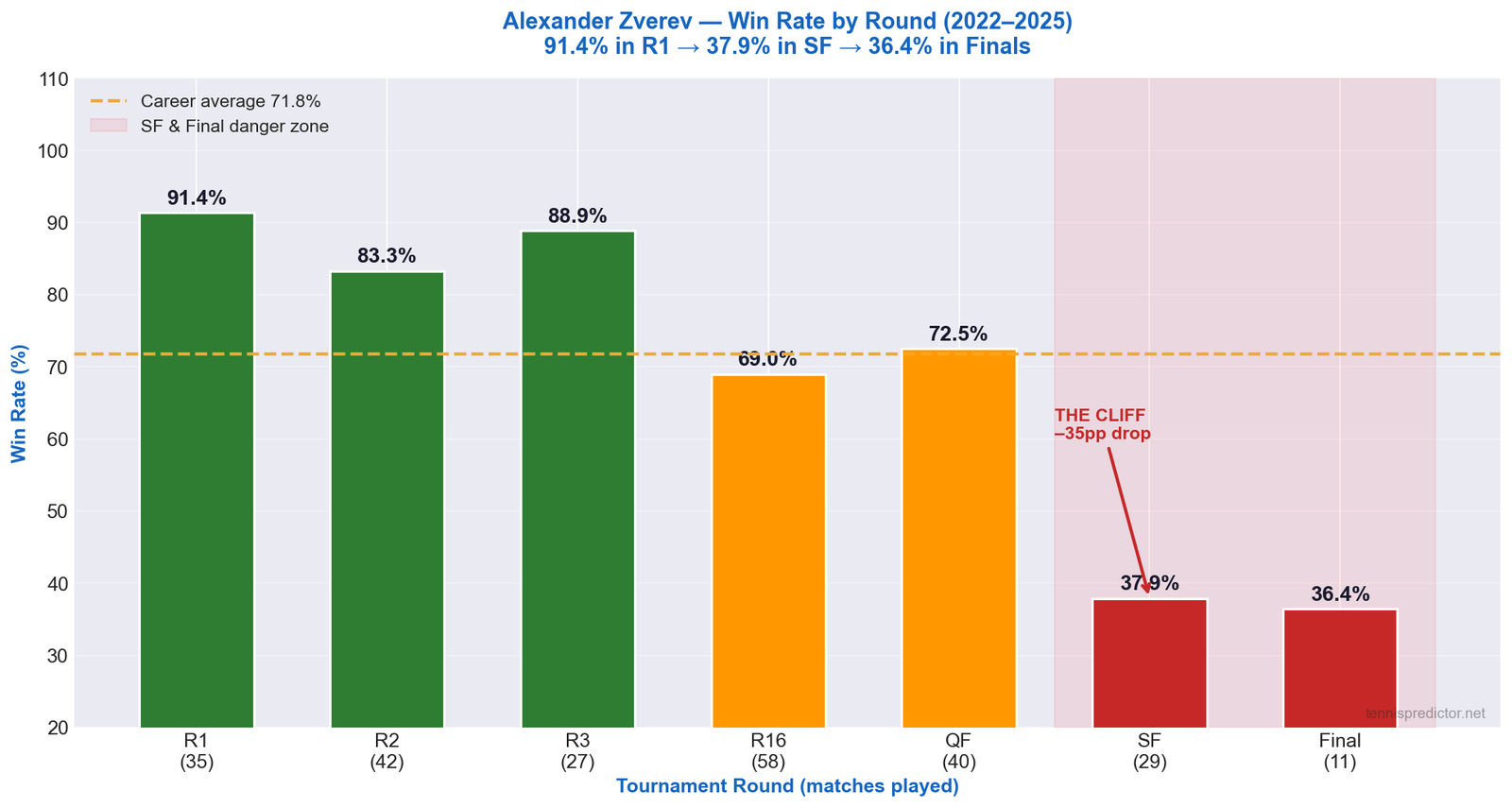
His round-by-round win rates expose a dramatic and consistent pattern:
| Round | Matches | Win rate | Interpretation |
|---|---|---|---|
| 1st Round | 35 | 91.4% | Near-certainty |
| 2nd Round | 42 | 83.3% | Still dominant |
| 3rd Round | 27 | 88.9% | Strong |
| Round of 16 | 58 | 69.0% | Slight dip |
| Quarterfinal | 40 | 72.5% | Solid |
| Semifinal | 29 | 37.9% | Cliff edge |
| Final | 11 | 36.4% | Structural weakness |
Read that again. 91.4% in round one. 37.9% in semifinals. 36.4% in finals.
The collapse is not a gradual decline — it is a cliff edge between the quarterfinals and the final stages. Through the first four rounds, Zverev is dominant and reliable. From the semifinal onward, he wins fewer than 4 in 10.
This pattern has practical confirmation: across our dataset he reached 11 finals, winning just 4 of them (Chengdu 2023, Hamburg 2023, Rome 2024, Munich 2025). A 36.4% final win rate is one of the lowest among players who regularly reach finals at this level.
The structural explanation involves several factors:
- Opposition quality — SF and F opponents are invariably top-10, often the players with losing H2H records against him (Medvedev, Alcaraz, Sinner)
- Psychological pressure — documented in tennis literature as a recurring theme in Zverev's biggest matches
- Fatigue accumulation — at 6'6", his physical effort through early rounds may extract a cost that compounds in five-setters
Betting implication — the most important takeaway: Zverev at short odds in semifinals and finals represents negative expected value. At odds of 1.50 in a final, you need 67% implied probability — but his actual historical final win rate is 36.4%. The maths does not support it, regardless of the narrative. Understanding expected value calculations in detail is covered in our value betting guide.
The seasonal calendar: February is a danger month
One of the more surprising findings in this dataset concerns when Zverev plays best — and worst — across the calendar year.
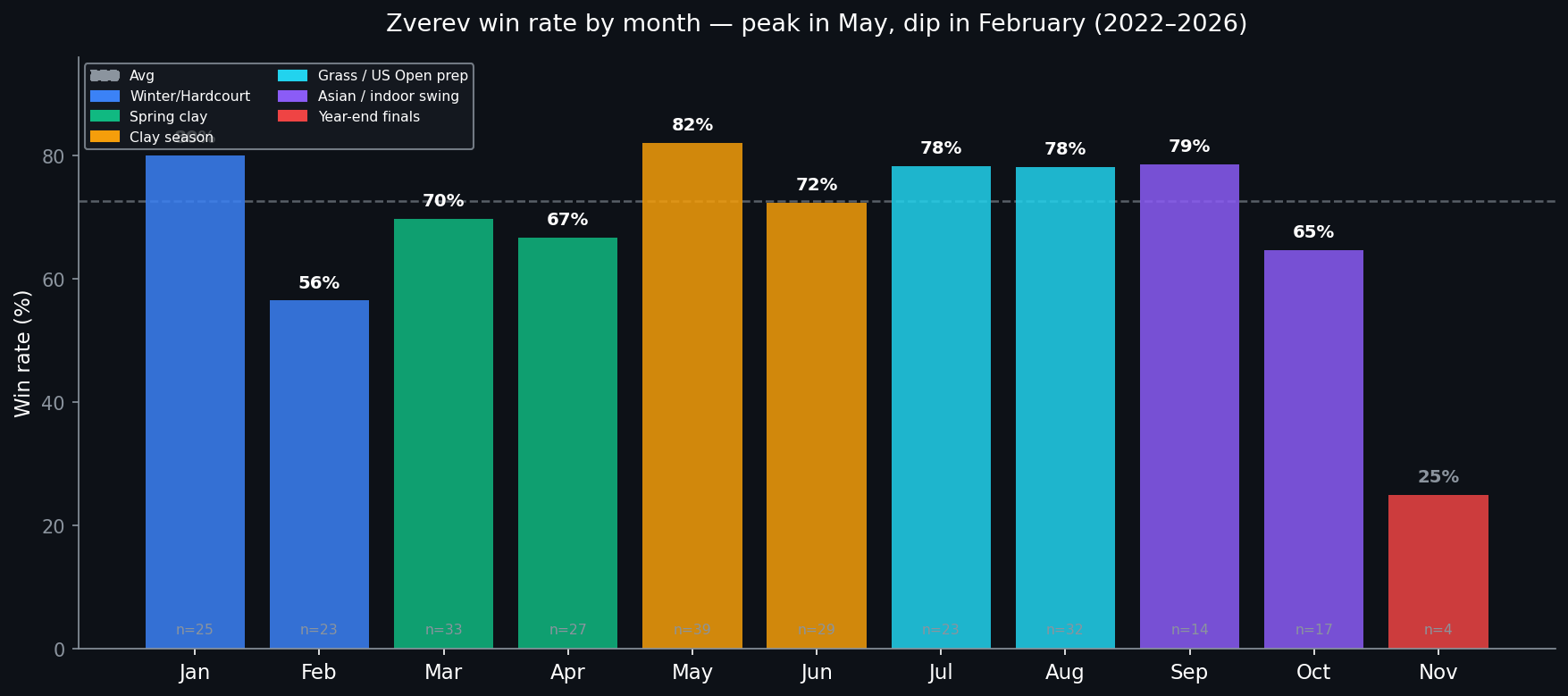
Monthly win rates across 261 matches:
| Month | Matches | Win rate | Season context |
|---|---|---|---|
| January | 25 | 80.0% | Australian Open hard courts |
| February | 23 | 56.5% | Post-AO soft patch |
| March | 33 | 69.7% | Indian Wells / Miami |
| April | 27 | 66.7% | Clay swing start |
| May | 39 | 82.1% | Clay Masters season (best month) |
| June | 29 | 72.4% | Roland Garros / grass transition |
| July | 23 | 78.3% | Wimbledon / summer hardcourt |
| August | 32 | 78.1% | US Open swing |
| September | 14 | 78.6% | US Open completion |
| October | 17 | 64.7% | Asian swing |
| November | 4 | 25.0% | Year-end finals (small sample) |
The pattern tells a clear story. May is Zverev's strongest month — 82.1% across 39 matches, driven by the Rome Masters and the broader clay swing. This is where his surface edge combines with peak physical condition coming out of the spring.
February is his softest month — just 56.5% across 23 matches. This is the post-Australian Open period: Rotterdam, Dubai, Marseille, and Acapulco. The transition from hard-court Grand Slam intensity to the high-variance 250/500 circuit appears to knock Zverev off his rhythm. Four of his most surprising upset losses occurred in February events.
Betting implication: Treat February Zverev with caution, especially at 250 and 500 level. His market price rarely reflects this historical soft patch. In May — particularly clay Masters — he frequently offers value at generous odds.
Monthly betting decision framework:
| Month | Verdict | Key reason |
|---|---|---|
| January | Back (cautious) | AO hard courts, strong but format variance |
| February | Avoid / reduce | Historically 56.5% — weakest month in dataset |
| March | Neutral | Indian Wells/Miami, mixed hard-court conditions |
| April | Neutral–positive | Clay swing starting, building form |
| May | Back (full stake) | Best month — 82.1%, clay Masters specialist |
| June | Positive | Roland Garros form carries through grass transition |
| July | Back | Wimbledon and summer hard courts, 78.3% |
| August | Back | US Open swing, 78.1% — reliable pick |
| September | Back | US Open completion, consistent at 78.6% |
| October | Neutral–avoid | Asian swing soft patch, 64.7% |
| November | Avoid | Year-end finals small sample, 25.0% win rate |
This framework, applied consistently over a season, shifts the majority of Zverev bets into months where the data supports positive expected value and eliminates the February and late-year liability that costs casual bettors most.
Tiebreak performance: below his overall average
Our tiebreak database reveals a meaningful split in Zverev's performance.
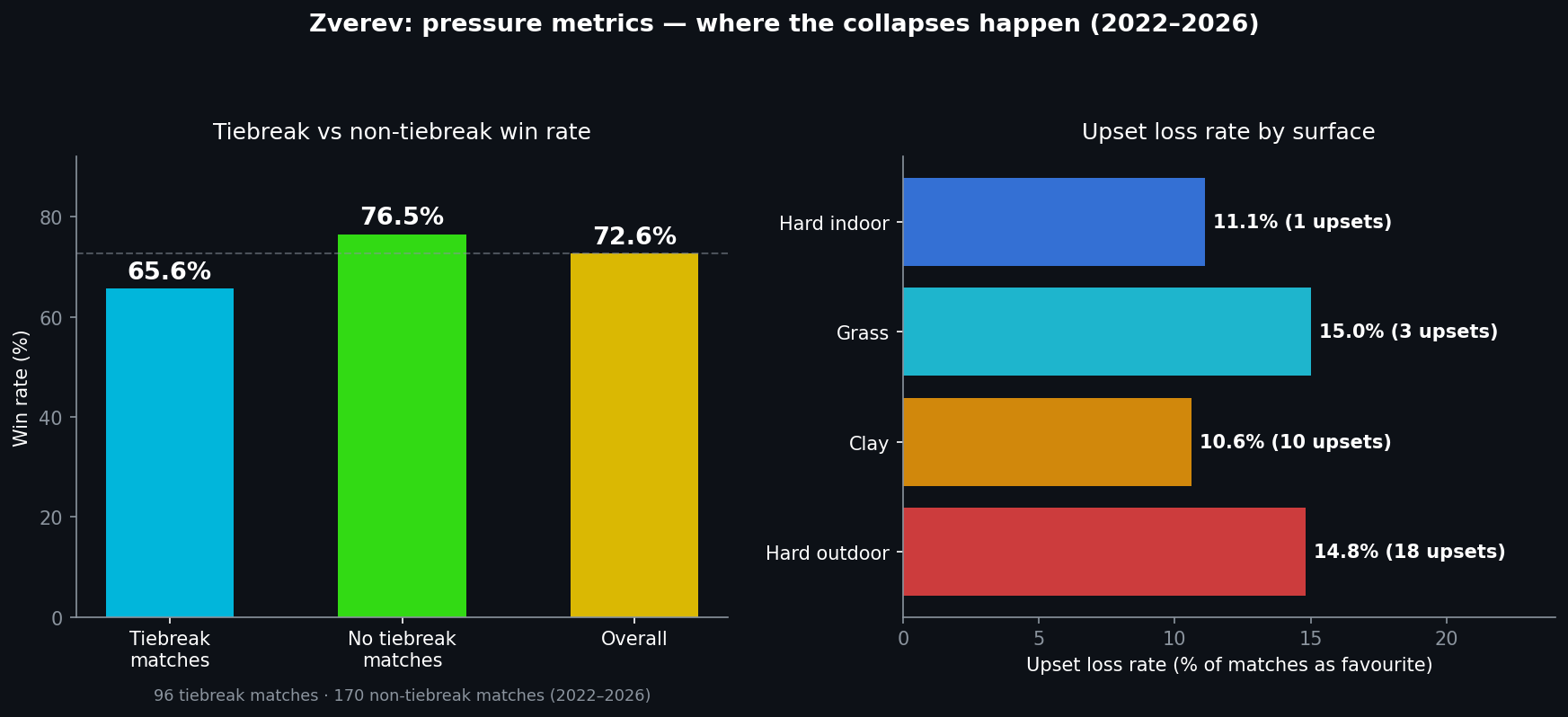
Across 261 matches, 96 (36.8%) contained at least one tiebreak.
| Match type | Matches | Win rate |
|---|---|---|
| Tiebreak matches | 96 | 65.6% |
| Non-tiebreak matches | 170 | 76.5% |
| Overall | 261 | 72.6% |
Zverev wins 10.9 percentage points fewer matches when tiebreaks are involved. This is a significant gap that the market rarely prices correctly.
The likely explanation: Zverev's psychological profile under extreme pressure — which tiebreaks represent in concentrated form — follows the same pattern visible in his semifinals and finals data. When a match reaches a single-point cliff-edge, his reliability drops sharply below his baseline.
For comparison, a statistically neutral player would be expected to perform roughly the same in tiebreak and non-tiebreak matches. A gap of nearly 11 points is a structural tell.
Betting implication: In pre-match betting on tight markets (odds around 2.00), be aware that Zverev is more likely than his ranking suggests to be edged out in tiebreak sets. Live betting — backing his opponent when a first-set tiebreak looms — may also carry positive expected value.
The upset vulnerability: 32 losses as favourite
The "nearly man" pattern is reinforced by a secondary finding: across our dataset, Zverev lost 32 matches where he was the betting favourite. For context on how favourite upset rates compare across the ATP Tour, see our guide on predicting upsets.
That is an upset loss rate of approximately 13% — higher than Alcaraz's 10.4%. The upset losses are not evenly distributed across surfaces:
- Hard (outdoor): 18 upsets — 14.8% of hard-court matches as favourite
- Clay: 10 upsets — 10.6% of clay matches as favourite
- Grass: 3 upsets — 15.0% of grass matches as favourite
- Hard (indoor): 1 upset — 11.1% of indoor matches as favourite
Outdoor hard court shows the highest absolute volume of upsets. Notably, several of the most extreme upset losses occurred in February and October — months already identified as soft patches in the seasonal analysis.
His sets distribution across 261 matches:
- 2-set matches: 126 (48.3%)
- 3-set matches: 88 (33.7%)
- 4-set matches: 23 (8.8%)
- 5-set matches: 11 (4.2%)
Nearly half of his matches resolve in straight sets, which is efficient. But the 33.7% three-set rate shows he regularly faces competitive opponents who push him. In those extended matches, the opponent has additional chances to exploit Zverev's inconsistencies under pressure.
Betting implication: In ATP Tour 250/500/1000 (best-of-three), Zverev's upset loss rate is meaningful enough to justify smaller stakes even when he is a clear favourite. Proper stake sizing in these scenarios is covered in our bankroll management guide.
Where Zverev creates betting value
Despite the limitations above, Zverev creates genuine value in specific contexts.
Back Zverev when:
- Playing on clay, especially ATP 500 and Masters level (75.5% win rate, 82.1% in May)
- Grand Slam early rounds — R1 through R16 (78–91% win rates)
- Against opponents ranked outside the top 20 on any surface
- Indoor hard courts at reasonable odds (77.8% win rate)
- In January or the summer hardcourt swing (August–September): 78%+ win rates
- Following adequate rest periods: he performs better with recovery time
Caution — reduce stake when:
- In Grand Slam or Masters semifinals (37.9% win rate)
- In any final at short odds (36.4% historical win rate)
- Against Medvedev (2–7 H2H), Alcaraz (2–6), or Sinner (2–5)
- On outdoor hard courts in February (historically his weakest month at 56.5%)
- When matches are likely to contain tiebreaks (65.6% vs 76.5% win rate)
Avoid — do not back Zverev when:
- Priced below 1.40 in any semifinal or final
- Playing Medvedev at any market price shorter than even money
- Coming off an injury layoff onto outdoor hard courts
- In February 250/500 events priced below 1.50
How our model adjusts for Zverev
Our prediction engine incorporates the patterns above with specific calibrations:
- Grand Slam boost: We apply an upward probability adjustment of approximately 8.5 percentage points in Grand Slam contexts versus ATP Tour baseline
- Surface weighting: Clay matches receive a positive adjustment; outdoor hard matches receive a mild negative adjustment
- Round-specific: Our model applies a significant downward adjustment from the semifinal stage onward — we do not price Zverev the same at SF as at R16
- H2H flags: Matches against Medvedev, Alcaraz, and Sinner trigger automatic caution flags regardless of ranking or form inputs
- Calendar flags: February and November trigger a form discount; May receives a clay bonus multiplier
- Tiebreak adjustment: When a match is projected to contain high tiebreak probability, Zverev's win probability is adjusted down by approximately 6–8 percentage points relative to the market
The net result: our Zverev predictions tend to be more conservative in late-round and tiebreak-heavy predictions, and more positive in early-round clay and January–September Grand Slam contexts. For a full explanation of how our prediction engine weighs these factors, see how our AI predicts tennis matches.
Track today's Zverev match predictions — including round-specific and surface adjustments — on our live predictions dashboard.
Frequently asked questions
Is Zverev worth betting on?
Yes — in the right context. Zverev is excellent value in early-to-mid rounds of Grand Slams and clay events, particularly in May. He becomes poor value in semifinals and finals, where his historical win rate drops to 37–36%. Always bet the stage and the surface, not just the ranking.
Why does Zverev lose so many finals?
Our data shows a 36.4% final win rate across 11 finals (4 wins). The structural causes are a combination of opponent quality (his SF/F opponents are almost always Medvedev, Alcaraz, or Sinner — all of whom have winning H2H records against him), the psychological pressure of the biggest stage, and potential fatigue from long runs through draws.
What is Zverev's best surface for betting?
Clay, followed by indoor hard court. His clay win rate of 75.5% is 6.6 points above his outdoor hard rate, and on clay he has actual title wins (Rome 2024, Hamburg 2023) confirming the data. Indoor hard courts (77.8%) are also favourable but the sample is small.
Does Zverev struggle with tiebreaks?
Yes, meaningfully. He wins 65.6% of matches containing at least one tiebreak, versus 76.5% without — a gap of nearly 11 percentage points. This is a structural pattern that aligns with his broader pressure performance profile.
When should I avoid betting on Zverev?
The highest-risk situations: against Medvedev (2–7 H2H), in any final priced below 1.50, in February events on outdoor hard courts, and when tiebreaks are expected in a close match. These scenarios combine to produce well below his average win rate.
How has Zverev started 2026?
Strongly — 13 wins from 16 matches (81.2%) through March 2026. This is the best opening stretch in our dataset and suggests he may be entering a peak phase of his career.
How does our model use Zverev's data?
We apply multiple contextual adjustments: a Grand Slam boost (+8.5pp), a clay surface bonus, a round-specific penalty from SF onward, H2H malus vs Medvedev/Alcaraz/Sinner, a February calendar discount, and a tiebreak-risk penalty. Together, these calibrations make our Zverev predictions among the most contextually nuanced in our player library.
Conclusion: bet the stage, not the name
Alexander Zverev is a legitimate top-5 player with real Grand Slam credentials. His clay-court dominance, his formidable serve, and his physical recovery from a career-threatening injury make him one of the most compelling players in the modern game.
But the data is unambiguous: Zverev's value is round-specific, surface-specific, and calendar-specific. In rounds 1 through 16, especially on clay and in Grand Slams, he is systematically undervalued. In semifinals and finals, he is systematically overvalued. In February events on outdoor hard courts against players who push him to tiebreaks, he is among the riskiest favourites in the ATP.
The betting market prices Zverev on reputation and ranking. Our data prices him on 261 real matches. The difference between those two approaches is where the value lies.
Bet the stage, not the name. And when the stage is a final, look elsewhere.
All statistics extracted from our tournament database covering 261 Alexander Zverev matches played between 2022 and March 2026. Data includes ATP Tour and Grand Slam events across all surfaces.


