
Alex de Minaur: Australia's ATP contender decoded by the numbers
Published: May 11, 2026 Reading Time: 12 minutes Category: Player Analysis
Alex de Minaur is one of the most intriguing players on the ATP tour. Nicknamed "the Demon" for his relentless speed and court coverage, he has climbed to the top 10 and cemented himself as Australia's best player. Yet questions persist: can a counter-puncher without a dominant serve or devastating groundstroke actually beat the elite? Is his clay weakness a genuine ceiling or a manageable gap? And does the betting market correctly price him?
This analysis answers those questions with data. We examined 247 ATP matches from 2022 to 2026, extracting win rates by year, surface, tournament tier, Grand Slam event, and market odds. Every figure below is sourced from our tournament match database — no estimates, no rounding to round numbers.
Dataset and methodology
Our dataset covers all ATP matches involving de Minaur across tournament records from January 2022 through May 2026. Each match record includes the two players, the winner, the tournament name, the surface, and pre-match decimal odds where available.
Match count: 247 (169 wins, 78 losses)
Surface classification uses the tournament's reported surface field: Hard (outdoor), Indoors, Grass, and Clay. Tournament tier is assigned based on tournament name, mapping Grand Slams, Masters 1000 events, ATP 500 events, and ATP 250 events. Favourite or underdog status is determined by comparing pre-match odds for the two players; 131 of 247 matches had missing or equal odds and are excluded from odds-specific analysis.
The headline number: 68.4%
Over 247 matches, de Minaur has won 68.4% — a solid top-10-level win rate that reflects consistent excellence without being dominant in the way a Djokovic or Sinner is.
For context, the ATP tour average (all players, all matches) sits around 50% by definition (every win has a mirror loss). Among top-10 regulars tracked in our database, the top tier runs from around 72% (Sinner, Alcaraz) down to the high 60s for the next cohort. De Minaur at 68.4% is squarely in that second group — genuinely elite, with a measurable gap to the very top.
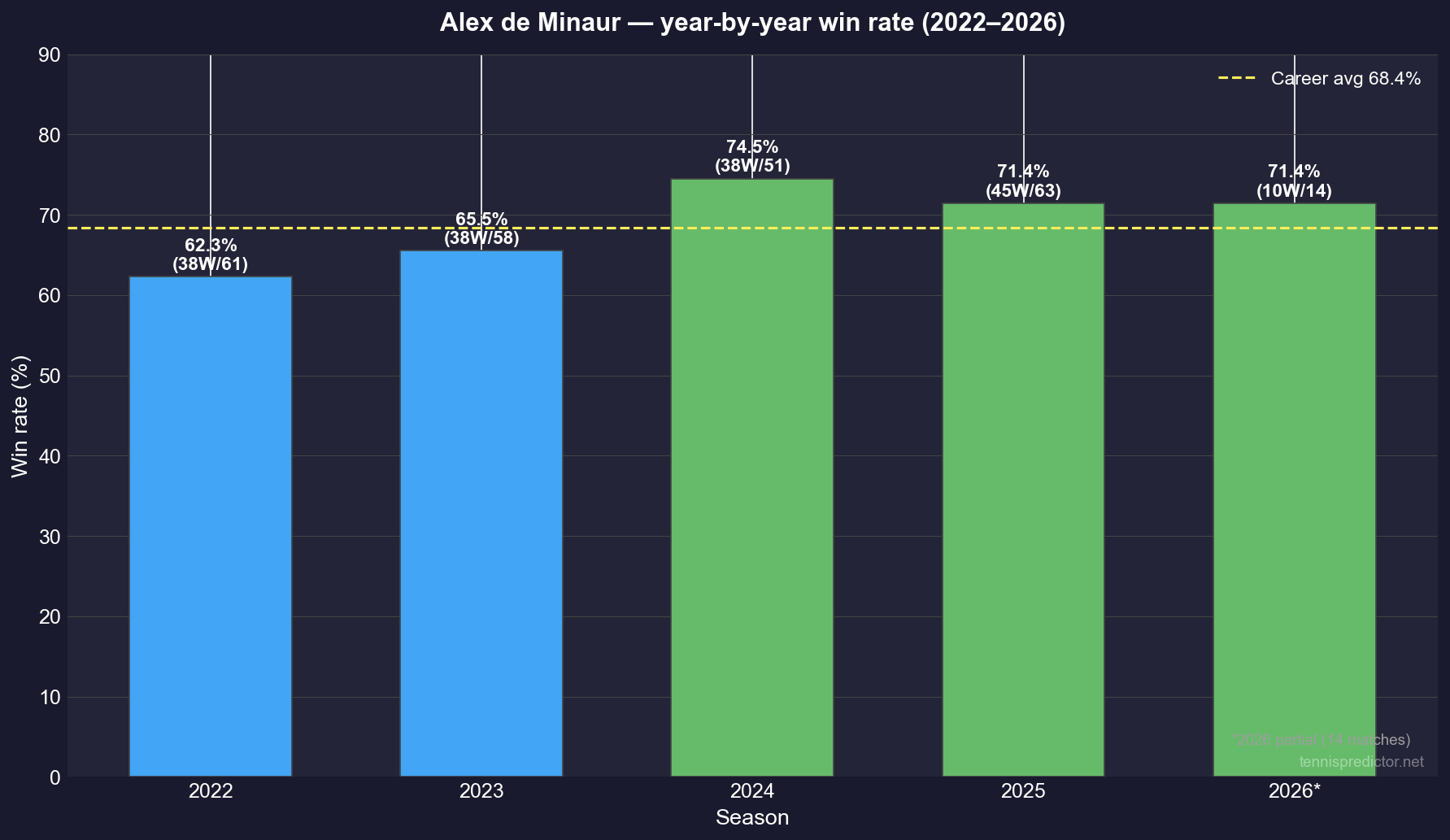 Figure 1: Win rate by year, 2022–2026. The upward trend from 2022 to 2024 reflects de Minaur's rising ranking and schedule management.
Year-by-year: a clear upward arc
| Year | W | L | Win % | Matches |
|---|---|---|---|---|
| 2022 | 38 | 23 | 62.3% | 61 |
| 2023 | 38 | 20 | 65.5% | 58 |
| 2024 | 38 | 13 | 74.5% | 51 |
| 2025 | 45 | 18 | 71.4% | 63 |
| 2026 | 10 | 4 | 71.4% | 14 |
The trend is unambiguous. De Minaur won 62.3% of his matches in 2022, and that number climbed to a career-best 74.5% in 2024. The 2024 season was his most efficient — 38 wins from just 51 matches, reflecting smarter scheduling, a tighter loss column, and fewer early exits.
2025 was busier (63 matches) and slightly noisier (71.4%), but the volume of 45 wins in a single season suggests a player who was reliably deep in draws rather than peaking sporadically. 2026 is too early to read at 14 matches, but the rate holds at 71.4%.
What the progression tells us: de Minaur is not a plateauing player. From 2022 to 2024 he added roughly 12 percentage points to his annual win rate — a genuine improvement, not just variance. The 2025 slight dip came alongside a heavier schedule.
Surface breakdown: where he wins and where he leaks
This is the most revealing dimension of de Minaur's profile.
| Surface | W | L | Win % | Matches |
|---|---|---|---|---|
| Indoors | 23 | 8 | 74.2% | 31 |
| Hard (outdoor) | 88 | 38 | 69.8% | 126 |
| Grass | 24 | 11 | 68.6% | 35 |
| Clay | 34 | 21 | 61.8% | 55 |
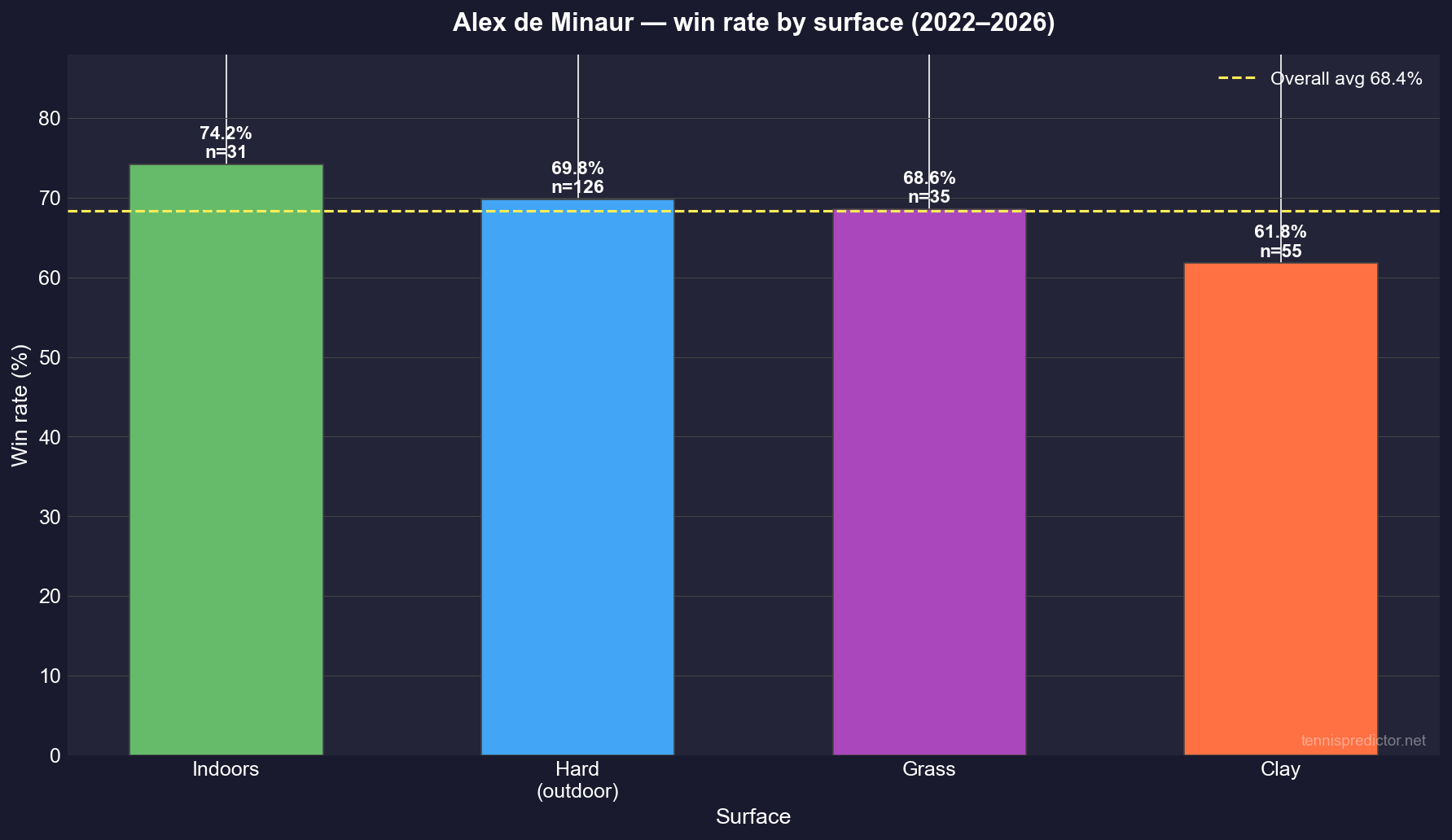 Figure 2: Win rate and match count by surface. Indoor hard is his best environment; clay is the structural weak point.
Indoor hard (74.2%) is de Minaur's best environment. Indoor courts reward quick movement, compressed time between bounces, and aggressive returning — all attributes that suit his game. Events like Rotterdam, Basel, and Paris Indoors align with his strengths. The sample is smaller (31 matches) but the pattern is consistent.
Outdoor hard (69.8%) is his bread and butter with 126 matches. The Australian Open, US Open, and the hard-court Masters events form the backbone of his season, and he wins seven in ten on this surface. This is his volume surface — not his highest win rate, but where he accumulates most of his wins.
Grass (68.6%) is a mild surprise for a player whose game is built on movement rather than serve-dominance. The data shows de Minaur is more dangerous on grass than the conventional wisdom might suggest — his speed and ability to read angles compensates for a lack of first-strike power.
Clay (61.8%) is the structural gap. Across 55 clay matches, he wins roughly three in five — solid, but clearly below his overall rate. Clay rewards heavy topspin groundstrokes, physical baseline dominance, and the ability to end points quickly from the baseline — none of which are de Minaur's primary weapons. Clay is where he most often faces opponents whose strengths neutralise his speed.
The 12.4 percentage point gap between his indoor hard rate (74.2%) and clay rate (61.8%) is one of the largest surface differentials among top-10 players in our database.
Grand Slam performance: his best tournaments
Grand Slams are best-of-five, which generally rewards the superior player more reliably than best-of-three. For de Minaur, the data confirms this:
| Tournament | W | L | Win % | Matches |
|---|---|---|---|---|
| Australian Open | 17 | 5 | 77.3% | 22 |
| US Open | 13 | 4 | 76.5% | 17 |
| Wimbledon | 11 | 4 | 73.3% | 15 |
| French Open | 6 | 4 | 60.0% | 10 |
| All Grand Slams | 47 | 17 | 73.4% | 64 |
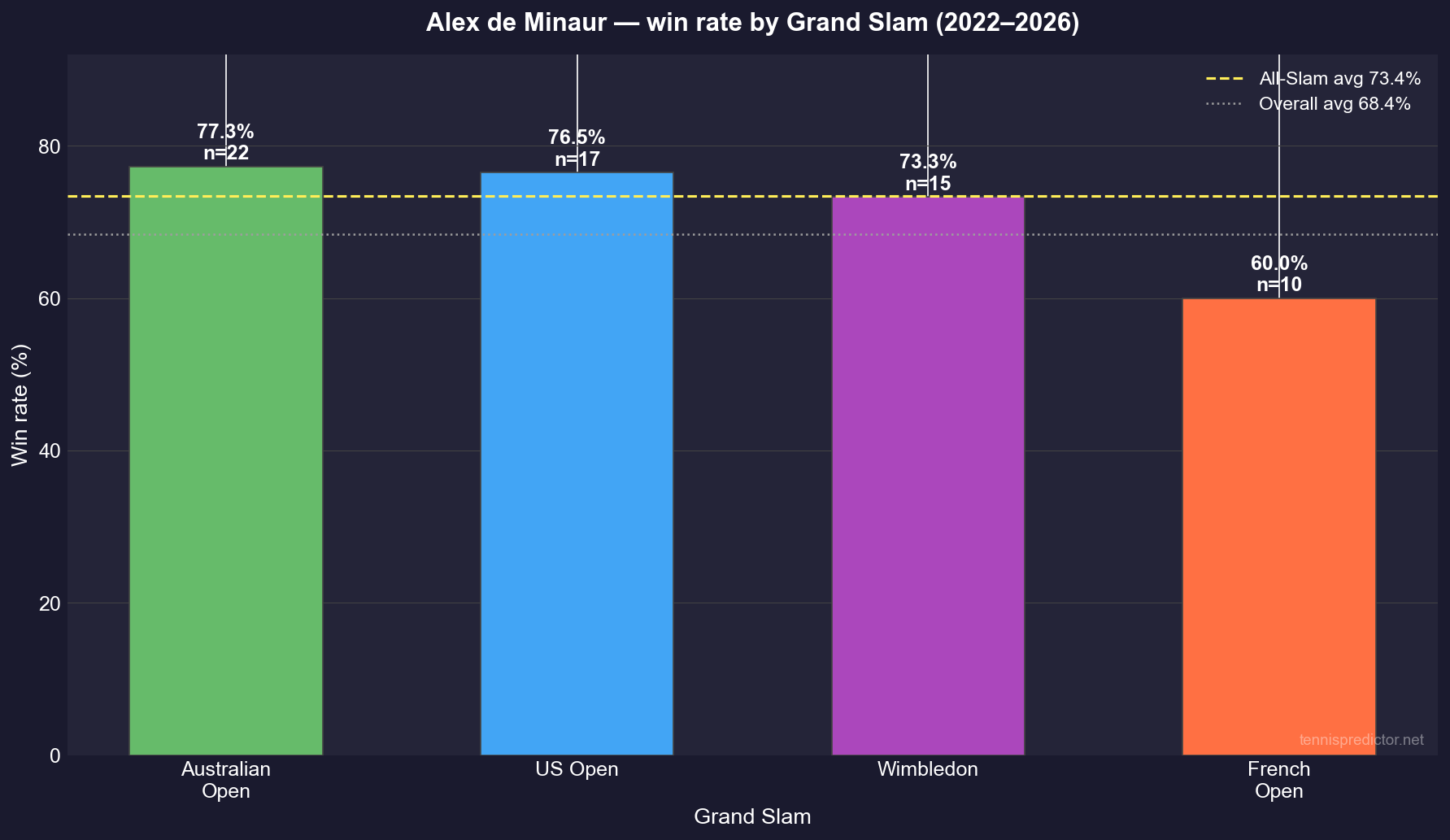 Figure 3: Win rate by Grand Slam event. The Australian Open is his best major; Roland Garros is the outlier.
His overall Grand Slam win rate of 73.4% actually beats his all-tournament rate of 68.4% by five full percentage points. Best-of-five suits him: his stamina and retrieval become even more valuable over five sets, and opponents cannot simply muscle through him in a short sprint.
The Australian Open (77.3%) is his home Slam and his best. The surface (outdoor hard in summer heat) suits his game, the crowd is behind him, and the longer format rewards his fitness. 17 wins in 22 matches at the AO is an outstanding record.
The US Open (76.5%) is his second-best Slam — another hard-court event where his foot speed on the faster Flushing Meadows courts translates into consistent deep runs.
Wimbledon (73.3%) confirms the grass finding from the surface section: he performs above his overall average on grass at the Grand Slam level.
The French Open (60.0%) mirrors the clay surface finding exactly. 6 wins from 10 Roland Garros matches is his weakest Slam record by a significant margin.
For betting purposes, this Slam breakdown is actionable: de Minaur at the Australian Open or US Open is a more reliable proposition than de Minaur at Roland Garros, particularly in deep rounds where the margin separating the players is small.
Tournament tier: the Masters problem
| Tier | W | L | Win % | Matches |
|---|---|---|---|---|
| Grand Slam | 47 | 17 | 73.4% | 64 |
| ATP 500 | 50 | 20 | 71.4% | 70 |
| ATP 250 | 21 | 8 | 72.4% | 29 |
| Masters 1000 | 51 | 33 | 60.7% | 84 |
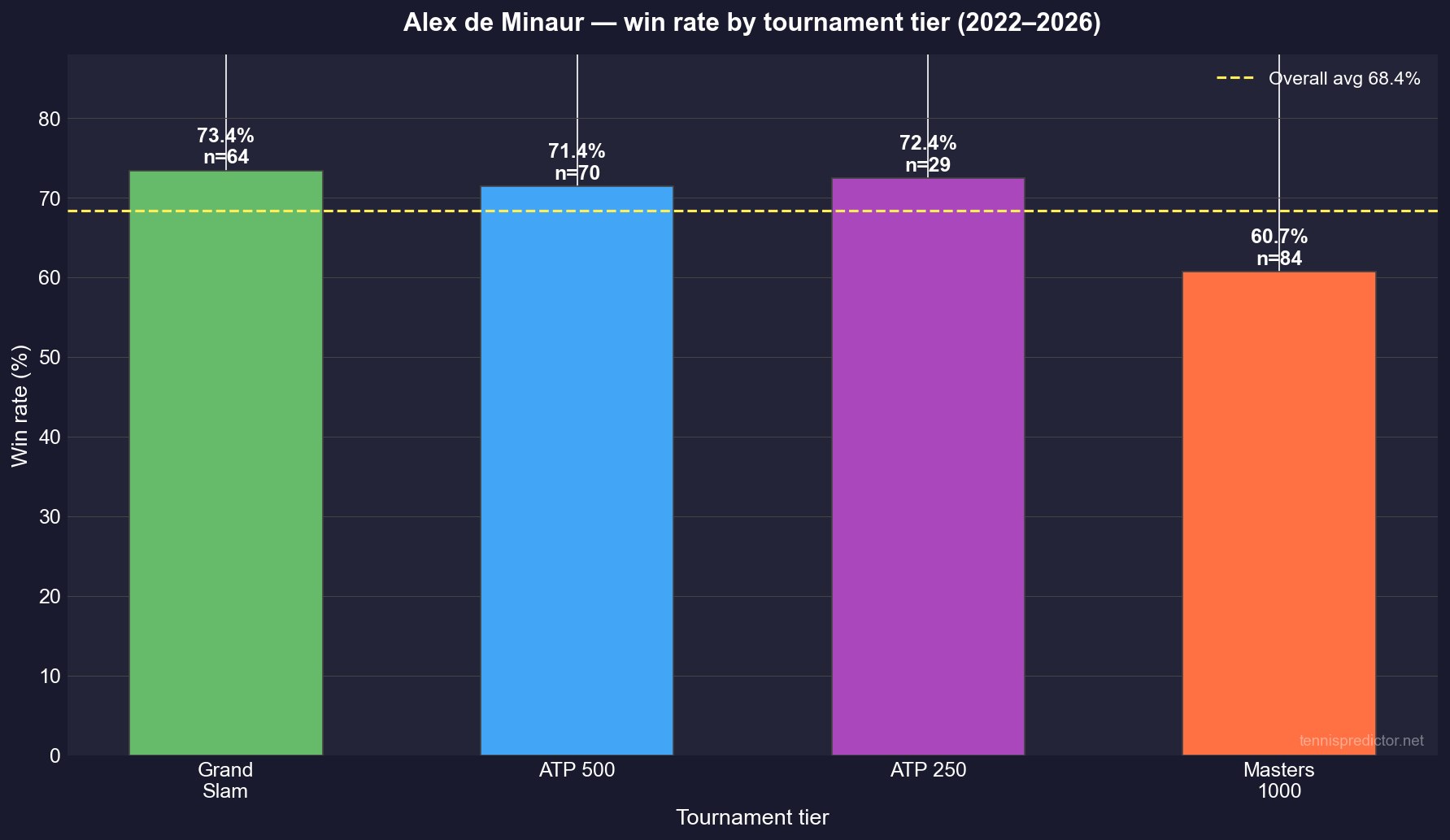 Figure 4: Win rate by tournament tier. Masters 1000 events are where de Minaur most regularly encounters the elite.
The tier breakdown reveals a significant pattern: de Minaur wins at 72–73% in Grand Slams, ATP 500s, and ATP 250s, but drops to 60.7% at Masters 1000 events. That is a 12-point drop from his next-lowest tier.
Why? Masters 1000 events combine near-Grand-Slam field depth with best-of-three format. Best-of-three on hard courts (Indian Wells, Miami, Cincinnati, Shanghai, Paris) means a top player with a dominant serve or heavy forehand can be explosive in a way that neutralises de Minaur's running game over a shorter match. Grand Slams give him five sets to exhaust opponents; Masters give opponents five games per set to end things.
The Masters result also reflects the clay component: Monte Carlo, Madrid, and Rome are all Masters 1000 events on clay, and those three tournaments systematically drag his Masters average down.
Key bet signal: at Masters 1000 events, de Minaur is a 60.7% player, not a 68.4% player. If the odds are built on his headline win rate, there may be value on his opponents in early Masters rounds on clay.
Odds profile: favourite vs underdog
Of the 110 matches in our sample with usable odds data:
| Role | W | L | Win % | Matches |
|---|---|---|---|---|
| As favourite | 67 | 20 | 77.0% | 87 |
| As underdog | 10 | 13 | 43.5% | 23 |
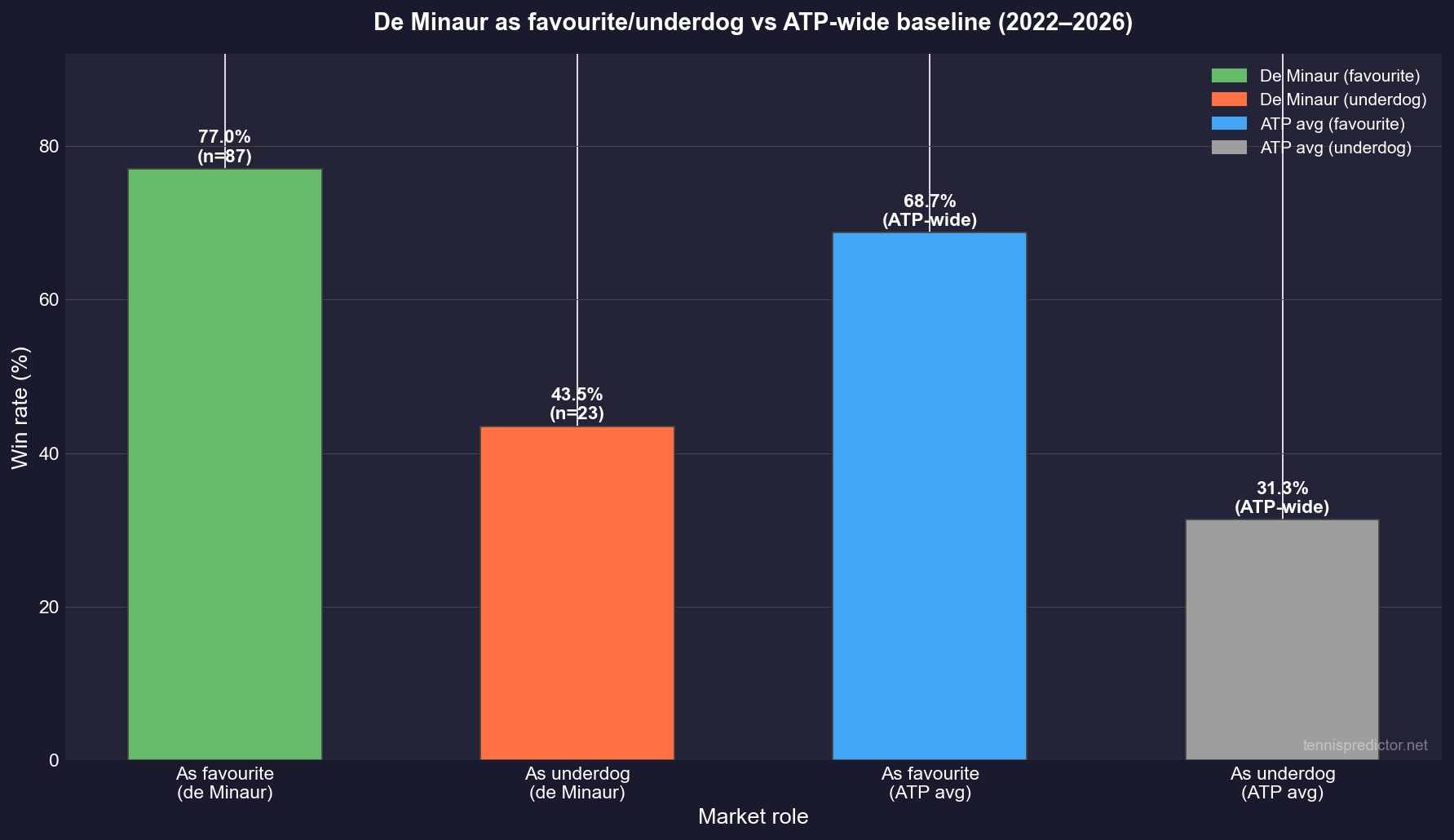 Figure 5: De Minaur's win rate as favourite and underdog vs the ATP-wide baseline.
When the market makes de Minaur the favourite, he delivers: 77.0% is a strong favourite-role conversion rate. He is not a player who squanders his status as favourite.
When priced as the underdog (23 instances in our sample), he wins 43.5% of the time. For context, our full ATP dataset analysis shows the ATP-wide underdog win rate is approximately 31.3%. De Minaur at 43.5% as the underdog beats that baseline by 12 points — he punches above his implied odds when written off by the market.
This underdog outperformance is consistent with his playing style: de Minaur's game is built to extend matches, wear opponents down, and exploit any drop in opponent concentration. Against heavy favourites, that can produce genuine upset potential.
Practical application: in rounds where de Minaur is a mild underdog (implied probability 45–50%), the historical rate suggests the market may be slightly undervaluing him.
Betting angle: what the numbers mean in practice
The data draws a clear player profile for de Minaur:
Back him when:
- Playing at the Australian Open or US Open (77%+ win rate)
- On indoor hard courts (74.2%)
- Priced as a mild underdog on hard courts
- In the later rounds of best-of-five Grand Slams where his fitness and retrieval have more time to matter
- Against players whose game is based on power rather than tactical variety — de Minaur's speed neutrealises power
Be cautious when:
- Playing at Roland Garros or any clay Masters 1000 event (60% range)
- Facing elite clay specialists where their strength directly cancels his counter-punching
- In shorter best-of-three formats at Masters 1000 where his game has less time to wear opponents down
Cross-referencing with our first set analysis: de Minaur is well-suited to in-play betting. His game picks up steam over the course of a match — if you see him win set one, apply the same logic as our general favourite first-set close-out rates data (80.7% overall close-out rate when the favourite wins set one). For a player of de Minaur's physical style, that rate may actually be higher in longer matches.
For deciding sets, our decisive set statistics article provides the broader context. In a five-set match, de Minaur's fitness makes him a more dangerous opponent in the fifth than the scoreline might suggest at 2-2.
Track current predictions and upcoming de Minaur matches on the live dashboard.
Limitations
This analysis covers 247 matches across 2022–2026 and is limited to the data available in our tournament records. Several caveats apply:
- Opponent quality is not controlled for. A Masters 1000 quarter-final loss to world No. 1 counts the same as an early-round loss to a qualifier. The tier and surface splits partially account for this, but they are not a full quality-adjusted metric.
- Match context is absent. Injury, retirement, or rain delays are not flagged in the data.
- 131 of 247 matches lacked odds data, meaning the favourite/underdog split is based on a subset and may not represent the full distribution of match types.
- 2026 has only 14 matches. The year-to-date figures should be treated as directional, not definitive.
Frequently asked questions
1. What is Alex de Minaur's overall win rate?
Across 247 ATP matches from 2022 to 2026, de Minaur has won 68.4% (169 wins, 78 losses). This is a consistent top-10 level rate, reflecting strong baseline performance across a varied schedule.
2. What is his best surface?
Indoor hard courts are his best environment (74.2%, 31 matches), followed by outdoor hard (69.8%). Clay is his weakest surface at 61.8% across 55 matches.
3. How does he perform at Grand Slams?
His Grand Slam win rate is 73.4% (47–17 across 64 Slam matches), which is higher than his overall rate. Best-of-five suits his fitness-based style. The Australian Open (77.3%) and US Open (76.5%) are his strongest majors; the French Open (60.0%) is his weakest.
4. Is de Minaur a good underdog bet?
He wins 43.5% of matches when priced as the underdog, which is significantly above the ATP-wide underdog baseline of around 31%. When priced as a mild underdog on hard courts, he represents value relative to his market price.
5. Why does his Masters 1000 win rate drop so sharply?
His Masters 1000 rate is 60.7%, versus 72–73% at other tiers. The drop has two drivers: three of the nine Masters 1000 events are on clay (Monte Carlo, Madrid, Rome), and the best-of-three format compresses matches in a way that reduces his fitness advantage over explosive opponents.
6. What does his year-by-year trend show?
His win rate rose from 62.3% in 2022 to a career-best 74.5% in 2024, before settling at 71.4% in 2025. The upward trajectory reflects both improved ranking (better scheduling, seeded entries) and genuine on-court development.
7. How does his surface gap compare to other top players?
The 12.4 percentage point gap between his best surface (indoors, 74.2%) and worst (clay, 61.8%) is one of the larger differentials among top-10 regulars in our database. Most elite players show a 5–8 point spread across surfaces; de Minaur's clay weakness is a structural feature worth factoring into any clay-season assessment.


