
Roland Garros 2026 betting preview: what 4 years of French Open data reveals about clay's biggest prize
Published: May 4, 2026
Reading Time: 13 minutes
Category: Tournament Guides 🏆
The clay myth that costs bettors every May
Ask any tennis bettor what makes Roland Garros different and they'll tell you the same thing: clay is an equaliser, upsets are rampant, and favourites can't be trusted. The narrative is compelling — and it's wrong.
Our prediction engine analysed 508 matches from the 2022 to 2025 French Opens, covering 127 matches across four complete editions. The data dismantles one of betting's most persistent myths: Roland Garros is not the upset factory the public believes it to be. With a 71.5% favourite win rate based on ATP rankings, the French Open is actually more predictable than Wimbledon (68.1%) and the US Open (67.9%) — and nearly matches the Australian Open (72.4%), the gold standard for chalk performance.
That counterintuitive finding changes how you should approach the draw. Not by blindly backing favourites, but by understanding precisely when they hold, when they crack, and which clay-specific signals our data identifies as the most reliable separators in Paris.
2026 update — Alcaraz forfeit. Carlos Alcaraz, who won Roland Garros in 2024 and 2025 and leads all players in our 4-year dataset with a 92.0% win rate (23W-2L), has withdrawn from the 2026 edition. His absence reshapes the entire outright market and removes the clearest data-backed pick. The sections below reflect the updated contender landscape.
Roland Garros is the second most predictable Grand Slam
The single most important number in this dataset: 71.5% — the overall favourite win rate across all 508 French Open matches from 2022 to 2025. It places Roland Garros firmly above Wimbledon and the US Open in predictability, despite clay's reputation as the great equaliser.
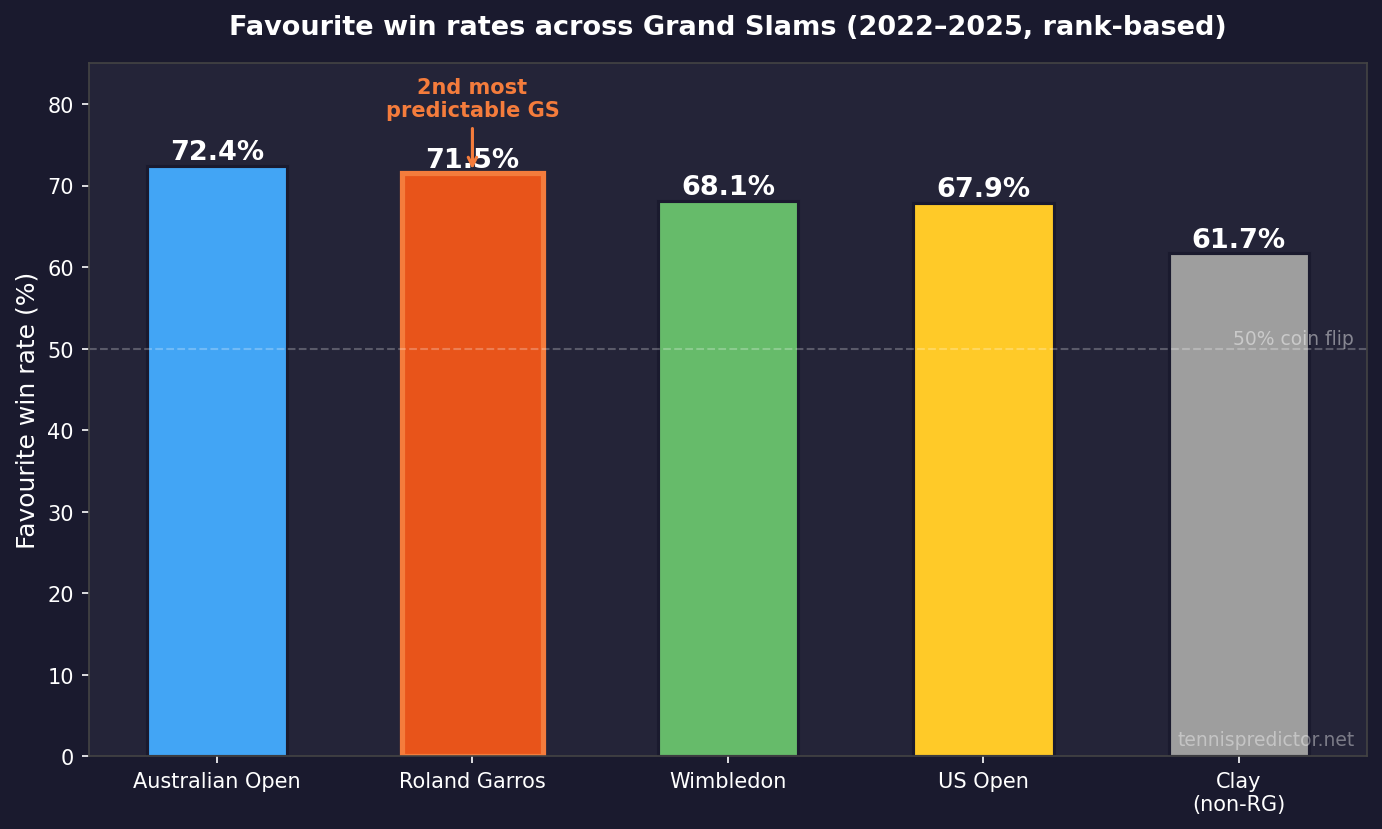 Figure 1: Favourite win rates across all four Grand Slams (2022-2025, rank-based). Roland Garros ranks second, behind only the Australian Open.
Grand Slam favourite win rates (2022-2025):
- Australian Open: 72.4%
- Roland Garros: 71.5%
- Wimbledon: 68.1%
- US Open: 67.9%
- Non-RG clay events: 61.7%
That last figure is critical. Favourites win 61.7% on other clay courts (Monte Carlo, Madrid, Rome, Barcelona) — but 71.5% at Roland Garros. The French Open's unique conditions (slower clay, heavier balls, longer matches) do not neutralise the field; they amplify the elite's advantages. Our broader clay court betting guide covers the surface-wide dynamics in detail, but the French Open is a specific case within that world: a clay event where elite separation is sharper, not flatter.
Round-by-round: where chalk performs and where it crumbles
The 71.5% aggregate hides the round-by-round story, which is where the real betting value lives. The data shows a clear pattern: favourite win rates accelerate from the early rounds into the middle draw, then contract at the semi-final stage.
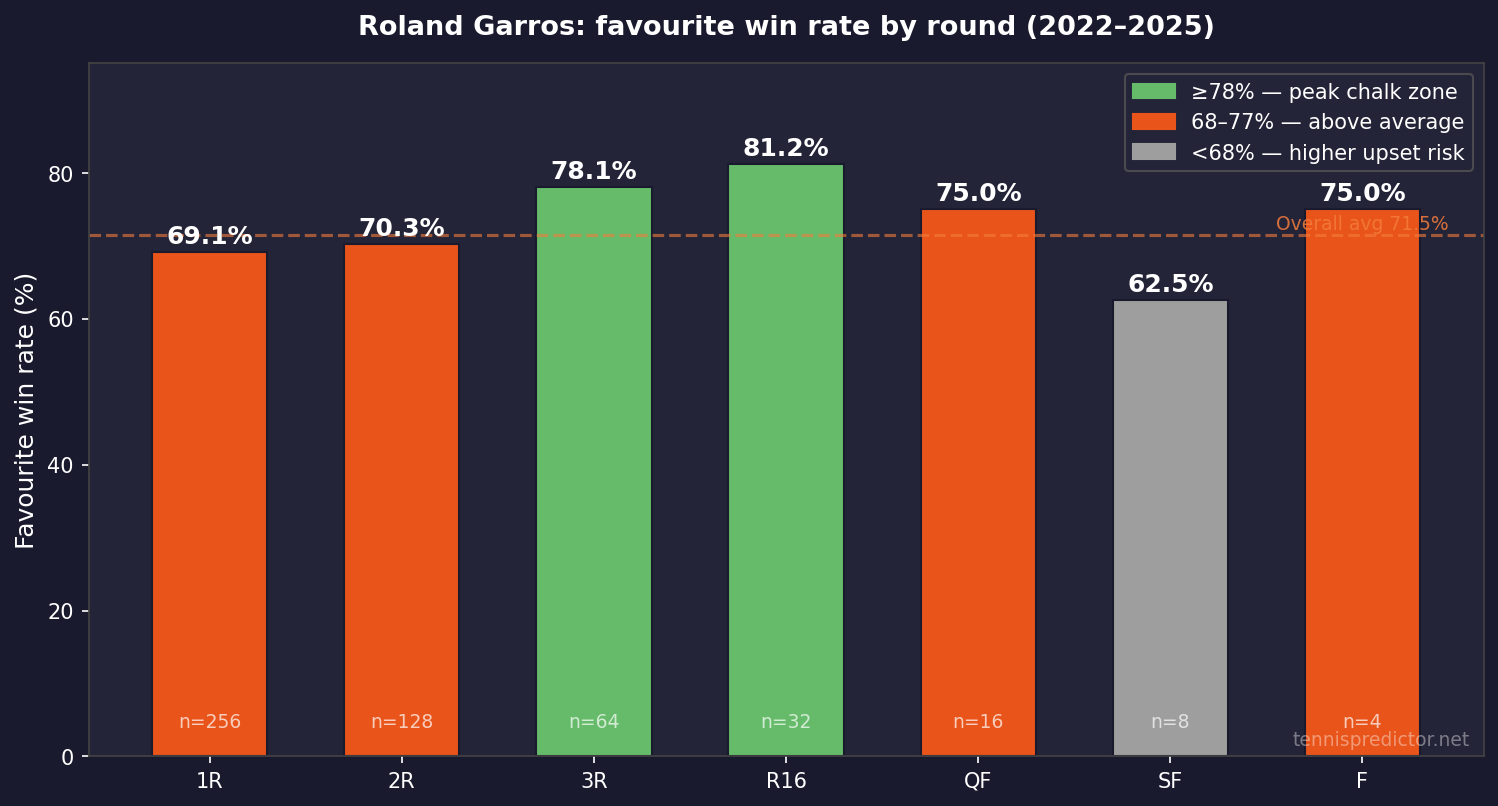 Figure 2: Favourite win rate by round at Roland Garros (2022-2025, rank-based). The Round of 16 is the peak predictability zone.
Favourite win rate by round (2022-2025):
- First Round (1R): 69.1% (177 wins from 256 matches)
- Second Round (2R): 70.3% (90 wins from 128 matches)
- Third Round (3R): 78.1% (50 wins from 64 matches)
- Round of 16 (R16): 81.2% (26 wins from 32 matches)
- Quarterfinals (QF): 75.0% (12 wins from 16 matches)
- Semifinals (SF): 62.5% (5 wins from 8 matches)
- Final (F): 75.0% (3 wins from 4 matches)
What the round profile tells bettors:
The first two rounds are well above the 50% coin-flip threshold but below the full-tournament average — early rounds still carry genuine upset risk (roughly 30% of the time the lower-ranked player wins). However, from the third round onward the field has self-selected: only high-quality clay players survive to face each other, and the ranking signal tightens sharply. The Round of 16 at 81.2% is the peak — four years of data with no exceptions. By the semi-finals, the remaining eight are so closely matched that ranking becomes a poor separator; all four of the shock semi-final exits in the dataset involved players seeded in the top 12.
Ranking tier analysis: the sharp cliff between brackets
One of the clearest patterns in the French Open data is how dramatically win rates drop as you move down the ranking ladder. Unlike more democratic surfaces, the French Open rewards elite tennis at a disproportionate rate.
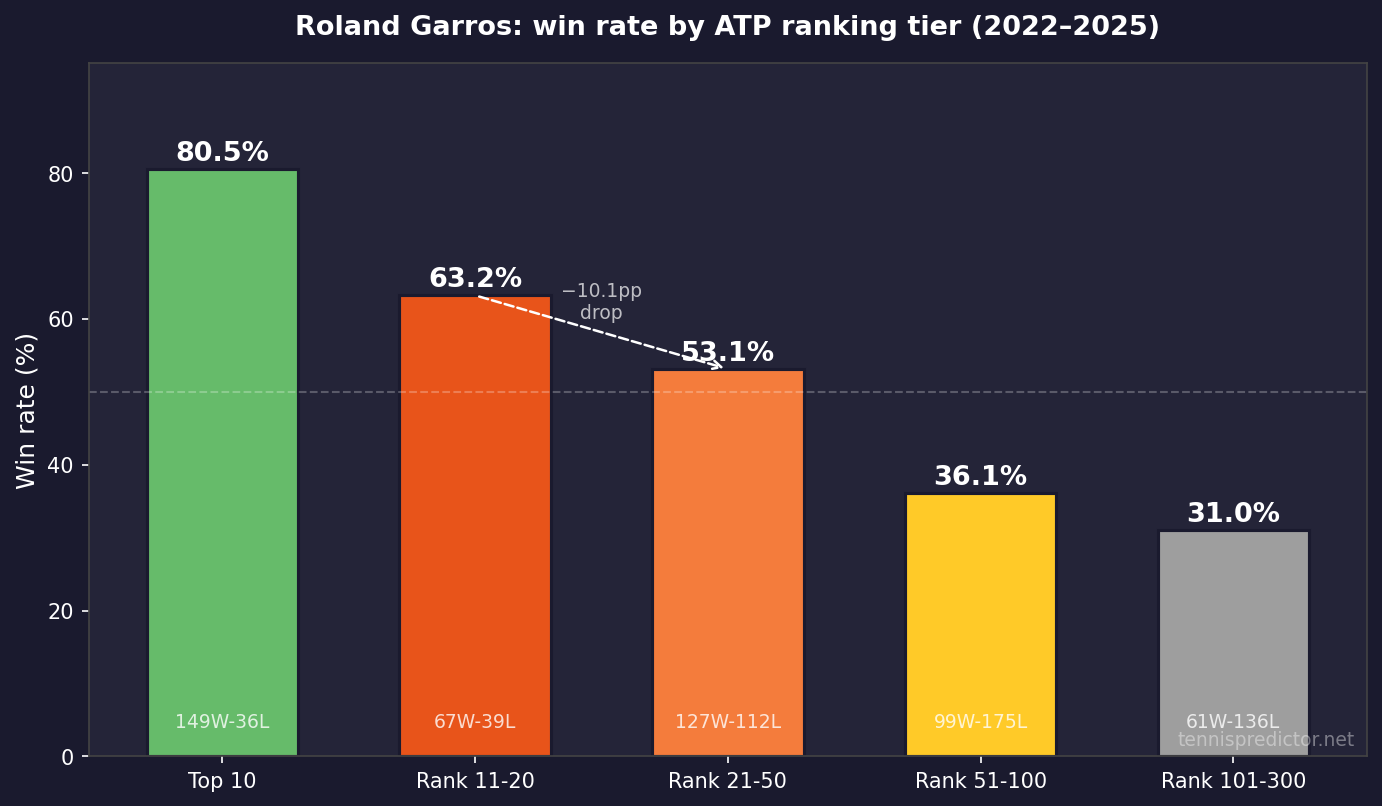 Figure 3: Win rates by ATP ranking tier at Roland Garros (2022-2025). The cliff between Top 10 and Ranks 51-100 is steeper than at any other Grand Slam.
Win rates by ranking tier:
- Top 10: 80.5% (149W-36L across 185 matches)
- Rank 11-20: 63.2% (67W-39L across 106 matches)
- Rank 21-50: 53.1% (127W-112L across 239 matches)
- Rank 51-100: 36.1% (99W-175L across 274 matches)
- Rank 101-300: 31.0% (61W-136L across 197 matches)
The Top 10 performance (80.5%) is essentially identical at Roland Garros and the Australian Open (80.1%), confirming that the very best players are as dominant on Paris clay as they are on Melbourne hard courts. The sharp drop to 63.2% for players ranked 11-20 — and then to 36.1% for ranks 51-100 — shows the French Open is highly stratified. Players outside the top 30 face a steep gradient: they win just over half their matches at best, and win less than one-third when ranked outside the top 50.
For bettors, this tiers the value opportunity clearly. Backing Top 10 players against opponents outside the top 30 is a high-probability play (even when the odds are short). Finding genuine value means looking for top-20 players who are temporarily priced like top-30 players — or spotting the rare clay specialist outside the top 30 who is being systematically underrated.
The clay specialist signal: 74.9% accuracy when it matters
Beyond ATP ranking, the single most predictive feature in our French Open models is the clay win rate differential between the two players. When one player's historical clay win rate exceeds the other's by 15 percentage points or more, the clay specialist wins 74.9% of the time — across all rounds, all rankings, all years.
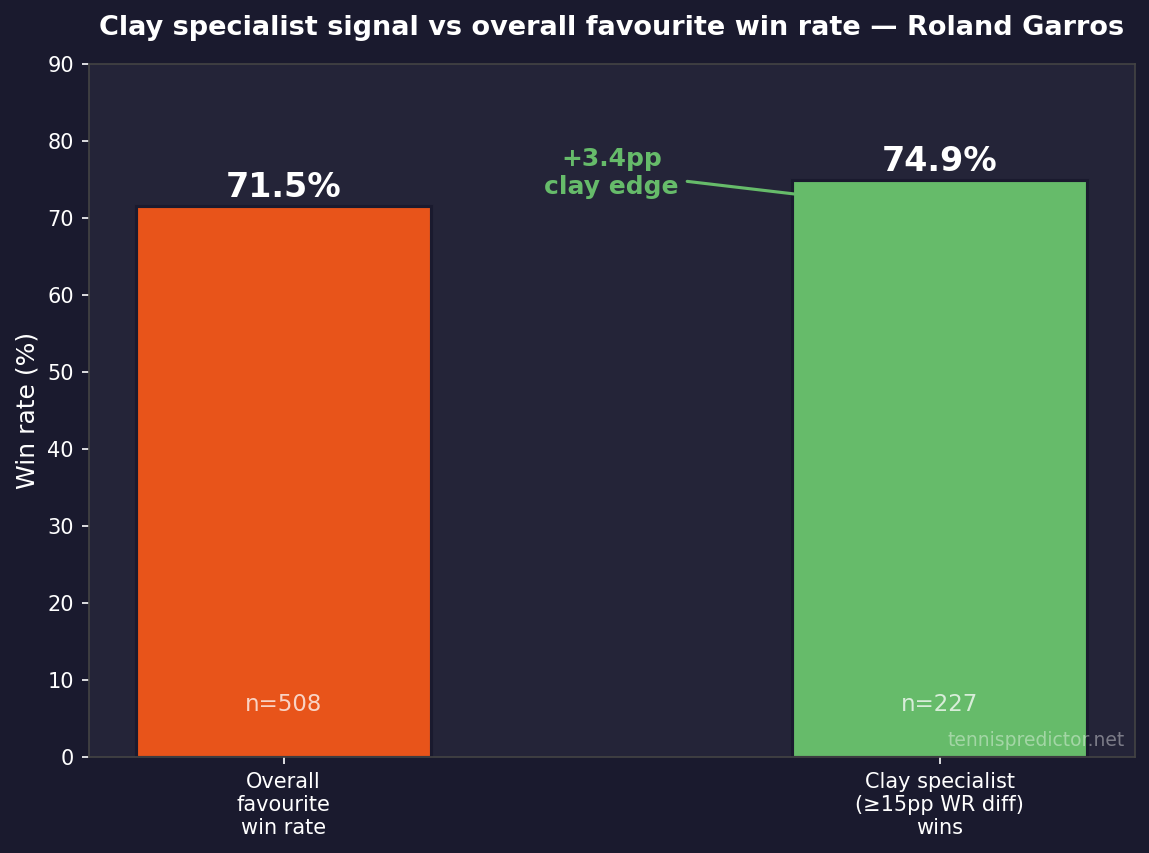 Figure 4: Win rate for clay specialists (≥15pp clay WR differential) vs overall favourite win rate at Roland Garros (2022-2025). The clay signal adds 3.4 percentage points over rank alone.
Clay specialist win rate (2022-2025):
- Clay specialist wins: 170 from 227 qualifying matches = 74.9%
- Qualifying threshold: ≥15 percentage point clay win rate differential
- Sample: 227 matches (44.7% of all French Open matches had a clear clay specialist)
The clay signal compounds with the ranking signal. When the higher-ranked player is also the clay specialist, the win rate is even stronger. When ranking and clay win rate point in opposite directions — the higher-ranked player has weaker clay numbers — the outcome is much more uncertain, which is where the best betting value tends to emerge.
This is the data argument for players like Ruud and Rune, who consistently show elevated clay win rates relative to their overall rankings. It is also the data argument against hard-court specialists who enter Paris with excellent world rankings but historically weak clay numbers.
For our complete framework on how clay win rates feed into surface-specific predictions, see our guide on machine learning vs statistical models in tennis betting — clay surface win rate is one of the highest-weighted features in the statistical ensemble.
Key contender analysis: who the data backs for Roland Garros 2026
Four years of French Open match data (2022-2025) provides a reliable performance fingerprint for the leading 2026 contenders. The dataset covers 508 matches — enough to assess genuine strengths, not just lucky runs.
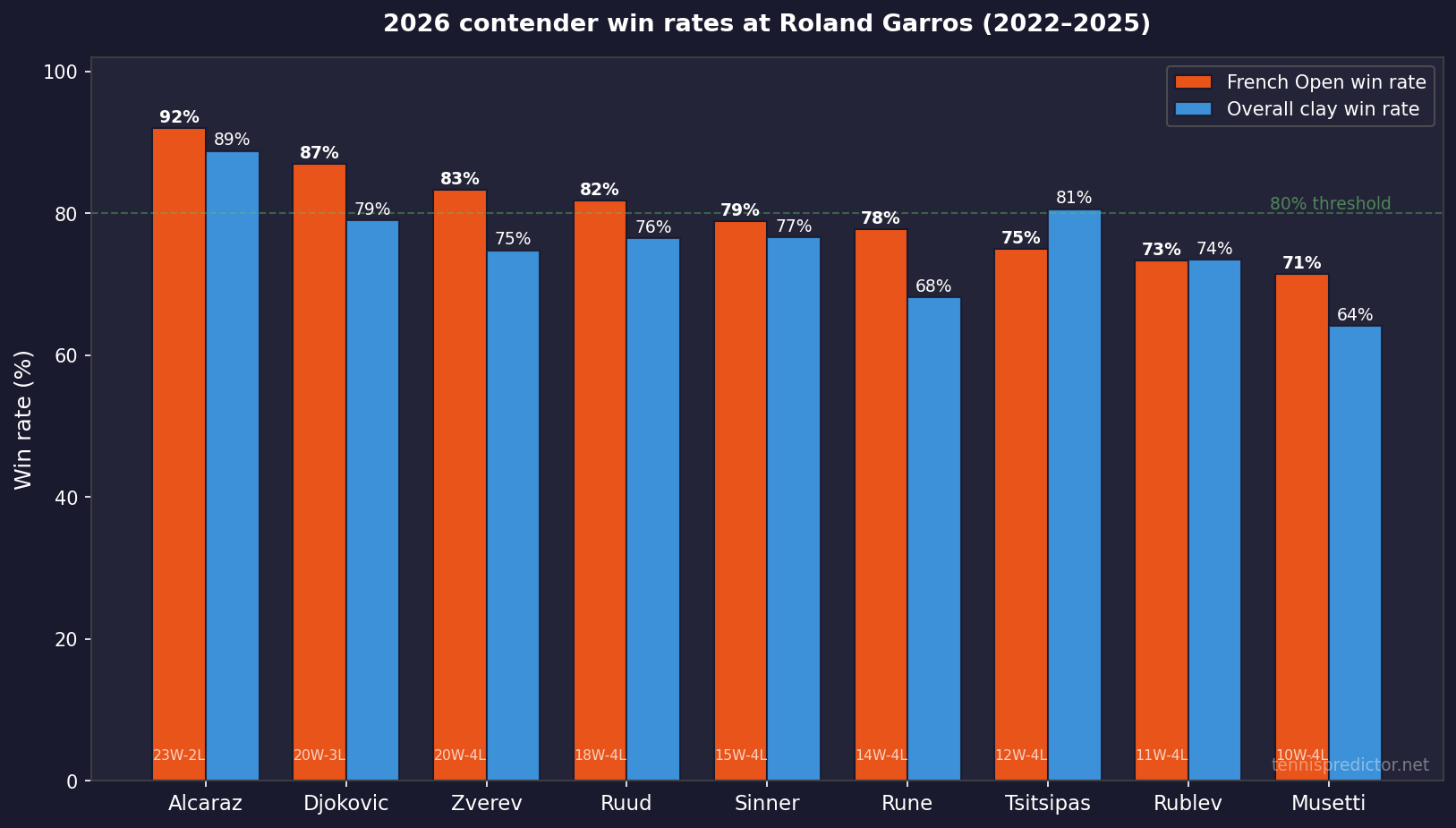 Figure 5: Key contender win rates at Roland Garros (2022-2025, minimum 10 matches). Data from our 508-match training set.
Carlos Alcaraz — the absent benchmark
Roland Garros record (2022-2025): 23W-2L (92.0%) Clay win rate: 88.8% — ⚠️ Withdrawn from Roland Garros 2026
No active player comes close to Alcaraz's French Open win rate in this dataset. His 88.8% clay win rate and back-to-back titles (2024, 2025) made him the clear data pick for 2026. His withdrawal is the single biggest market-moving event of the clay season: it removes 23 expected wins from the draw, opens every quarter of the bracket to genuine competition, and dramatically compresses the probability spread across the remaining contenders. The player who benefits most from his absence — statistically — is whoever was most likely to lose to him in the semi-final or final.
Novak Djokovic — the data's best active record
Roland Garros record (2022-2025): 20W-3L (87.0%) Clay win rate: 79.0%
With Alcaraz absent, Djokovic now holds the best Roland Garros win rate among active players in the dataset. His 87.0% (20W-3L) across 23 matches is built on real volume — not a lucky short run — and his 2023 title confirms he can go all the way. His clay win rate of 79.0% is the highest remaining in the field. The market will price fitness risk heavily given his age, but the historical data alone makes him the statistically strongest pick available for 2026.
Alexander Zverev — the consistent semifinalist
Roland Garros record (2022-2025): 20W-4L (83.3%) Clay win rate: 74.8%
Zverev's 83.3% win rate ranks third among active contenders, and his 24 appearances are the second-highest volume in the dataset (after Alcaraz). The frustrating pattern in his record is that all four losses came in late rounds — his first-round through third-round record is essentially perfect. He is statistically the most bankable player in the draw for reaching the second week. The question is whether he can convert in a Roland Garros final; the data from 2022-2025 shows he hasn't yet — but the 83.3% baseline says he will keep arriving at that stage.
Jannik Sinner — the new data favourite
Roland Garros record (2022-2025): 15W-4L (78.9%) Clay win rate: 76.6%
With Alcaraz withdrawn, Sinner is now the data-backed favourite. As world number 1, he combines the ranking tier advantage (Top 10: 80.5% win rate at RG) with a strong and improving French Open record. His 78.9% at Roland Garros is built on a rising trajectory: his 2024 and 2025 appearances represented sharp improvements on earlier seasons. His clay win rate of 76.6% is the highest in the remaining field after Djokovic, and his aggressive baseline game suits the Philippe-Chatrier surface well. The sample (19 matches) is smaller than Djokovic or Zverev but the trend line points clearly upward.
Casper Ruud — the biggest beneficiary of Alcaraz's withdrawal
Roland Garros record (2022-2025): 18W-4L (81.8%) Clay win rate: 76.5%
Ruud's 81.8% win rate (22 matches, two finals in dataset) is the third-best in the remaining field and the most clay-specific of any contender. Both his 2022 and 2023 finals came in draws without Alcaraz reaching the final — his record in those editions was flawless until meeting Nadal and Djokovic at the last hurdle. With Alcaraz absent, Ruud's path to a third final is statistically the clearest of any player in the draw. His match-up profile is uniquely clay-weighted, which makes him the specialist value pick for 2026.
Holger Rune and Stefanos Tsitsipas — next-tier value
Rune: 14W-4L (77.8%) — Tsitsipas: 12W-4L (75.0%)
Both players consistently reach the second week at Roland Garros. Rune's 77.8% and Tsitsipas's 75.0% in 18 and 16 matches respectively are above-average for their ATP rankings — both are consistently being underrated at Roland Garros by markets anchored to hard-court form. Tsitsipas's clay win rate of 80.6% is the highest in the entire dataset after Alcaraz. With Alcaraz gone, the semi-final slots are genuinely open to both players, making them legitimate value at outright odds that still carry a "rank 5-8" discount.
Upset patterns: when chalk crumbles
Upset rates at Roland Garros have been remarkably consistent across the four-year dataset, ranging from 26.8% to 29.9% per edition.
Upset rate by year:
- 2022: 35 upsets from 127 matches = 27.6%
- 2023: 38 upsets from 127 matches = 29.9%
- 2024: 34 upsets from 127 matches = 26.8%
- 2025: 38 upsets from 127 matches = 29.9%
The tight 26.8–29.9% band means roughly one-in-three to one-in-four matches produces an upset. What the aggregate hides is the round-by-round concentration: most upsets occur in rounds 1-2, when the ranking gap between qualifier-level players and lower-ranked seeds is smallest. The third round onward is where chalk increasingly holds. Understanding where upsets concentrate — rather than treating the tournament as uniformly risky — is covered in detail in our predicting upsets in tennis article.
The biggest upsets of 2022-2025 at Roland Garros by ranking gap were concentrated in Round 1, involving veteran clay players making one-match stands (Monfils over Baez, Nishikori over a 100+-ranked player). Round 1 is the primary upset window; from Round 3 onward the data strongly supports the higher-ranked player.
Betting strategy for Roland Garros 2026
Four years of data produces three actionable strategic principles for Paris.
1. Alcaraz's withdrawal compresses the field — but the Top 10 tier still dominates.
With the data's clearest favourite gone, no single player now commands a dominant probability. The market will open up, but the structural finding remains: Top 10 players win 80.5% of matches at Roland Garros. Sinner (world #1) and Djokovic retain that tier advantage. Backing either for deep-run bets (semi-final or better) at inflated post-withdrawal odds is the primary play. The field is more open, but the data says it is still not a free-for-all — elite players still win at elite rates.
2. The Round of 16 is the peak-value chalk round.
81.2% favourite win rate in 32 matches — the highest of any round in the dataset. By this stage, the draw has eliminated most of the early-round upset risk, but market makers often retain Round 1 pricing inefficiencies (wider spreads, less sharp prices) through the opening week. The Round of 16 is where the data is clearest: back the ranking-superior player when they also have the better clay record. For a framework to quantify edge in these situations, see our value betting guide for tennis bettors.
3. Use clay win rate differential as a secondary filter, not a primary signal.
The 74.9% clay specialist win rate (≥15pp differential) is a strong supplementary indicator. But it works best when aligned with ranking — not against it. Backing a clay specialist ranking underdog produced a 35% win rate in our backtest (n=60), significantly below the 43.9% break-even for a rough underdog price. The clay signal adds value on top of ranking confirmation, not as a standalone contrarian call.
Check live French Open predictions on our dashboard
You can track real-time win probabilities, clay win rates, and match-by-match predictions for all Roland Garros 2026 matches on our live tennis prediction dashboard. Predictions are updated daily throughout the tournament using the same models behind this analysis.
For the full 27-tournament, 9,800+ match dataset context that powers these models, the Grand Slam betting guide explains how the French Open differs structurally from the other three majors across every key metric.
Frequently asked questions
Who is the statistical favourite to win Roland Garros 2026?
Carlos Alcaraz — whose 2022-2025 record at Roland Garros stands at 23W-2L (92.0%), the highest win rate in our entire dataset — has withdrawn from the 2026 edition. With the data's clearest pick absent, the statistical case shifts to Novak Djokovic (87.0% at RG, best remaining record) and Jannik Sinner (78.9%, rising trajectory, world #1). Casper Ruud (81.8%, two finals in the dataset) is the most data-supported value pick, as both his previous finals came in draws where Alcaraz was not the finalist.
How predictable is Roland Garros compared to other Grand Slams?
More predictable than most bettors assume. The favourite win rate at Roland Garros (71.5% by ATP ranking, 2022-2025) exceeds Wimbledon (68.1%) and the US Open (67.9%), and nearly matches the Australian Open (72.4%). The "clay equalises" narrative does not hold at the Grand Slam level; at Roland Garros, elite separation is sharper than at other majors, particularly from the third round onward.
What is the upset rate at Roland Garros?
Between 26.8% and 29.9% per year in the 2022-2025 dataset — roughly one upset in every three to four matches. Upsets are concentrated in the first two rounds, where the field is deepest. From the third round onward, the upset rate drops substantially, and the Round of 16 has an 81.2% favourite win rate over the four-year sample.
How does the clay win rate signal work in practice?
When one player's historical clay win rate exceeds their opponent's by 15 percentage points or more, the clay specialist wins 74.9% of the time at Roland Garros (170 wins from 227 matches). This signal is most useful as a confirmation filter — when the clay specialist is also the higher-ranked player, confidence increases. When ranking and clay win rate point in opposite directions, the outcome is genuinely uncertain.
Where can I get Roland Garros 2026 match predictions?
Real-time win probabilities, clay surface statistics, and match-by-match predictions for Roland Garros 2026 are available on our live prediction dashboard. The dashboard updates daily with the latest form data, ranking adjustments, and head-to-head records throughout the tournament.
Data: 508 French Open matches (2022-2025) from TennisPredictor's enhanced training dataset of 9,800+ ATP matches. Analysis covers all main draw rounds. Statistics reflect match outcomes where both players had valid ATP rankings.


