Sebastian Korda: hard-court threat with a third-round collapse and a clay floor
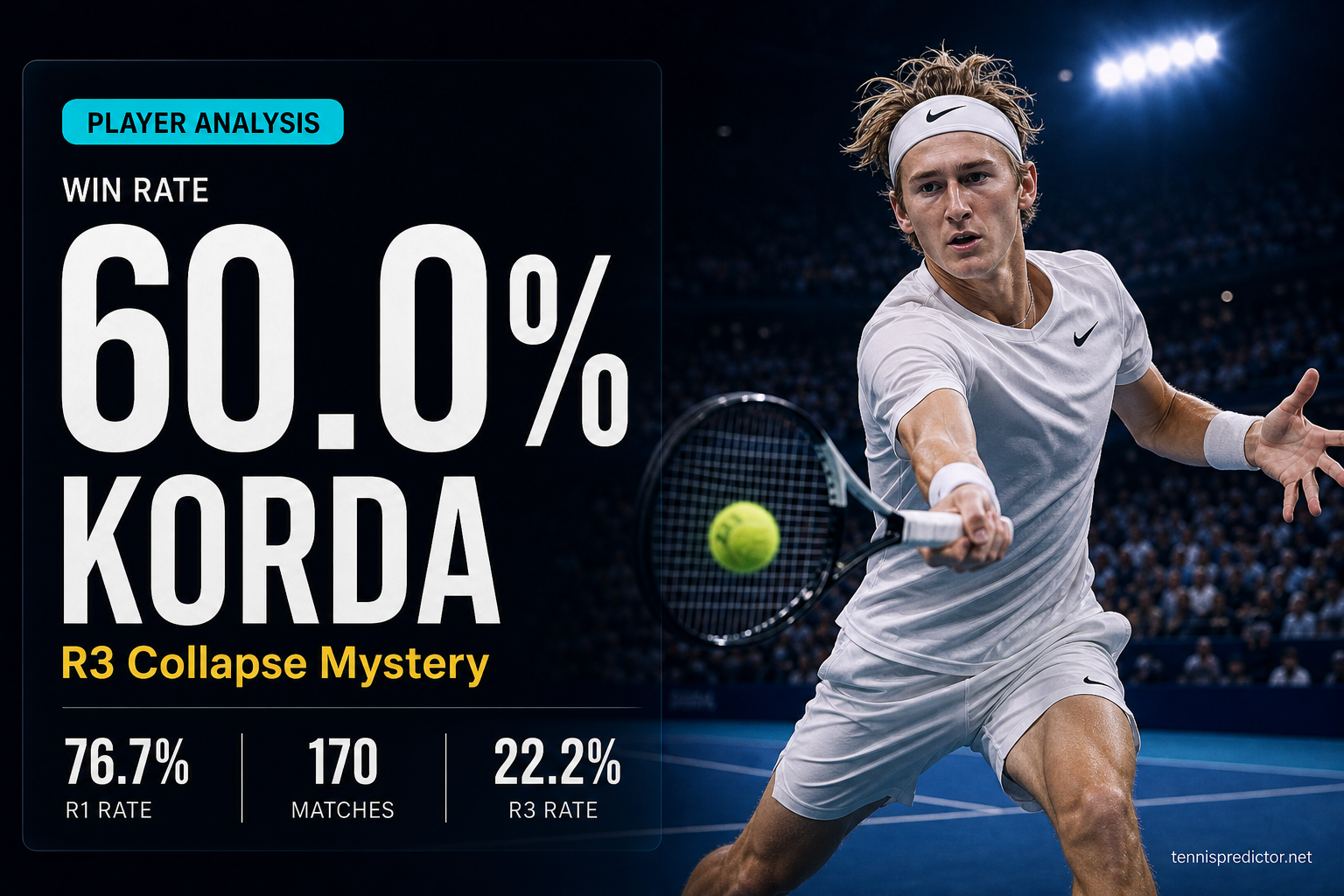
Sebastian Korda has played 170 ATP matches from 2022 to 2025 at a 60.0% overall win rate — the second-lowest among the Batch 3 players but with a gradual improvement trend (58.1% → 64.3% → 60.0% → 66.7%). He is a hard-court serve-and-forehand player whose data reveals an unusual structural anomaly: exceptional R1 and R2 conversion (76.7% and 70.6%), followed by a collapse to 22.2% at R3. Understanding that specific pattern — and whether it reflects opponent quality, schedule fatigue, or draw composition — is the central analytical question for Korda betting.
Key metrics at a glance
| Metric | Value |
|---|---|
| Overall win rate | 60.0% |
| Dataset rank (end of period) | ~19 (end-of-season snapshot) |
| Matches analysed | 170 (2022–2025) |
| Best surface | Hard — 62.2% |
| Grand Slam win rate | 56.2% |
| Worst surface | Clay — 50.0% |
| As market favourite | 72.5% |
| As underdog | 34.4% |
Korda's year-by-year record
| Year | Matches | Wins | Win rate |
|---|---|---|---|
| 2022 | 31 | 18 | 58.1% |
| 2023 | 14 | 9 | 64.3% |
| 2024 | 25 | 15 | 60.0% |
| 2025 | 18 | 12 | 66.7% |
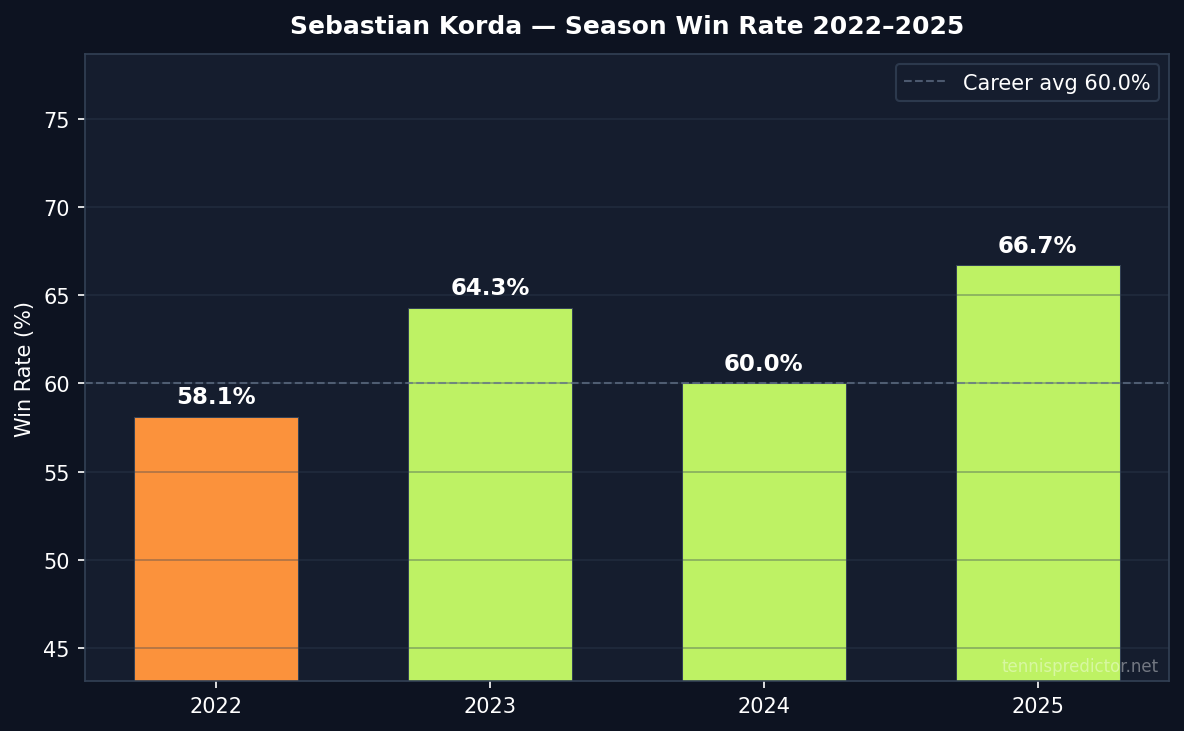
Win rate by season, Sebastian Korda, 2022–2025. Source: ATP match data via tennispredictor.net
The 2023 sample (14 matches) is thin but shows his highest single-season figure before 2025. The 2025 figure of 66.7% over 18 matches — while not a full season — is directionally positive and consistent with his improving serve consistency. The 2022 and 2024 figures at 58–60% represent his structural baseline. No sharp volatility unlike FAA or Musetti; Korda is a player whose level is narrow-range and slowly improving.
Surface breakdown: hard specialist, clay a floor
| Surface | Matches | Win rate |
|---|---|---|
| Hard | 90 | 62.2% |
| Grass | 18 | 61.1% |
| Grand Slam | 32 | 56.2% |
| Indoors | 20 | 60.0% |
| Clay | 38 | 50.0% |
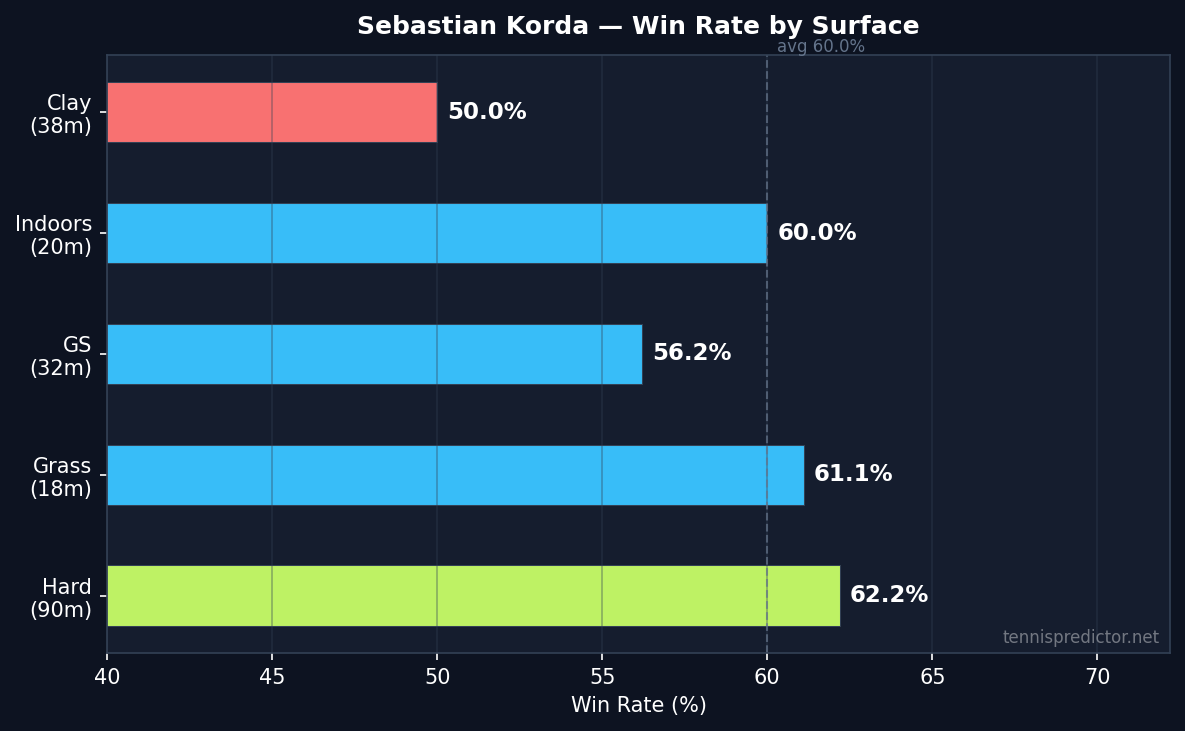
Win rate by surface, Sebastian Korda, 2022–2025. Source: ATP match data via tennispredictor.net
Korda's surface profile is relatively flat across hard, grass, and indoors — all in the 60–62% range — with clay (50.0%, 38 matches) as the clear floor. A 12.2-point gap between his hard rate (62.2%) and clay rate (50.0%) is not as extreme as Shelton's or Ruud's surface differentials, but it is large enough across 38 clay matches to be a reliable betting signal.
On clay, Korda's serve dominance partially evaporates due to slower ball travel and higher bounce, and his groundstroke depth is not developed enough to compensate. His clay rate of exactly 50.0% over 38 matches tells a precise story: every clay match against a comparable opponent is a 50/50 proposition.
The grass rate (61.1%, 18 matches) is his second-highest surface figure, driven by serve dominance on fast grass — a pattern similar to other American hard-court players in the dataset.
Round-by-round: the R3 anomaly
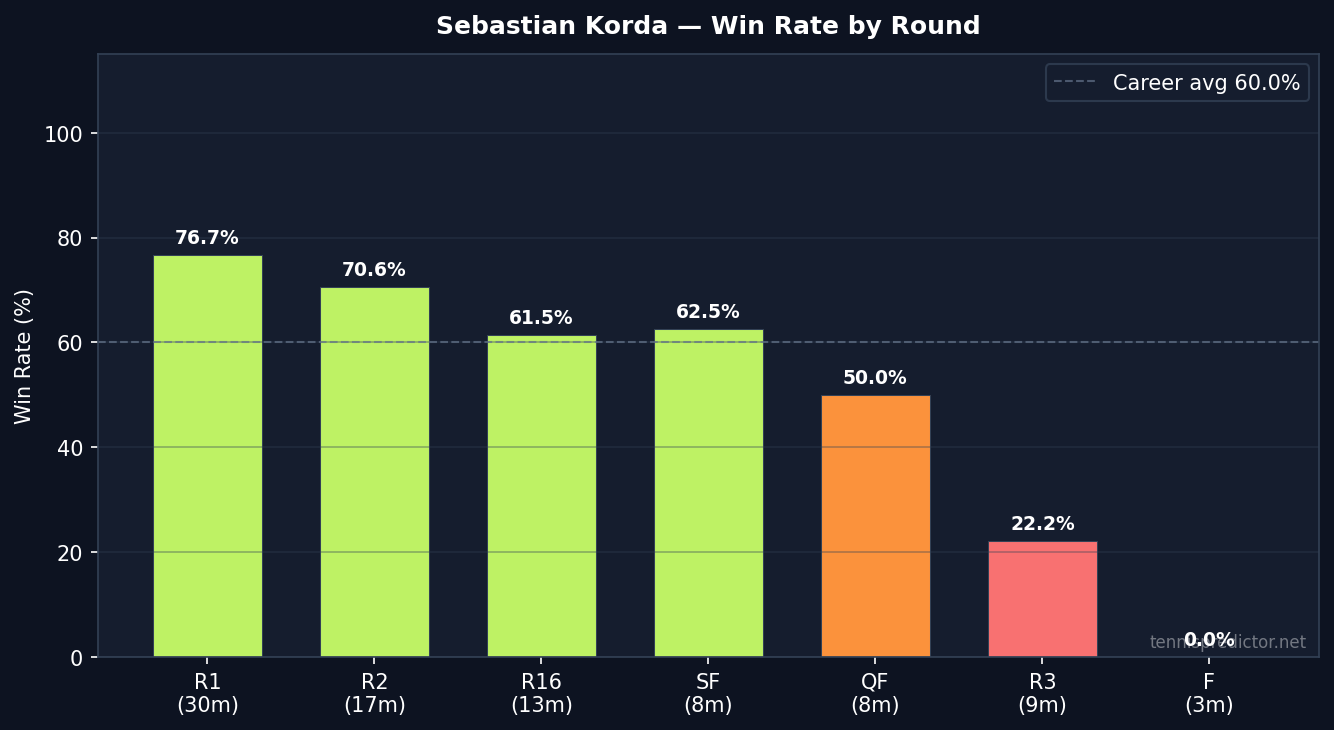
Win rate by round, Sebastian Korda, 2022–2025. Source: ATP match data via tennispredictor.net
| Round | Matches | Win rate |
|---|---|---|
| R1 | 30 | 76.7% |
| R2 | 17 | 70.6% |
| R16 | 13 | 61.5% |
| SF | 8 | 62.5% |
| QF | 8 | 50.0% |
| R3 | 9 | 22.2% |
| Final | 3 | 0.0% |
The R3 figure of 22.2% (2 wins from 9 matches) is the most unusual data point in the Batch 3 dataset. His R1 (76.7%) and R2 (70.6%) are strong, and his R16 (61.5%) is above his overall average — yet his R3 shows only 22.2%. In ATP draw structures, R3 represents the "third round" or entry of the higher seeds into some events, or the round that bridges the first phase and the second week at Slams. In smaller ATP 250 and ATP 500 events, R3 can expose Korda to seeded top-30 opponents for the first time. The data says he converts those matches at an unusually low rate.
The Final sample (0/3, 0.0%) is a small but concerning pattern — though 3 matches is too small to draw strong conclusions beyond noting the pattern exists.
H2H against the elite
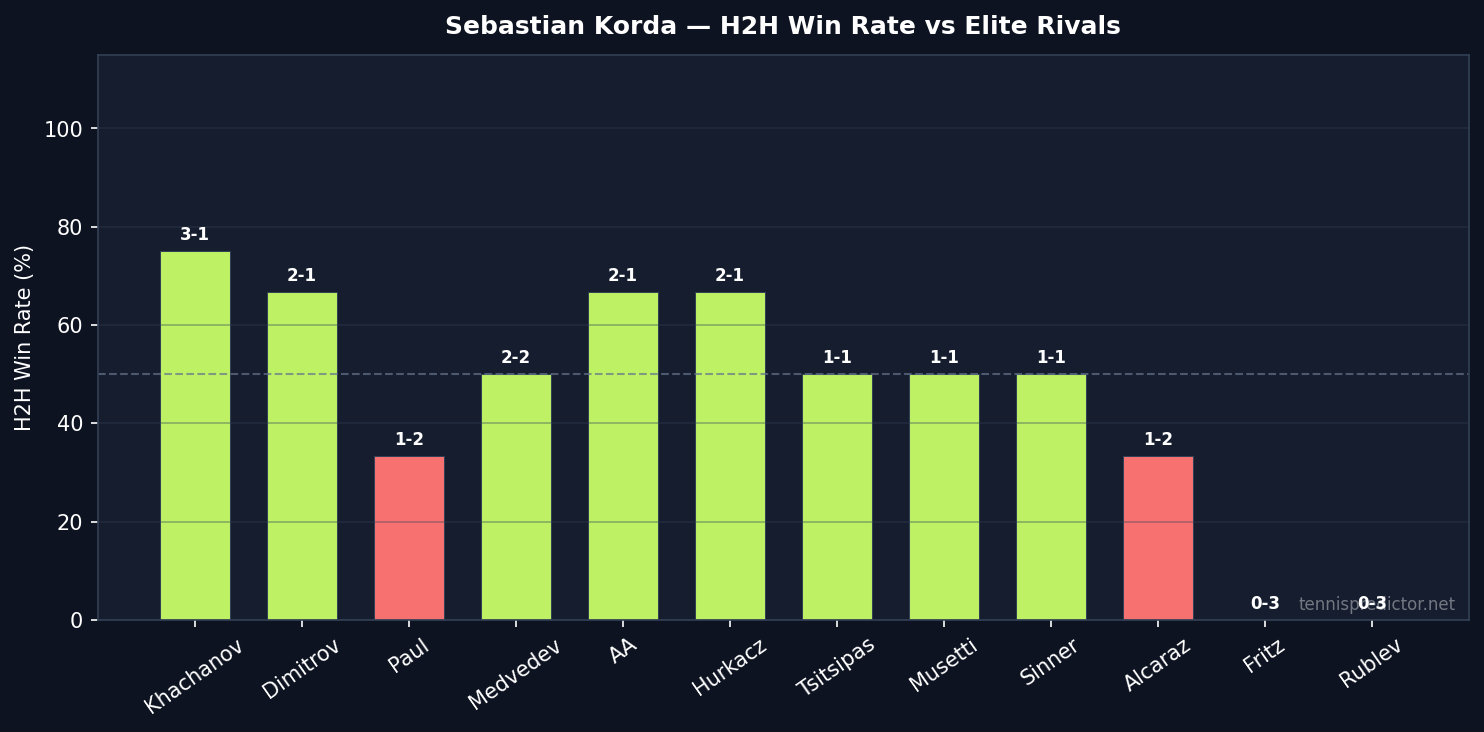
H2H win rate vs rivals with 2+ meetings, Sebastian Korda, 2022–2025. Source: ATP match data via tennispredictor.net
| Opponent | Record | H2H win rate |
|---|---|---|
| Khachanov | 3–1 | 75.0% |
| Dimitrov | 2–1 | 66.7% |
| Auger-Aliassime | 2–1 | 66.7% |
| Paul | 2–1 | 66.7% |
| Medvedev | 2–2 | 50.0% |
| Hurkacz | 2–1 | 66.7% |
| Tsitsipas | 1–1 | 50.0% |
| Musetti | 1–1 | 50.0% |
| Alcaraz | 1–2 | 33.3% |
| Fritz | 0–3 | 0.0% |
| Rublev | 0–3 | 0.0% |
| Sinner | 1–1 | 50.0% |
Korda's H2H data shows a player who is competitive against a wide range of opponents. His 75.0% record against Khachanov (3–1) and positive records against Dimitrov, AA, Paul, and Hurkacz indicate genuine value in matchups against players of similar or slightly higher ranking.
The 0–3 records against Fritz and Rublev are the clear negative signals. Against Fritz, the American-on-American hard-court dynamic has consistently favoured the Californian; against Rublev, the Russian's aggressive topspin tempo has been particularly disruptive to Korda's patterns.
As market favourite vs underdog
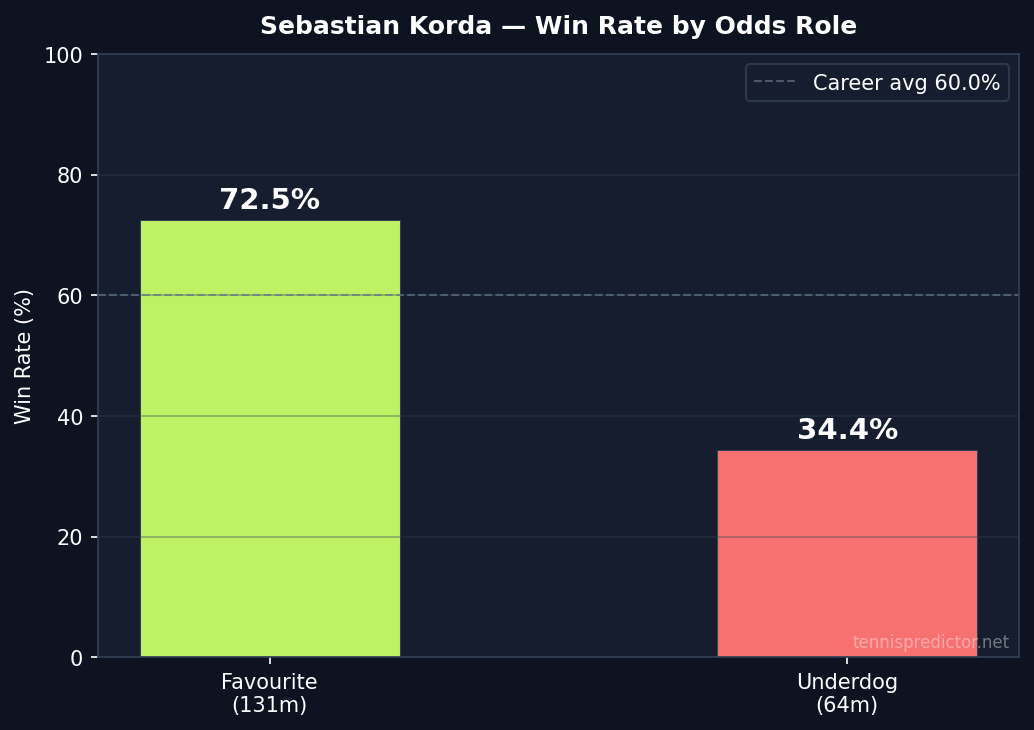
Win rate as market favourite vs underdog, Sebastian Korda, 2022–2025. Raw tournament cache. Source: tennispredictor.net
As favourite (131 matches): 72.5% — in line with expectations for a developing top-20/25 player. As underdog (64 matches): 34.4% — one of the lower underdog rates in Batch 3, confirming the pattern that when the market rates Korda as inferior, that assessment is usually correct.
What the betting market misses about Korda
The R3 specific fade. 22.2% in R3 across 9 matches is a genuine and unusual pattern. When Korda makes it to R3 at hard-court ATP 250/500 events, the data suggests fading him there even at long odds. This is primarily an early-draw betting signal (R1 and R2 are solid backing opportunities; R3 is not).
The clay floor. 50.0% on clay over 38 matches is the most reliable surface signal. The market prices clay events partly on ranking; against hard-court specialists who also struggle on clay, Korda and his opponent are effectively even regardless of the ranking gap.
The 2025 improvement trend. 66.7% in 2025 is above his career average and consistent with genuine serve improvement. Backing Korda in 2025 at early-round hard-court events is historically well-supported.
How our model treats Korda
- Hard court baseline — 62.2% hard rate anchors all hard-court predictions
- Clay penalty — 50.0% clay rate triggers a meaningful downward adjustment
- R3 anomaly flag — the model applies a caution flag at R3 stage in certain draw formats
- Fritz and Rublev negative overrides — 0–3 H2H against both applied as negative signal modifiers
- 2025 form uplift — rolling windows (last-5: 80%, last-10: 70%) are above career average
Frequently asked questions
What is Sebastian Korda's overall win rate?
60.0% across 170 matches from 2022 to 2025. His 2025 figure of 66.7% is his best in the dataset and suggests gradual structural improvement.
What is his worst surface?
Clay at exactly 50.0% over 38 matches — the most precise surface floor in Batch 3. Any clay match against a comparable opponent is a 50/50 proposition.
What is the R3 anomaly?
22.2% win rate across 9 R3 appearances — the sharpest mid-draw drop in the top-20 dataset. Despite 76.7% and 70.6% in R1 and R2, Korda converts only 22.2% at R3. This likely reflects the entry of seeded opponents at that stage of smaller events.
When is Korda worth backing?
In R1 and R2 of hard-court events (76.7% and 70.6% respectively), against Khachanov (3–1), and at hard-court events in 2025 where his improved form is most relevant. Fade him at R3 and on clay against clay specialists.
Conclusion
Sebastian Korda is among the most analytically tractable players in the dataset. His R1 and R2 hard-court conversion rates (76.7% and 70.6%) are among the strongest early-round figures in Batch 3, and his 2025 improving form (66.7%) supports current-form backing. The R3 anomaly (22.2%) and clay floor (50.0%) are the two clearest fade signals. For 2026, monitor whether the R3 pattern improves with experience — if Korda begins converting seeded R3 opponents at a higher rate, his overall tournament depth will expand significantly.
For another developing American hard-court specialist profile, see the Shelton analysis.
All statistics sourced from ATP match data 2022–2025. ATP Tour events only. Data extracted October 2025.
See today's match predictions with confidence scores and value signals.
View Live Predictionsarrow_forwardRelated Articles
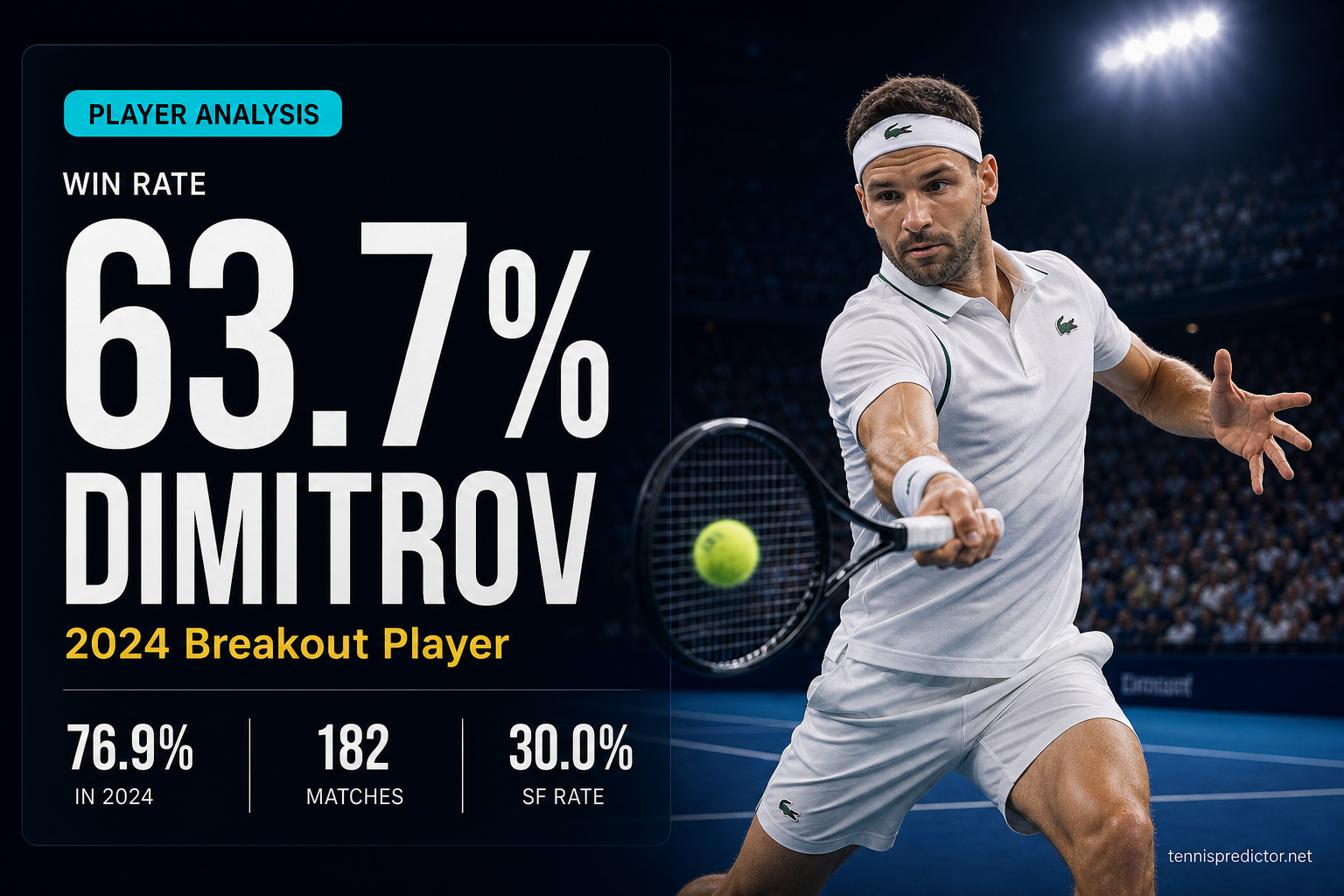
Grigor Dimitrov: the 2024 breakout player whose SF wall defines the ceiling
Dimitrov hit 76.9% in 2024 — his best season in the dataset. But behind the headline numbers: a 30.0% SF win rate across 10 appearances and a combined 0-15 record against four specific elite opponents. Here is where to back and fade the Bulgarian veteran.
June 14, 2026 · 12 min read
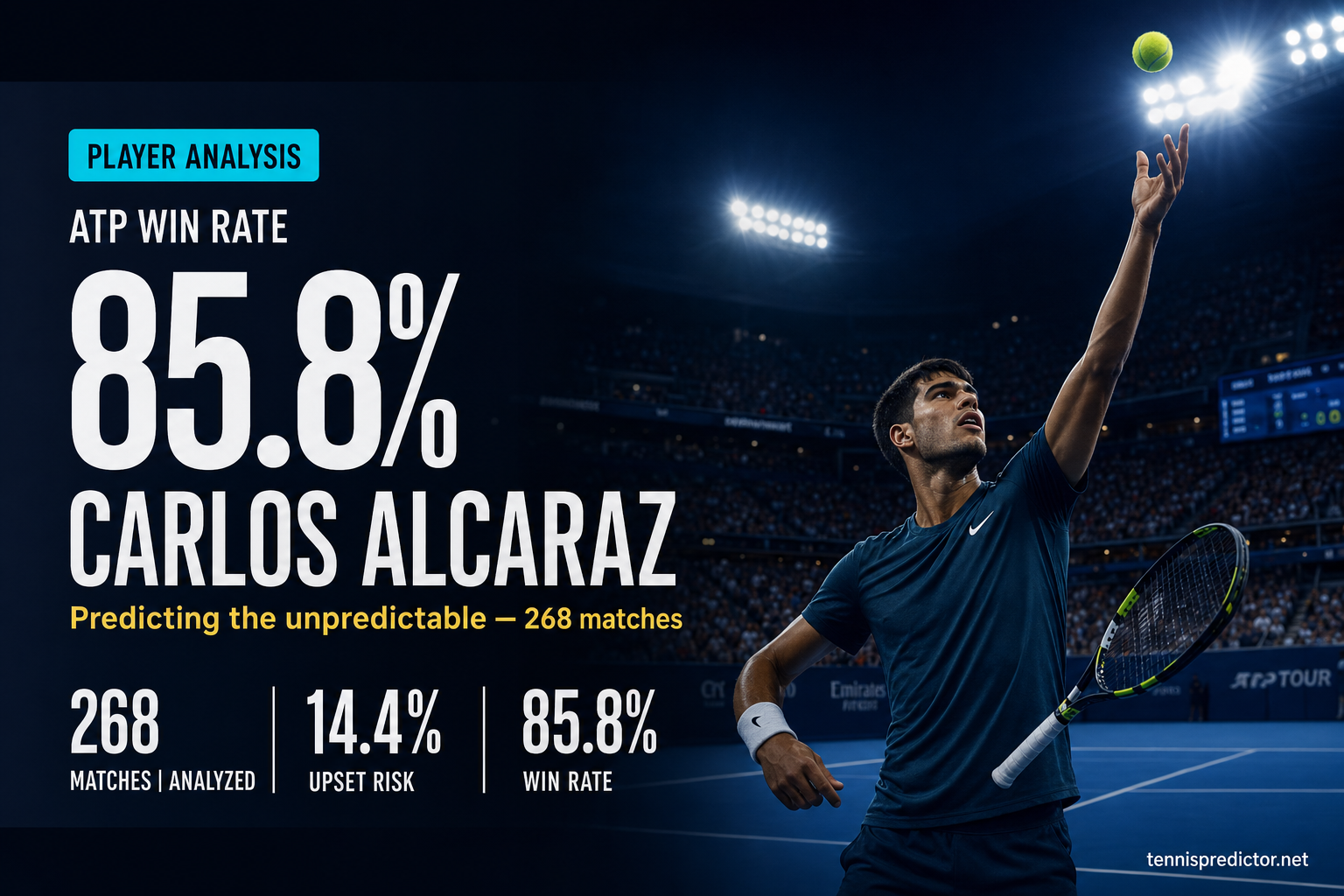
Carlos Alcaraz ATP analysis: predicting the unpredictable
Carlos Alcaraz has played 298 ATP main-draw matches from 2022–2026 at a 85.9% win rate. Data story: elite win rate with real favourite-upset risk that markets compress.
September 8, 2026 · 14 min read
Alex de Minaur ATP analysis: top-20 profile and betting read
Alex de Minaur has played 299 ATP main-draw matches from 2022–2026 at a 67.6% win rate. Data story: favourite conversion at 76.2% (23.8% upset risk).
September 8, 2026 · 12 min read
Felix Auger-Aliassime ATP analysis: top-20 profile and betting read
Felix Auger-Aliassime has played 278 ATP main-draw matches from 2022–2026 at a 63.7% win rate. Data story: Indoors edge (78.9%) vs Grass at 54.5%.
September 8, 2026 · 12 min read