The most predictable tennis players of 2025
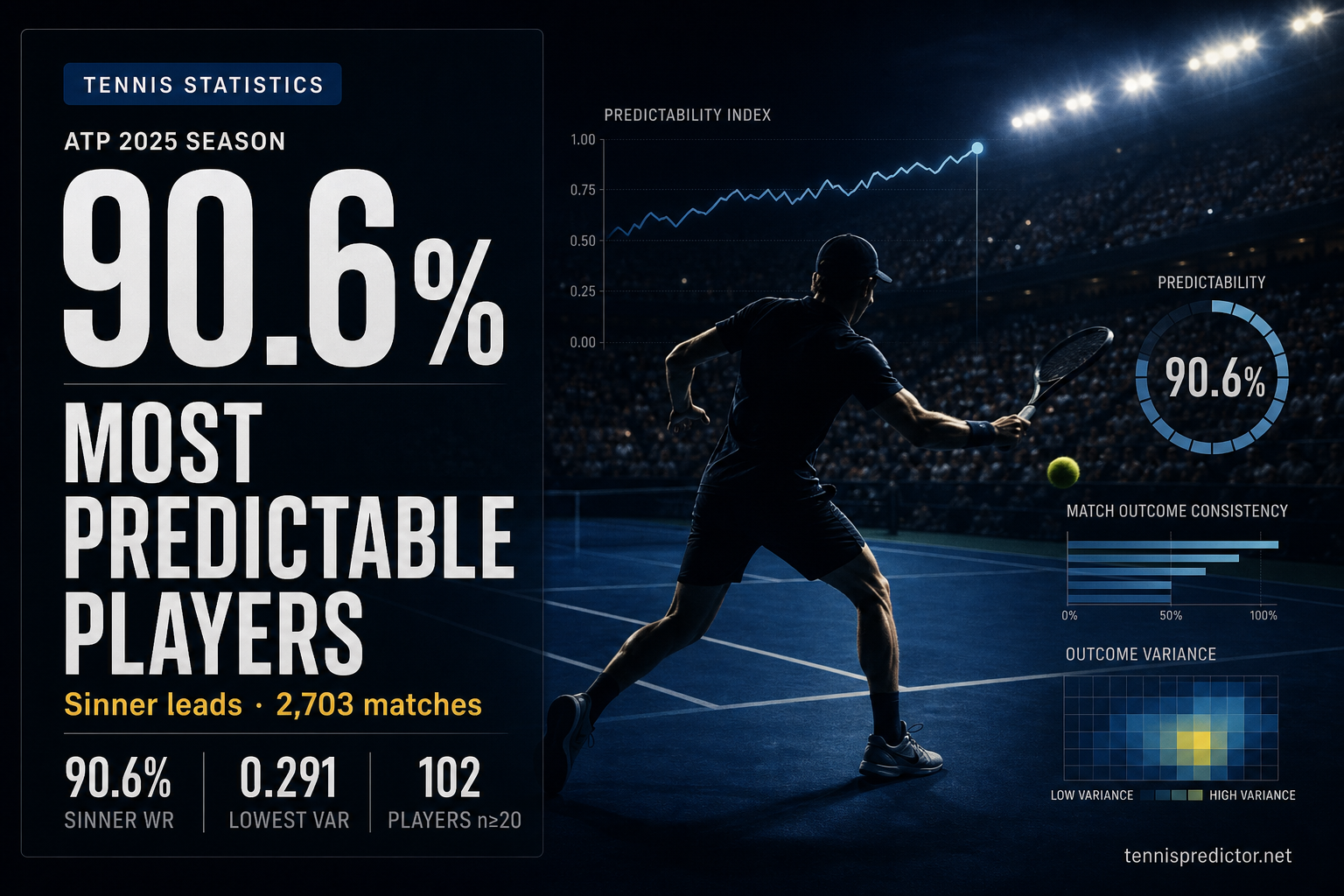
Not all ATP players are equally reliable as favourites. Some deliver expected results match after match. Others sit near a 50% win rate with maximum outcome noise — coin flips that look like value until they are not.
We scored every ATP main-draw match from the 2025 calendar season in our tournament cache: 2,703 matches, 102 players with at least 20 matches. The ranking below uses the same consistency definition as our earlier study, applied to a clean single-season window.
What consistency means here
Every match is a win or a loss. From a player’s season win rate, we can measure how “noisy” those results are — call that variance in this article.
Plain English:
- A player who wins ~90% of the time rarely surprises you. Most matches go the expected way → low variance (around 0.25–0.30).
- A player who wins ~50% of the time is a coin flip. Anything can happen → maximum variance (0.500).
- So variance here is not a fancy “mood” score. It is how unpredictable a binary win/loss record is at that win rate.
Consistency score = win rate / (variance + 0.1).
High win rate + low variance → ultra-predictable favourite. Mid-50s win rate + 0.500 variance → avoid as a “safe” chalk play.
(For the stats-curious: variance = (\sqrt{p(1-p)}) where (p) is the win rate.)
The 2025 scatter
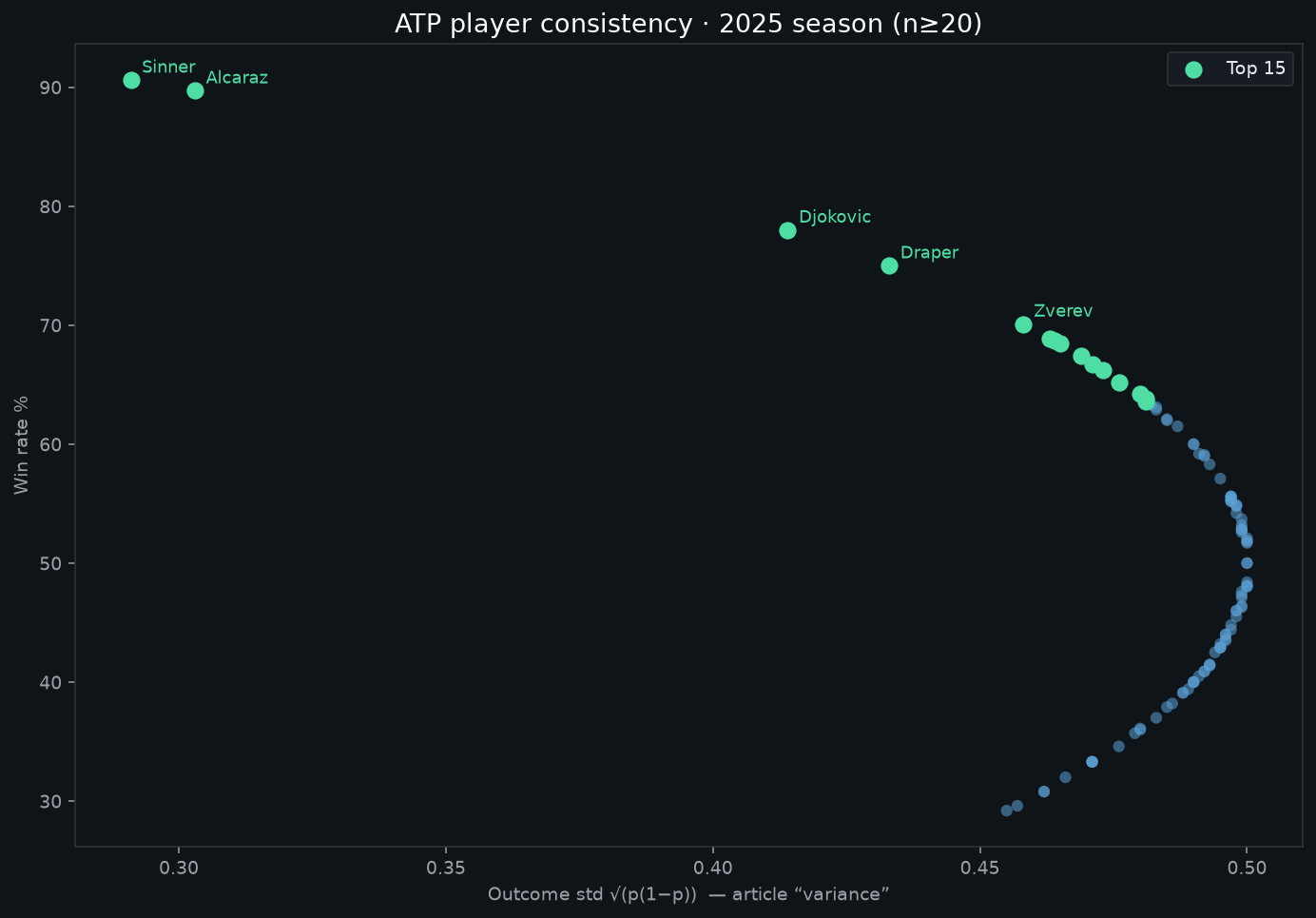 102 ATP players with ≥20 main-draw matches in 2025. Top-left = high win rate, low variance. Green = top-15 consistency scores.
Sinner and Alcaraz separate from the pack. Everyone else compresses into a diagonal band where win rate and variance move together — which is exactly what you expect when “noise” is tied to the win rate itself.
Top 15 most predictable players (2025)
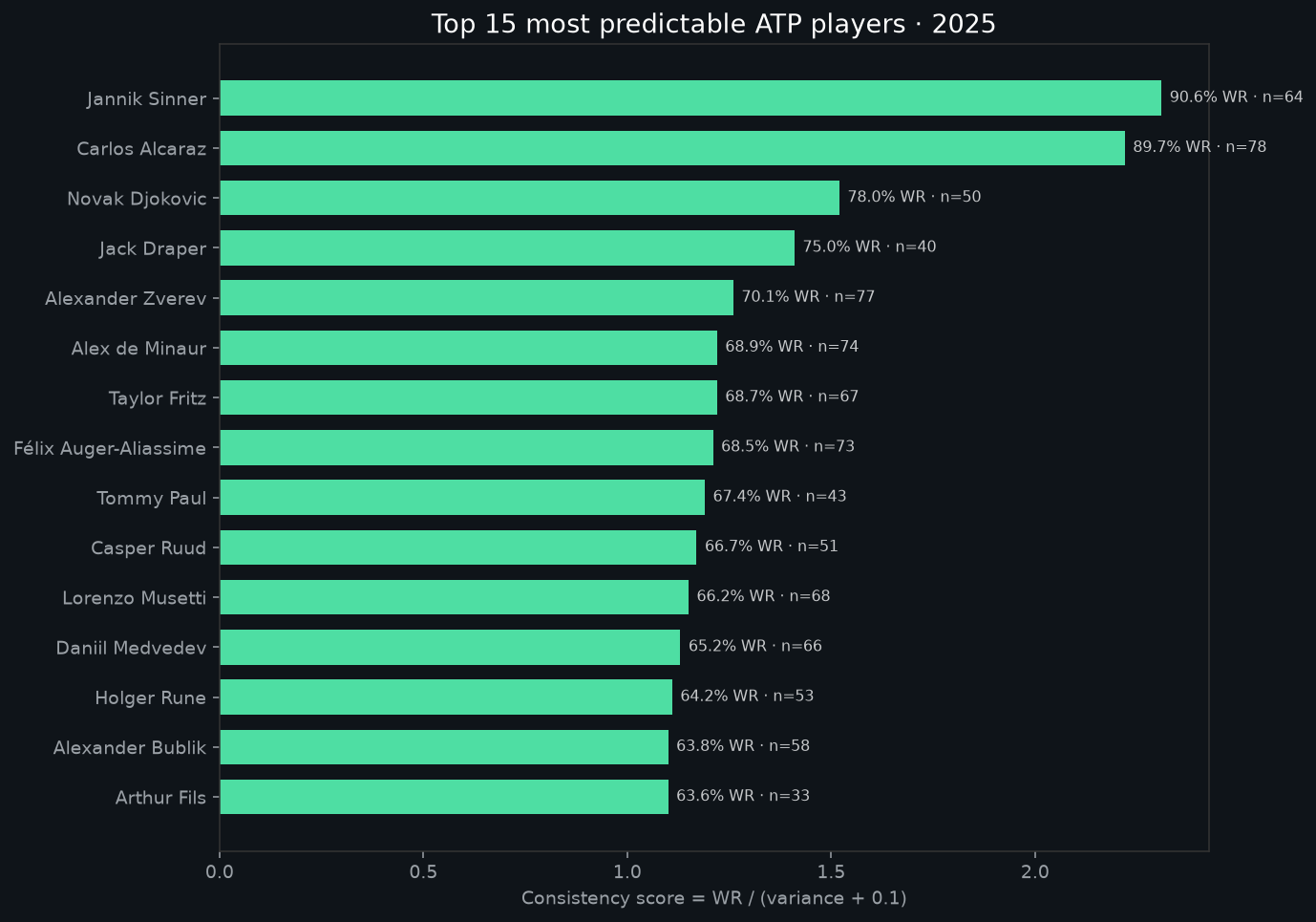 Ranked by consistency score = WR / (variance + 0.1). Source: 2,703 ATP matches, 2025 season.
| Rank | Player | Win rate | Variance | Matches | Tier |
|---|---|---|---|---|---|
| 1 | Jannik Sinner | 90.6% | 0.291 | 64 | Ultra-predictable |
| 2 | Carlos Alcaraz | 89.7% | 0.303 | 78 | Ultra-predictable |
| 3 | Novak Djokovic | 78.0% | 0.414 | 50 | Highly predictable |
| 4 | Jack Draper | 75.0% | 0.433 | 40 | Highly predictable |
| 5 | Alexander Zverev | 70.1% | 0.458 | 77 | Highly predictable |
| 6 | Alex de Minaur | 68.9% | 0.463 | 74 | Highly predictable |
| 7 | Taylor Fritz | 68.7% | 0.464 | 67 | Highly predictable |
| 8 | Félix Auger-Aliassime | 68.5% | 0.465 | 73 | Highly predictable |
| 9 | Tommy Paul | 67.4% | 0.469 | 43 | Highly predictable |
| 10 | Casper Ruud | 66.7% | 0.471 | 51 | Highly predictable |
| 11 | Lorenzo Musetti | 66.2% | 0.473 | 68 | Moderately predictable |
| 12 | Daniil Medvedev | 65.2% | 0.476 | 66 | Moderately predictable |
| 13 | Holger Rune | 64.2% | 0.480 | 53 | Moderately predictable |
| 14 | Alexander Bublik | 63.8% | 0.481 | 58 | Moderately predictable |
| 15 | Arthur Fils | 63.6% | 0.481 | 33 | Moderately predictable |
Notes on the leaders
- Sinner and Alcaraz are the only ultra-predictable pair: both above 89% with variance near 0.30.
- Djokovic remains Tier-1 reliable at 78.0% despite a smaller 50-match sample.
- Draper jumps into the top five on a strong 75.0% season (40 matches) — treat the sample as solid but not Slam-length.
- FAA enters the top eight after a breakout year; the consistency score finally matches the ranking climb.
Least predictable: the 50% trap
Among players with ≥25 matches, these sat closest to a coin flip (variance ≈ 0.500):
- Fabian Marozsan — 50.0% (50 matches)
- Arthur Cazaux — 50.0% (32)
- Hamad Medjedovic — 48.4% (31)
- Nuno Borges — 51.7% (58)
- Luciano Darderi — 51.8% (56)
- Kamil Majchrzak — 51.9% (27)
- Laslo Djere — 48.1% (27)
- Arthur Rinderknech — 48.1% (54)
- Alex Michelsen — 48.0% (50)
- Reilly Opelka — 52.1% (48)
A 50% win rate at maximum variance means ranking gaps and “form stories” explain less than they feel like they should. Our models often disagree on these names for a reason.
How to use this in betting
For Tier 1–2 favourites (top ~10):
- Prefer them when they are clear favourites against lower-ranked opponents
- Size stakes larger when surface also matches their profile
- Do not confuse “predictable” with “always overlays” — short odds still need edge
For near-50% players:
- Avoid treating them as safe chalk
- Look for model disagreement + large price edges, not narrative confidence
- Fade blind accumulator legs built on “hot streak” stories
Nationality context: country-level reliability is a separate signal — see The nationality factor.
FAQ
What does “predictable” mean in this study?
A player who wins a high share of matches and whose results do not behave like a coin flip. We combine those ideas into consistency score = win rate / (variance + 0.1).
Who were the three safest favourites in 2025?
Jannik Sinner (90.6%, 0.291), Carlos Alcaraz (89.7%, 0.303), and Novak Djokovic (78.0%, 0.414), among players with ≥20 ATP main-draw matches.
Why not include 2026 matches?
This article is a closed 2025 snapshot so year-labelled rankings stay comparable. For who is reliable right now, see the mid-season Most predictable players of 2026 so far (YTD through 29 Aug).
How many matches did you analyse?
2,703 ATP main-draw matches from the 2025 tournament cache (through the end of the 2025 season in our data). Rankings use players with ≥20 matches (102 players).
Data: ATP tournament cache, 2025 season. Metric: win-rate noise (“variance”) and consistency = WR / (variance + 0.1). Analytics only — not betting advice.
See today's match predictions with confidence scores and value signals.
View Live Predictionsarrow_forwardRelated Articles
The most predictable tennis players of 2026 so far
Mid-season snapshot of ATP consistency in 2026: 93 players with 20+ matches through 29 August. Sinner sits alone at 93.6%; Alcaraz is second on a thinner 26-match sample. This is year-to-date — not a finished season.
September 4, 2026 · 10 min read

The nationality factor: which countries produce the most reliable players?
With the full 2022–2026 tournament cache, nationality still predicts reliability — but the leaderboard moved. China, Czechia and Argentina top consistency; Germany and Canada sit at the high-variance end.
September 3, 2026 · 11 min read
Tiebreak mastery: who wins when it matters most?
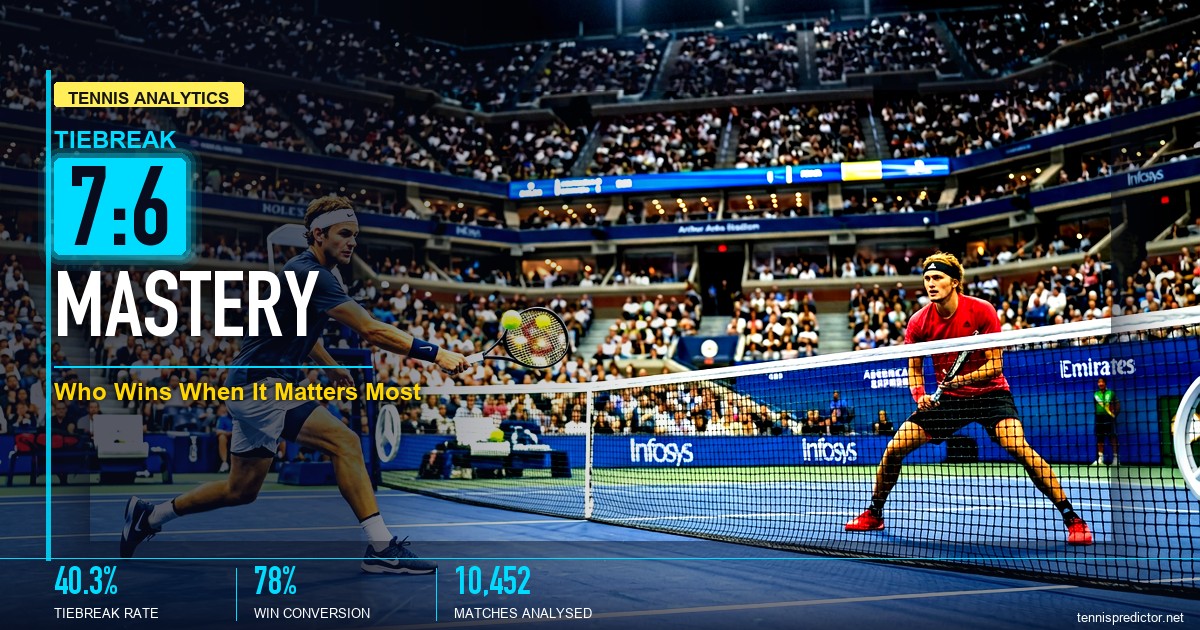
40.3% of professional matches feature a tiebreak — but that hides enormous variation. June grass-season matches hit 47.9%; April clay hits 33.7%. Sinner wins 79% of hard-court tiebreaks but only 46% on clay. And some players recover from a lost set-1 tiebreak 64% of the time, others just 7%.
April 10, 2026 · 18 min read
Quentin Halys: Clay specialist edge (59.4%) vs Indoors at 23.5%
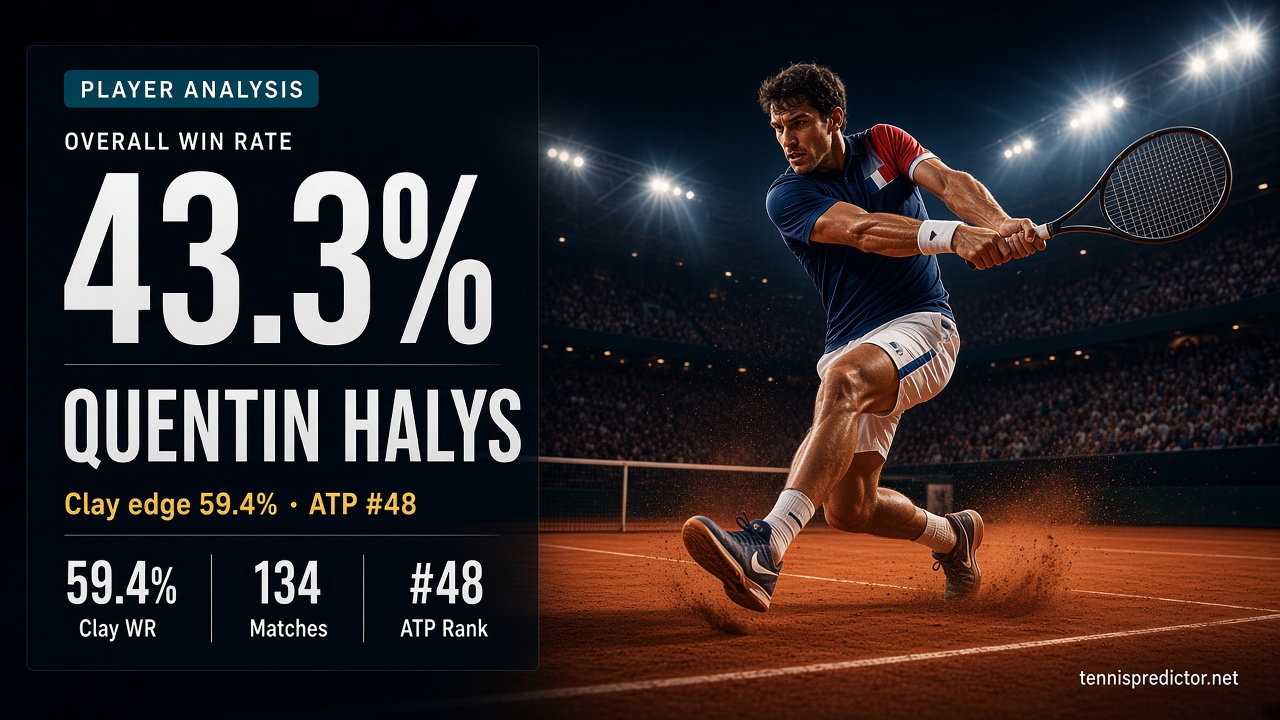
Quentin Halys has played 134 ATP main-draw matches from 2022–2026 at a 43.3% overall win rate. The data story: Clay specialist edge (59.4%) vs Indoors at 23.5%.
October 17, 2026 · 11 min read