Luciano Darderi ATP Analysis: Argentina's Clay Surgeon with a Hard Court Blind Spot
Data note: Darderi's dataset covers 93 matches primarily from 2024–2025. Statistical confidence intervals are wider than for players with 150+ matches. Trends are genuine but should be interpreted with appropriate caution.
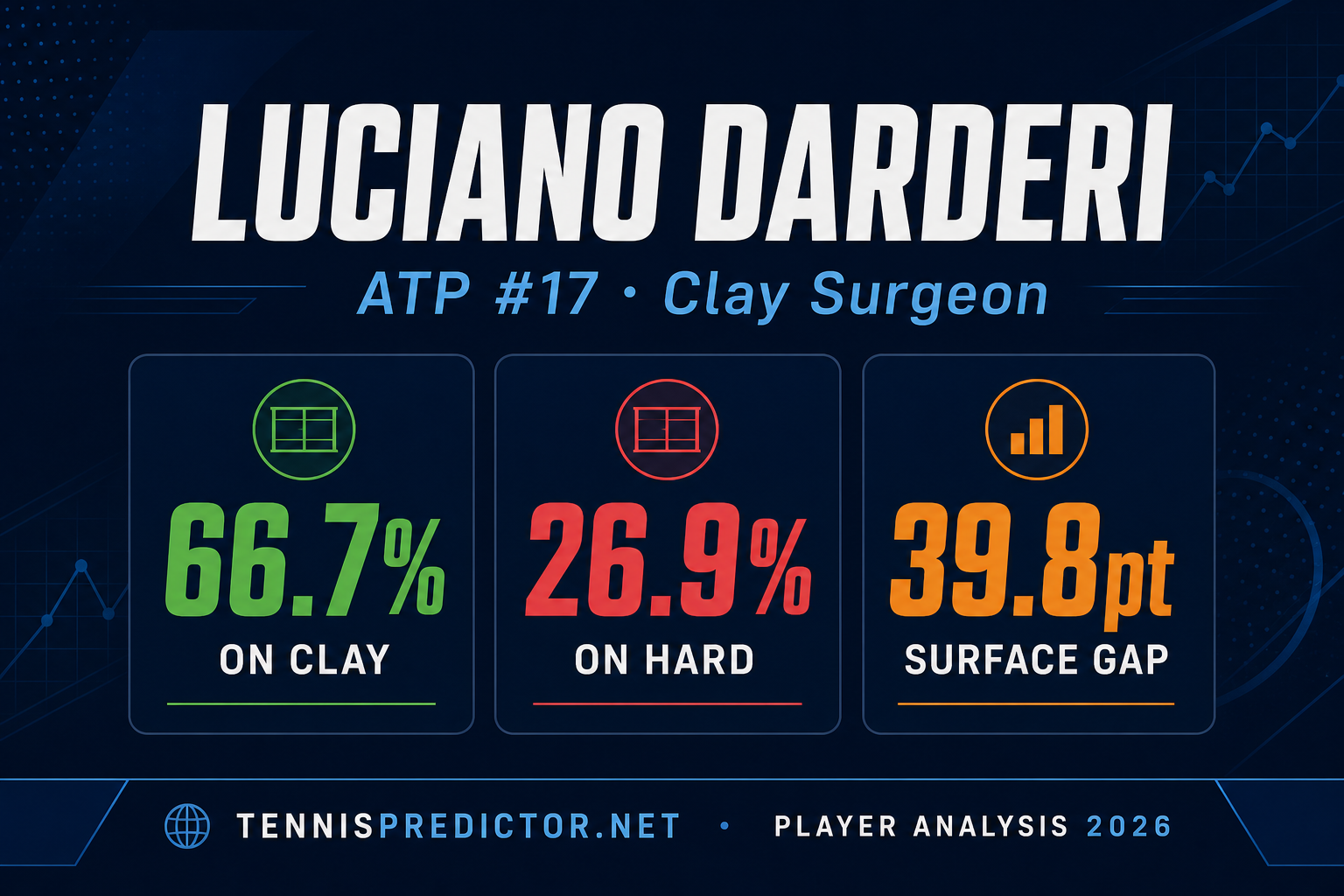
Luciano Darderi is the most extreme surface specialist in the current ATP top 20. The Italian-Argentine's 66.7% clay win rate stands alongside his 26.9% hard court rate — a 39.8 percentage point gap that is almost unprecedented at this ranking level. This is not a player the model can treat as a generic top-20 entity. He is, analytically speaking, two different players depending on the surface under his feet.
Key Metrics at a Glance
| Metric | Value |
|---|---|
| Overall Win Rate (OWR) | 48.4% |
| Matches in dataset | 93 (2023–2025) |
| Best surface | Clay — 66.7% |
| Worst surface | Hard — 26.9% |
| As favourite | 25 matches — 64.0% win rate |
| As underdog | 40 matches — 35.0% win rate |
| Current ATP ranking | #17 (June 2026) |
Year-by-Year Progression
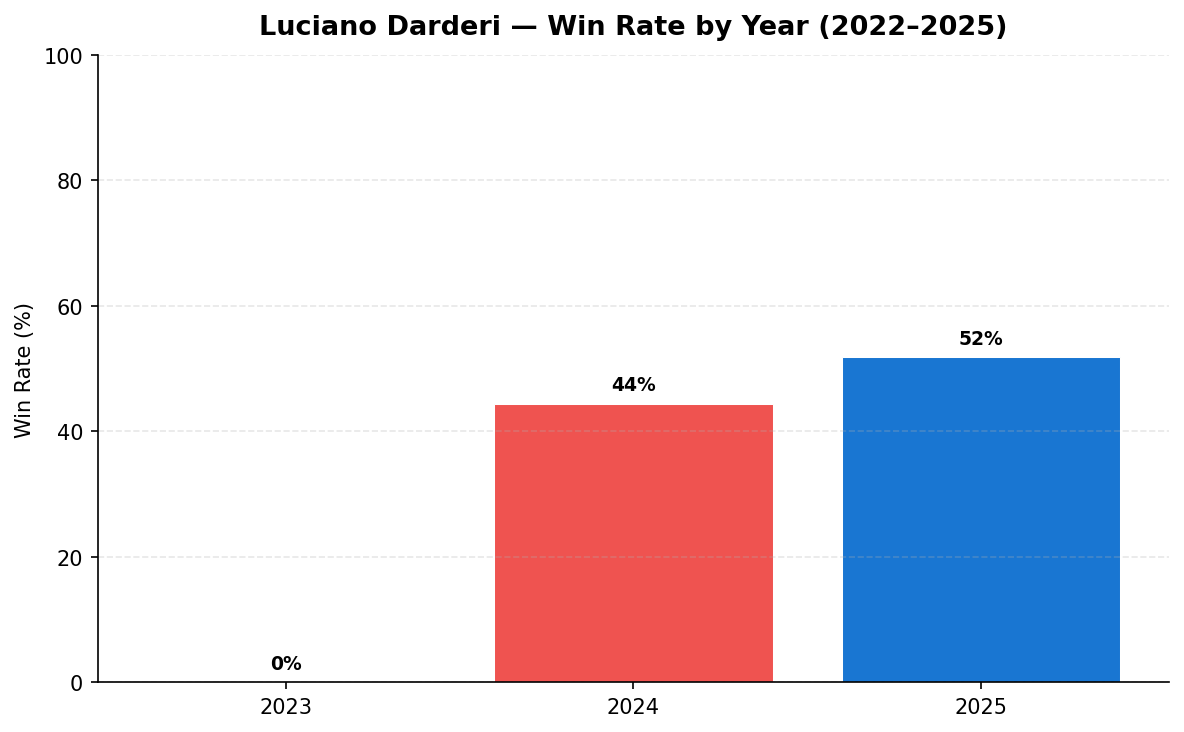
| Year | Matches | Win Rate |
|---|---|---|
| 2023 | 1 | 0.0% |
| 2024 | 36 | 44.4% |
| 2025 | 56 | 51.8% |
Reading the limited data window:
Darderi's meaningful dataset begins in 2024. The single 2023 match is statistically irrelevant. His 44.4% debut season is below average for a new top-100 player, but the surface composition of that season matters: a significant proportion of his 2024 matches came on hard courts where his weaknesses were most exposed.
2025's improvement to 51.8% reflects more clay scheduling (where his win rate is dominant) and continued development. The model expects further improvement as his clay-heavy months accumulate more data.
Important caveat: At 93 total matches, Darderi's year-by-year numbers have wide confidence intervals. Do not over-index on single-season figures.
Surface Analysis
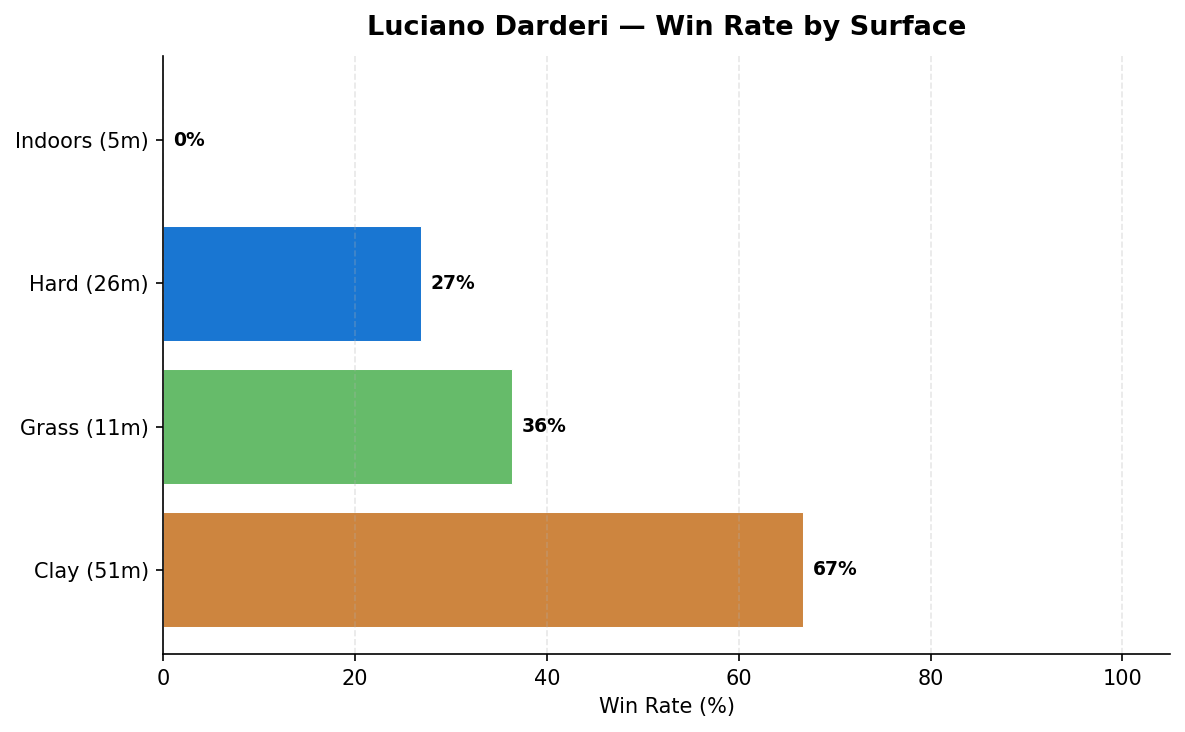
| Surface | Matches | Win Rate |
|---|---|---|
| Clay | 51 | 66.7% |
| Grass | 11 | 36.4% |
| Hard | 26 | 26.9% |
| Indoors | 5 | 0.0% |
This is the defining data point in Darderi's entire profile.
The 39.8 percentage point gap between clay (66.7%) and hard (26.9%) is the largest surface differential of any current top-20 player in the dataset. No other player in the top 20 wins less than 30% of hard court matches.
Clay dominance is genuine:
51 clay matches at 66.7% is a large enough sample to be highly reliable. Darderi on clay operates at an elite level — comparable to players ranked 5–10 positions above him in the overall rankings.
Hard courts represent a structural problem:
26.9% from 26 matches is not bad luck. It reflects fundamental limitations: Darderi's reliance on heavy topspin, clay-court positioning, and attrition-style play becomes a liability on hard courts where opponents can hit through him and attack his second serve more effectively.
Indoors: 0% from 5 matches — too small to be conclusive, but directionally alarming.
Grass at 36.4% from 11 matches is somewhat expected — he does not have the serve or net game to adapt easily to grass.
Round-by-Round Breakdown
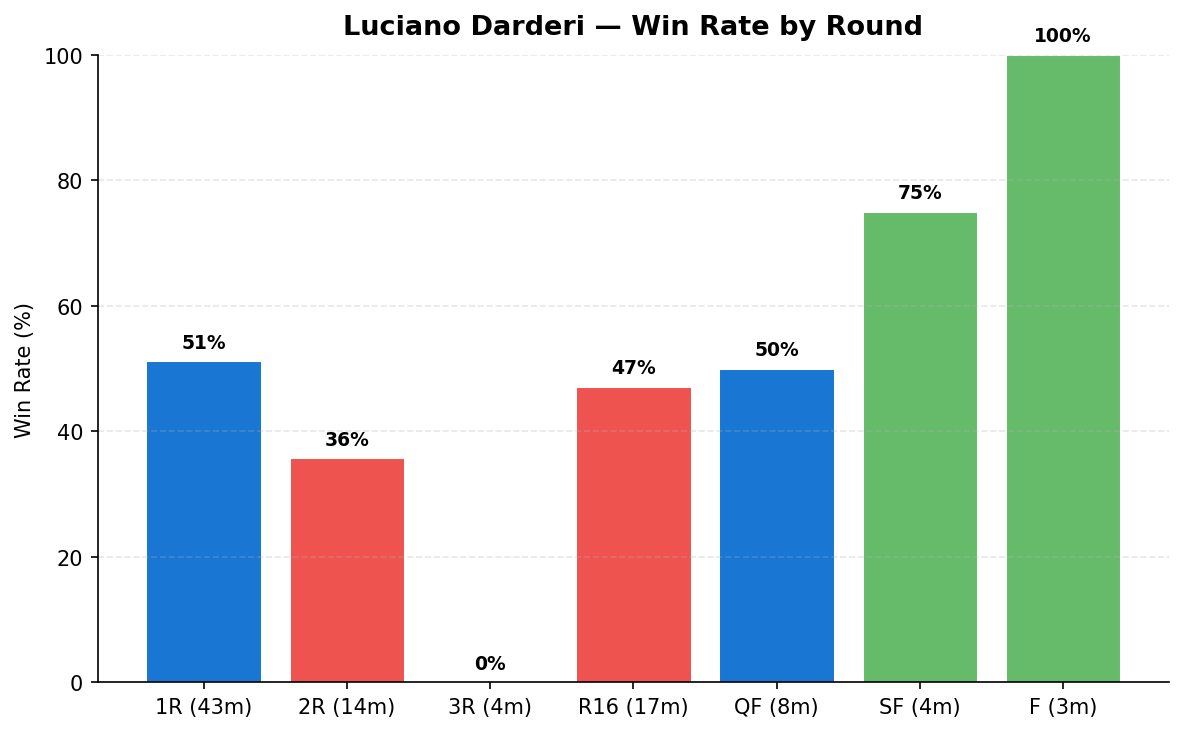
| Round | Matches | Win Rate |
|---|---|---|
| 1R | 43 | 51.2% |
| 2R | 14 | 35.7% |
| 3R | 4 | 0.0% |
| R16 | 17 | 47.1% |
| QF | 8 | 50.0% |
| SF | 4 | 75.0% |
| F | 3 | 100% |
The Finals perfection:
3 finals, 3 wins — 100% final win rate. All three finals came on clay, which massively inflates this figure. Do not treat it as a generalised clutch-performance indicator; treat it as a "Darderi is nearly unbeatable in ATP 250 clay court finals" signal.
The second-round drop:
35.7% in R2 is concerning and slightly counterintuitive. It reflects tournament composition: many of Darderi's second-round opponents on hard courts have been ranked 30–80, a tier where his hard court weaknesses are most exposed.
Third round 0% from 4 matches:
Again, surface-contaminated by hard court matches. A sample of 4 is too small for firm conclusions but consistent with the overall hard court weakness pattern.
H2H vs Elite Rivals
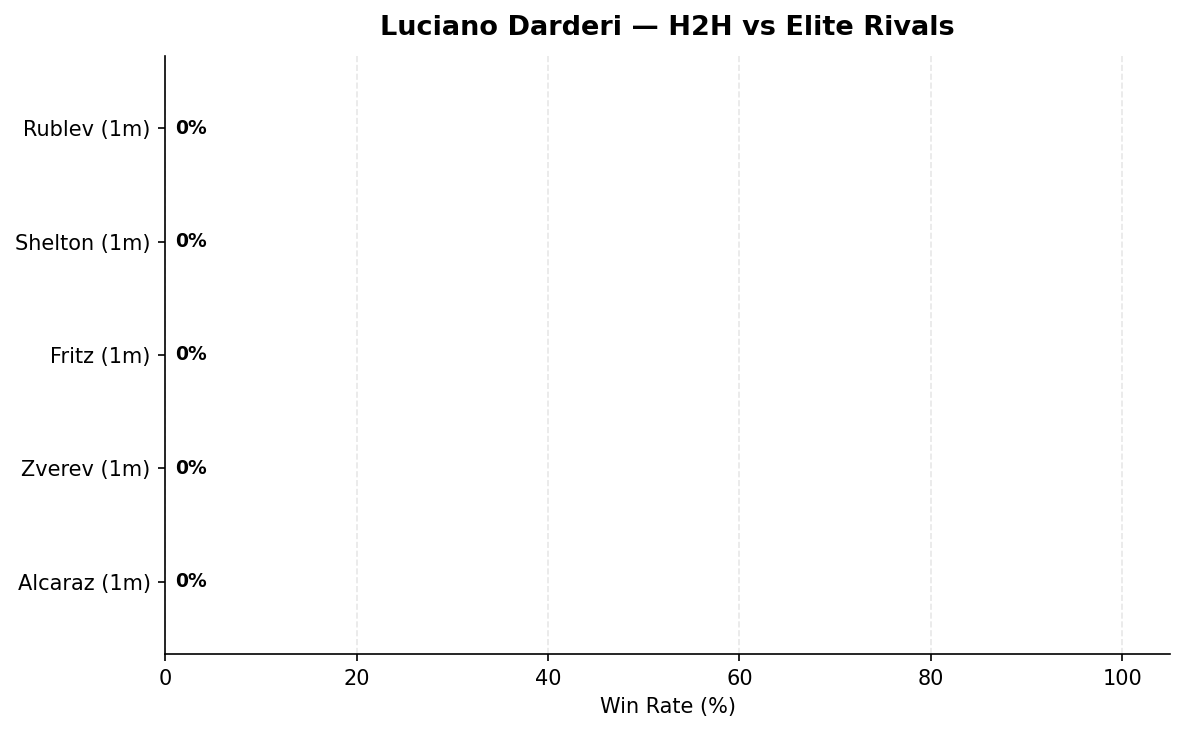
| Rival | Matches | Darderi W-L | Win Rate |
|---|---|---|---|
| Alcaraz | 1 | 0-1 | 0.0% |
| Zverev | 1 | 0-1 | 0.0% |
| Fritz | 1 | 0-1 | 0.0% |
| Shelton | 1 | 0-1 | 0.0% |
| Rublev | 1 | 0-1 | 0.0% |
H2H context is limited:
With only one match against each of the tracked elite players (all losses), there is insufficient data to draw conclusions about head-to-head dynamics. The model applies a generic elite-opponent discount rather than player-specific adjustments for Darderi.
Surface of these losses matters: Multiple of these encounters occurred on hard courts or indoors — precisely the conditions where Darderi is most vulnerable. A meeting on clay could produce very different results, particularly against players who are not clay specialists.
Favourite vs Underdog Split
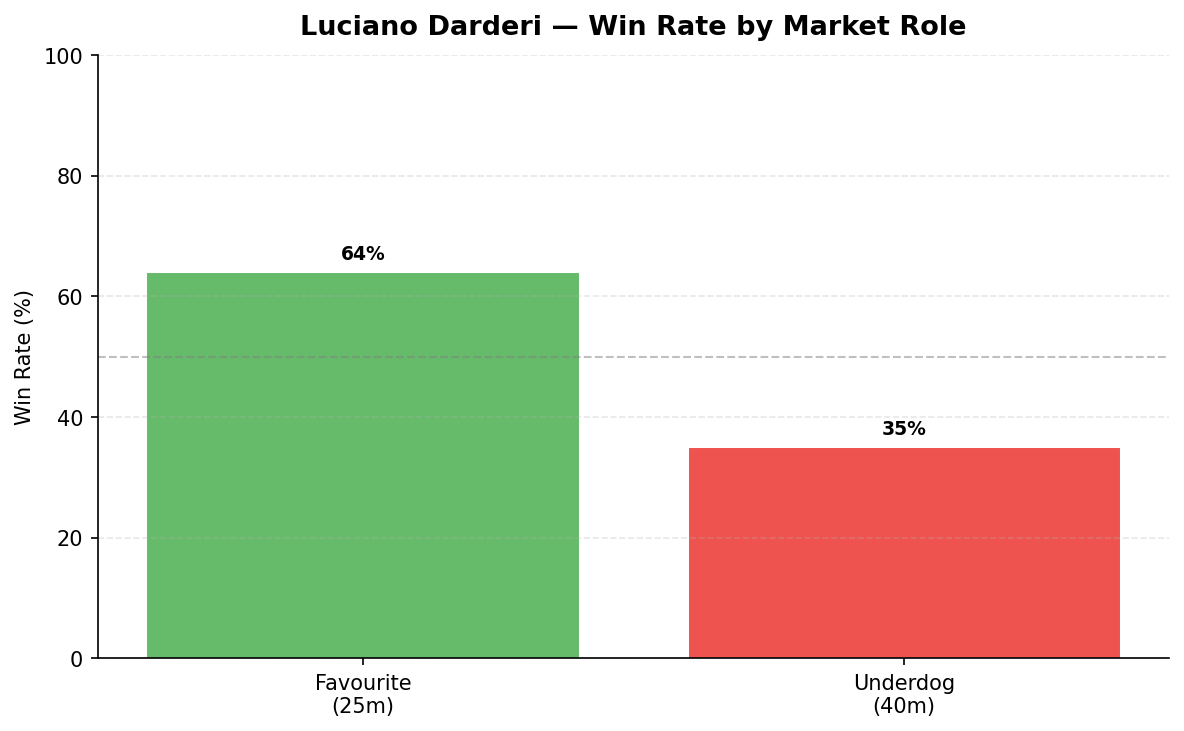
| Role | Matches | Win Rate |
|---|---|---|
| Favourite | 25 | 64.0% |
| Underdog | 40 | 35.0% |
The 64.0% favourite win rate is strong — when the market prices Darderi as the better player, he typically delivers. The 35.0% underdog rate is low but understandable given that most of his underdog appearances come on hard courts or against significantly higher-ranked opponents.
The favourite signal is most reliable on clay. The model distinguishes between Darderi-as-favourite on clay (high confidence) and Darderi-as-favourite on hard (treat with scepticism despite the overall 64.0% rate).
How the Model Treats Darderi
The prediction engine applies the most extreme surface bifurcation of any top-20 player to Darderi:
- Clay events: Treated as a genuine top-10 level threat. Probability significantly above his ranking suggests
- Hard/Grass/Indoors: Sharp downward adjustment. Treated as a top-40 equivalent on these surfaces
- Elite opponents on clay: Moderate uplift vs generic opponent discount
- Finals on clay: Strong favourite regardless of opponent ranking
Betting Insights
Back Darderi when:
- Clay court events of any size (Roland Garros, Monte Carlo, Rome, Barcelona, Buenos Aires, Houston, Marrakech)
- He is favourite on clay — 64.0% overall, likely higher on clay specifically
- Opponent is a hard/grass specialist mismatched on clay
- ATP 250 clay finals — 100% finals record (3/3) on clay
Fade Darderi when:
- Any hard court event (26.9% win rate — structural weakness)
- Indoors events
- Grass events unless draw opens exceptionally
- Draw forces him through hard court specialists in early rounds
FAQs
Is the 66.7% clay win rate sustainable or a small-sample artifact? 51 matches on clay is a meaningful sample, especially given the consistency across 2024 and 2025. The rate is genuine. Players with similar clay profiles (heavy topspin, baseline-first, exceptional court coverage) typically sustain high clay win rates across their careers.
Why is Darderi so much better on clay? His game is structured for clay: he uses high-margin, high-topspin patterns that allow him to construct points over many exchanges. His movement on clay is exceptional. On hard courts, his topspin generates less height, opponents can attack earlier, and his serve — not a weapon — gets exploited more.
How should the model's wide confidence intervals affect betting decisions? For Darderi more than most players, wait for clear-cut situations: clay events where he is favourite represent high-confidence picks. Hard court and mixed-draw scenarios are too uncertain to bet confidently.
Conclusion
Luciano Darderi is the ATP tour's most extreme surface dichotomy. On clay, he operates at a level that justifies his top-20 ranking and then some — a 66.7% win rate over 51 matches is elite. On hard courts, he is statistically one of the weakest players in the top 20. The model has fully absorbed this split, treating him as a different entity depending on the surface. For bettors, the strategy is simple: follow Darderi on clay, avoid him on hard. His 2026 performance at Roland Garros will be the most revealing data point yet.
See today's match predictions with confidence scores and value signals.
View Live Predictionsarrow_forwardRelated Articles
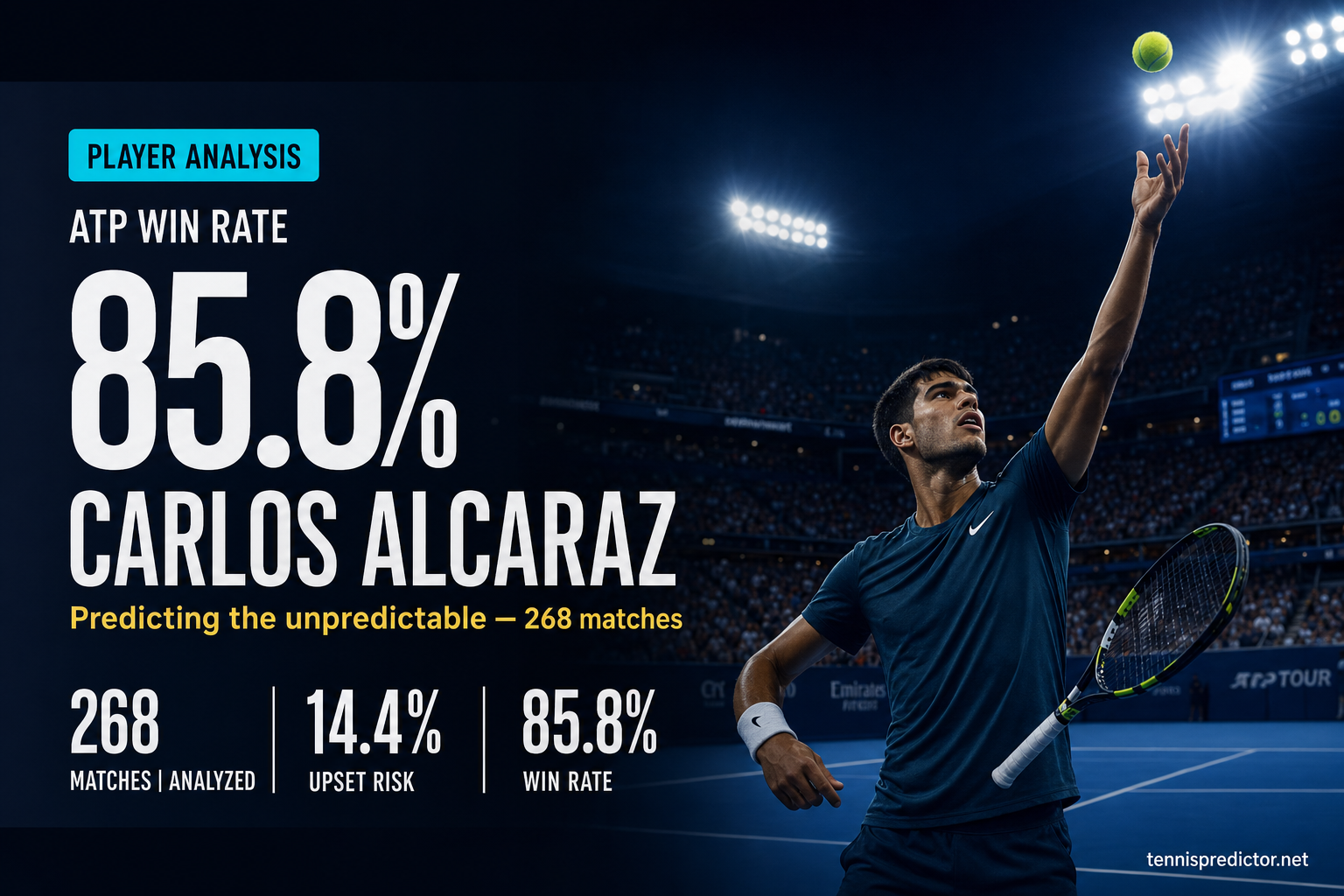
Carlos Alcaraz ATP analysis: predicting the unpredictable
Carlos Alcaraz has played 298 ATP main-draw matches from 2022–2026 at a 85.9% win rate. Data story: elite win rate with real favourite-upset risk that markets compress.
September 8, 2026 · 14 min read
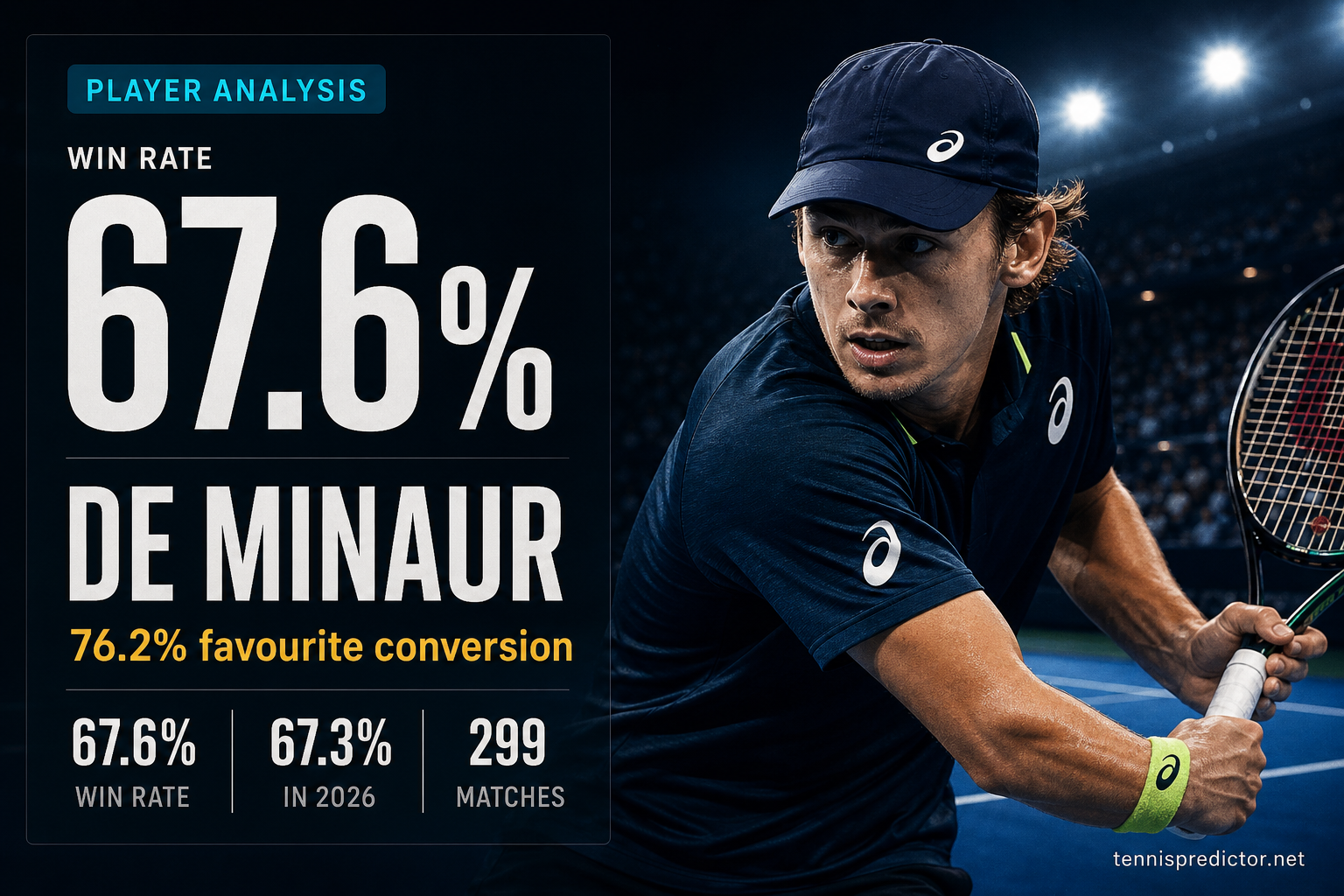
Alex de Minaur ATP analysis: top-20 profile and betting read
Alex de Minaur has played 299 ATP main-draw matches from 2022–2026 at a 67.6% win rate. Data story: favourite conversion at 76.2% (23.8% upset risk).
September 8, 2026 · 12 min read
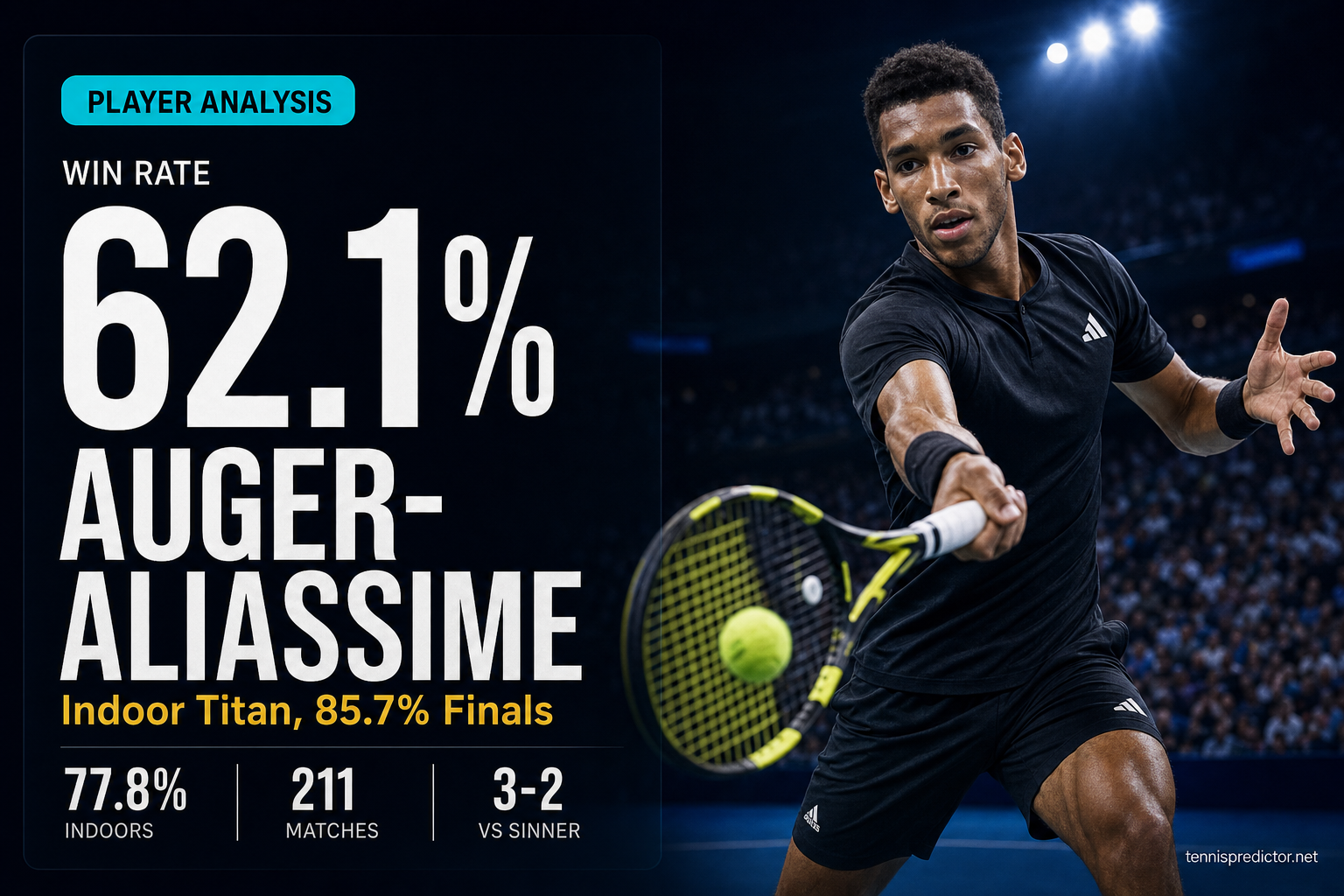
Felix Auger-Aliassime ATP analysis: top-20 profile and betting read
Felix Auger-Aliassime has played 278 ATP main-draw matches from 2022–2026 at a 63.7% win rate. Data story: Indoors edge (78.9%) vs Grass at 54.5%.
September 8, 2026 · 12 min read
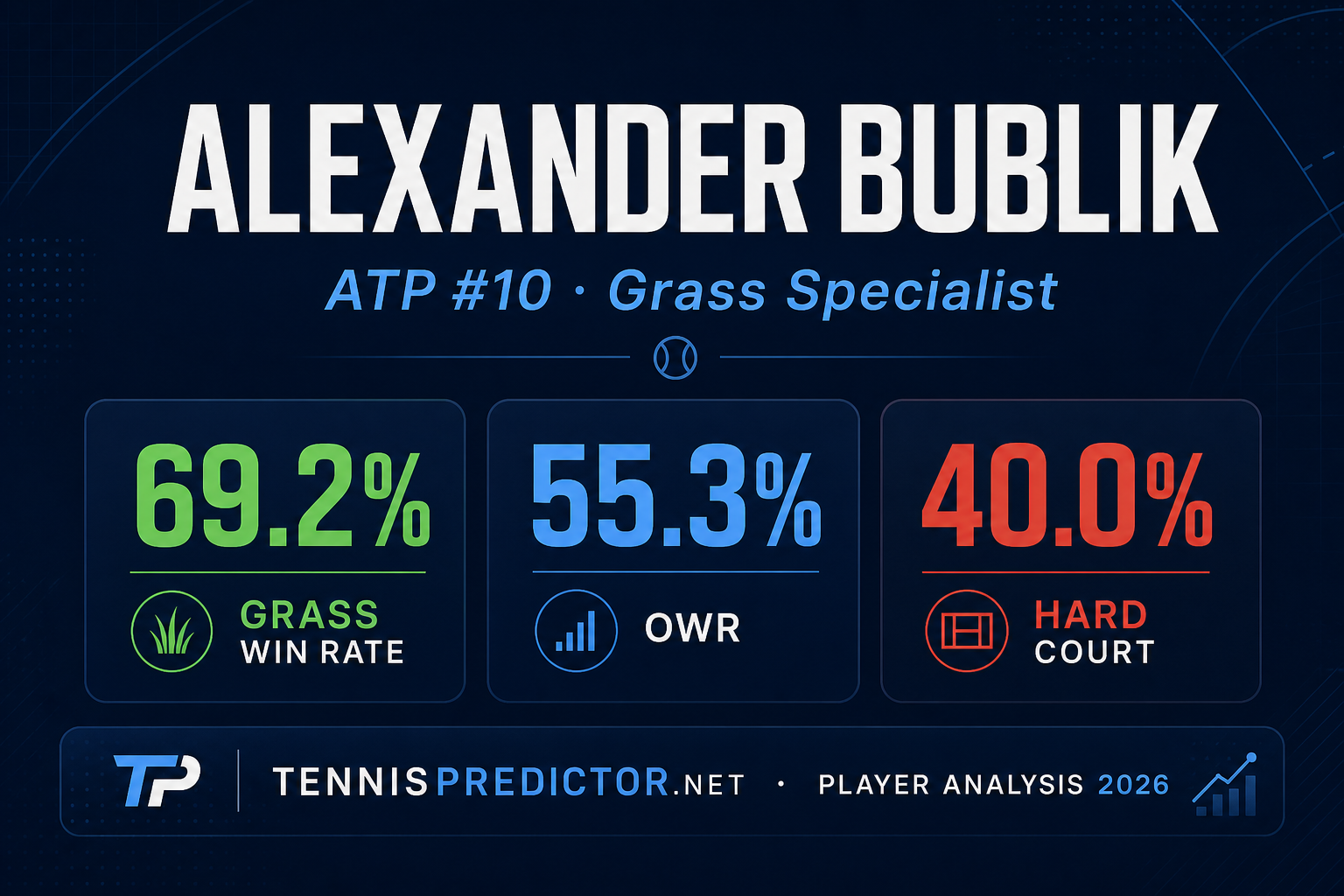
Alexander Bublik ATP analysis: top-20 profile and betting read
Alexander Bublik has played 238 ATP main-draw matches from 2022–2026 at a 56.3% win rate. Data story: Grass edge (68.0%) vs Hard at 46.1%.
September 8, 2026 · 12 min read