Alejandro Tabilo: Clay specialist edge (56.6%) vs Indoors at 40.0%
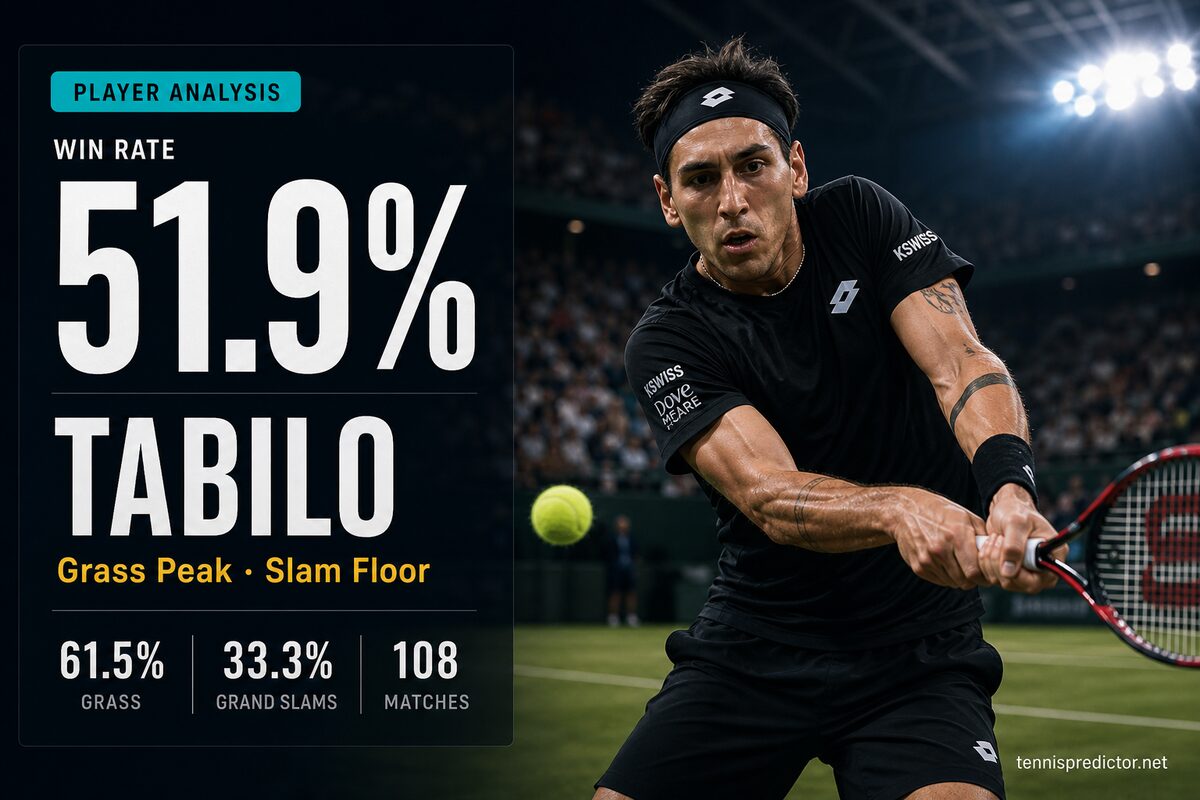
Alejandro Tabilo ranks #30 in the ATP (October 2026 snapshot) and has played 157 ATP main-draw matches in our database from 2022–2026. The headline number — 52.9% overall win rate — frames a clear mid-tier profile, but the 55.1% mark in 2026 (49 matches) shows a live uptick. The paradox worth betting on: Clay specialist edge (56.6%) vs Indoors at 40.0%.
Key metrics at a glance
| Metric | Value |
|---|---|
| Overall win rate | 52.9% |
| ATP rank (snapshot) | 30 |
| Matches analysed | 157 (2022–2026) |
| Best surface | Clay — 56.6% |
| Weakest surface | Indoors — 40.0% |
| Grand Slam win rate | 38.1% (8–13) |
| As favourite | 59.6% (n=52) |
| As underdog | 43.1% (n=65) |
Tabilo's year-by-year record
| Year | Matches | Wins | Win rate |
|---|---|---|---|
| 2022 | 27 | 14 | 51.9% |
| 2023 | 6 | 3 | 50.0% |
| 2024 | 46 | 27 | 58.7% |
| 2025 | 29 | 12 | 41.4% |
| 2026 | 49 | 27 | 55.1% |
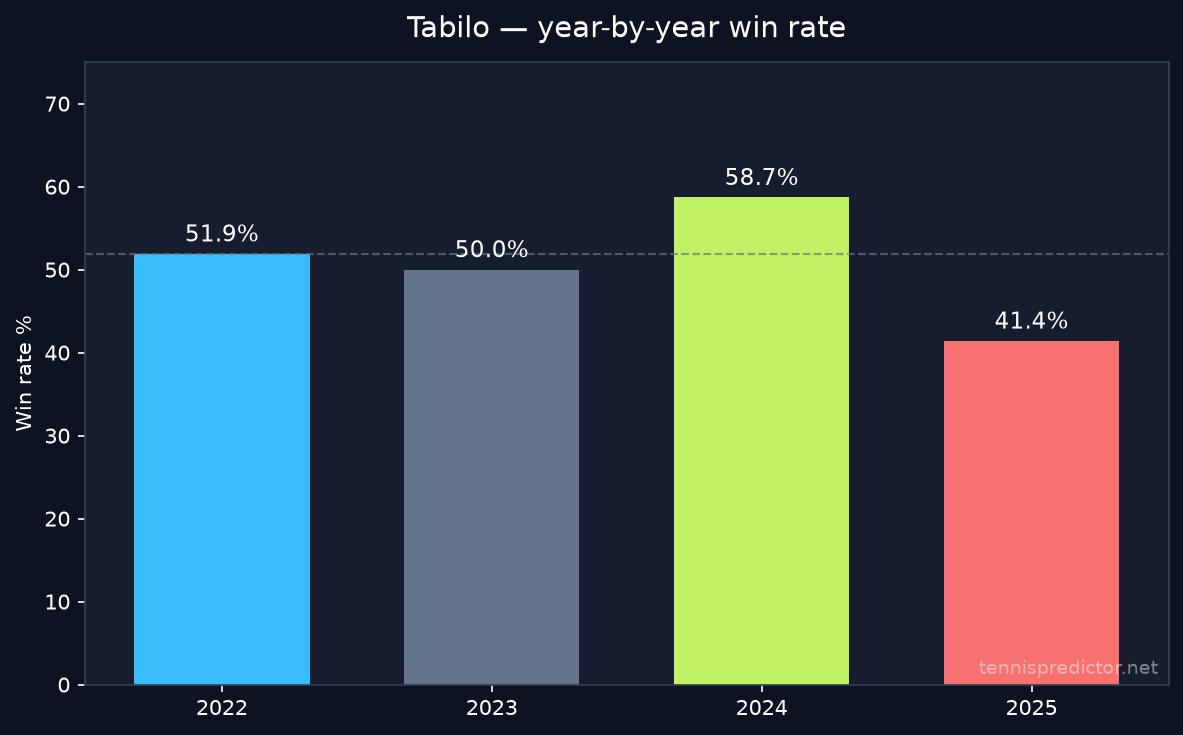
Win rate by season, Alejandro Tabilo, 2022–2026. Source: ATP match data via tennispredictor.net
Year-to-year movement shows where the market should update fastest. The Clay edge vs Indoors floor and the year table are the primary form anchors for live pricing — not a single career average.
Surface breakdown: where the edge lives
| Surface | Matches | Win rate |
|---|---|---|
| Clay | 76 | 56.6% |
| Hard | 60 | 50.0% |
| Grass | 16 | 50.0% |
| Indoors | 5 | 40.0% |
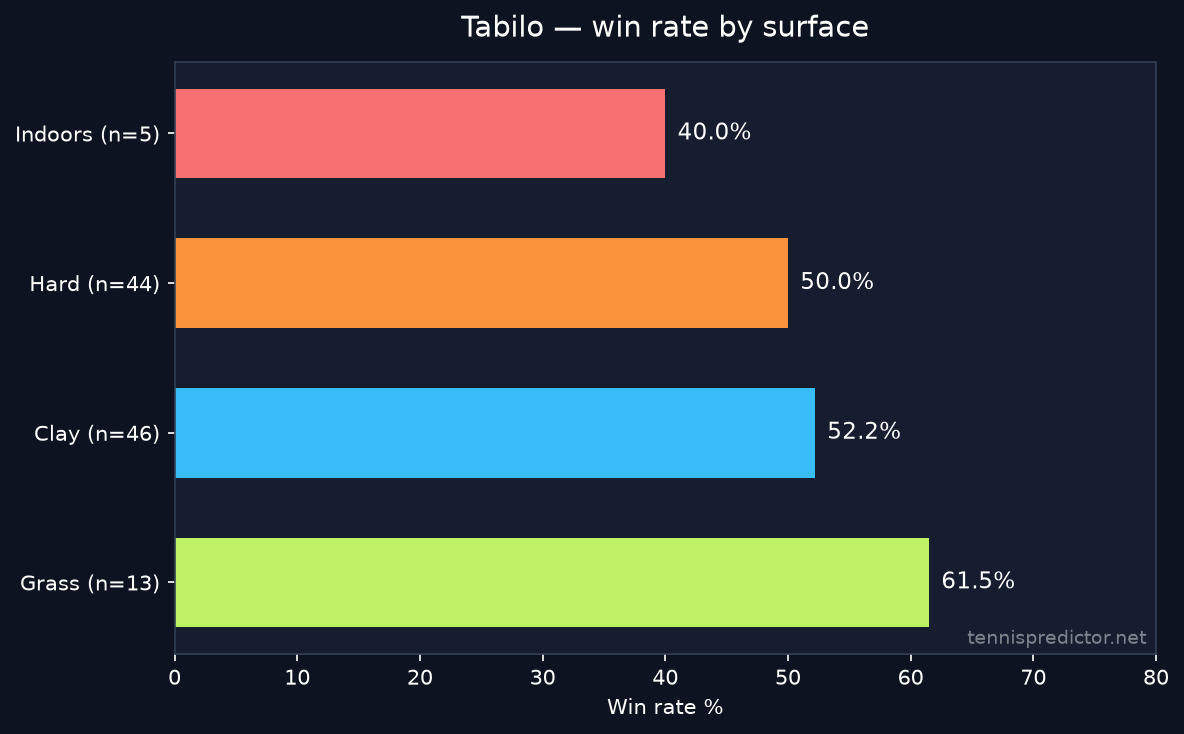
Win rate by surface, Alejandro Tabilo, 2022–2026. Source: ATP match data via tennispredictor.net
Surface is the first filter before round or opponent quality. Compare clay baselines in the clay-court betting guide and grass patterns in the grass-court specificity guide when translating these rates into match previews.
Tournament tier: reliability by event level
| Tournament level | Matches | Win rate |
|---|---|---|
| ATP 500 | 30 | 56.7% |
| ATP 250 | 63 | 55.6% |
| Masters 1000 | 43 | 53.5% |
| Grand Slam | 21 | 38.1% |
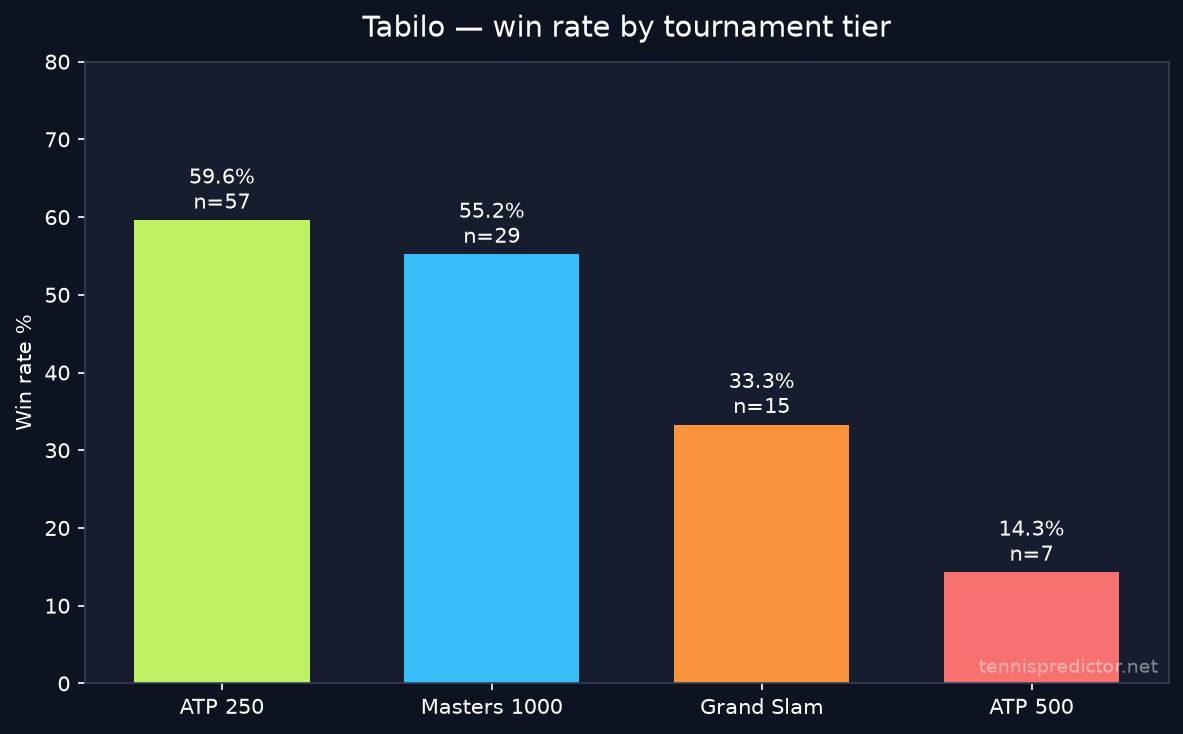
Win rate by tournament tier, Alejandro Tabilo, 2022–2026. Source: ATP match data via tennispredictor.net
Grand Slam and Masters samples matter most for pricing; ATP 250/500 volume often inflates or deflates the headline win rate. Cross-check against Francisco Cerundolo or Jaume Munar for other ranks-21–50 archetypes.
Round-by-round: early rounds vs deep runs
| Round | Matches | Win rate |
|---|---|---|
| R1 | 59 | 55.9% |
| R2 | 24 | 45.8% |
| R3 | 10 | 40.0% |
| R16 | 32 | 46.9% |
| QF | 15 | 73.3% |
| SF | 11 | 54.5% |
| F | 6 | 50.0% |
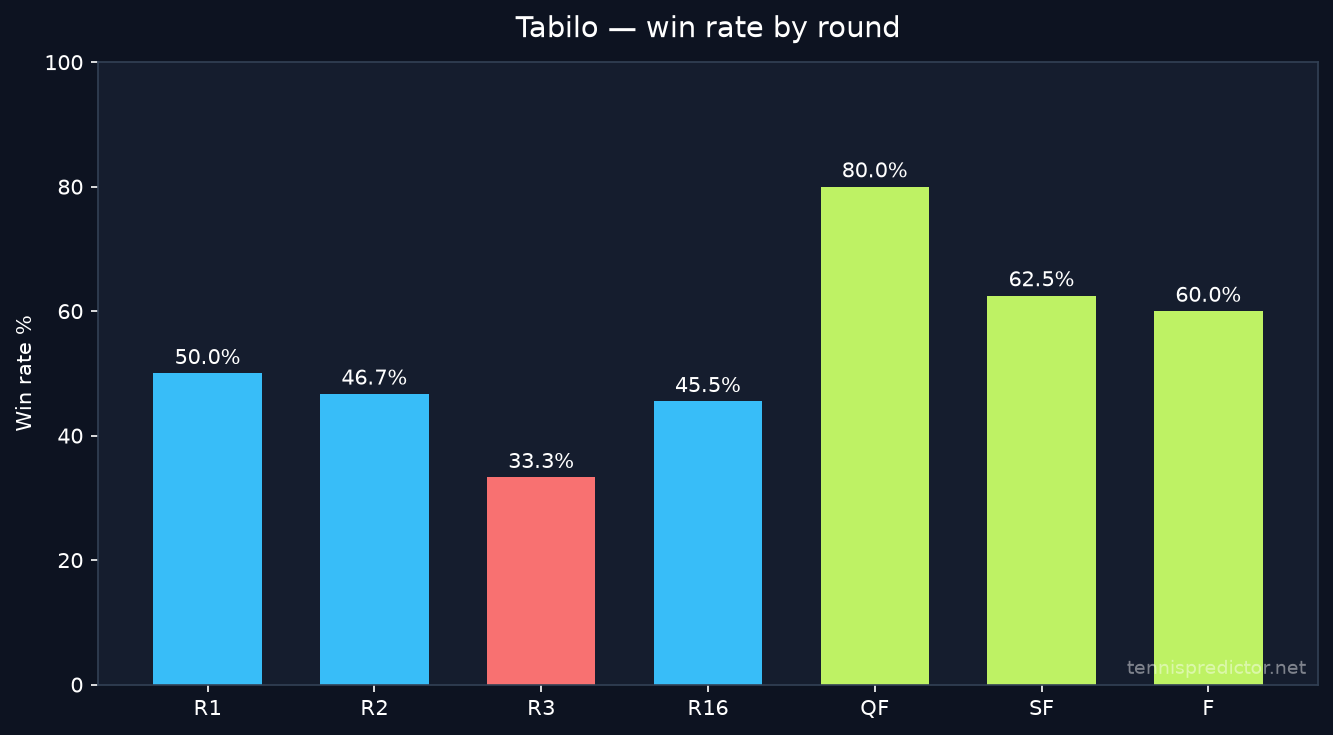
Win rate by round, Alejandro Tabilo, 2022–2026. Source: ATP match data via tennispredictor.net
Round curves separate true closers from early-round specialists. Use the drop from early rounds into deeper stages as a fade signal even when the overall win rate looks acceptable — the same structural idea as Rublev's late-round ceiling.
H2H against elite rivals
| Rival | W–L | Win rate |
|---|---|---|
| Majchrzak | 3–1 | 75.0% |
| Fritz | 0–4 | 0.0% |
| Darderi | 2–2 | 50.0% |
| Baez | 1–2 | 33.3% |
| Djokovic | 2–1 | 66.7% |
Elite H2H is sparse for many mid-ranked players; only rows with multiple meetings are shown. Use these as matchup modifiers, not as a substitute for surface form.
Favourite vs underdog split
| Role | Matches | Win rate |
|---|---|---|
| Favourite | 52 | 59.6% |
| Underdog | 65 | 43.1% |
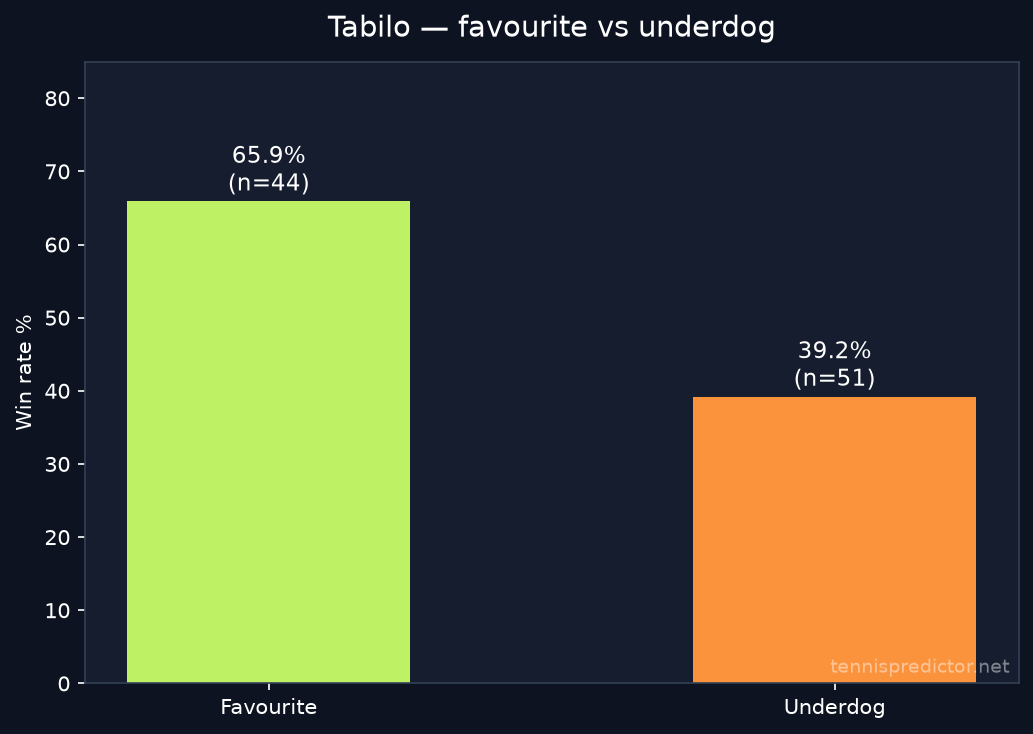
Favourite vs underdog win rate, Alejandro Tabilo, 2022–2026. Source: ATP match odds via tennispredictor.net
What the betting market misses about Alejandro Tabilo
Back Alejandro Tabilo when:
- on clay (56.6% over 76 matches)
- when priced as favourite (59.6% conversion, n=52)
- in first-round spots (55.9% over 59 matches)
- during strong 2026 form (55.1% over 49 matches)
Fade Alejandro Tabilo when:
- on indoors (40.0%)
- in R3 or later (40.0% at R3)
- against top-tier opponents with repeated negative H2H (e.g. Fritz 0–4)
For live slate context, open the predictions dashboard rather than relying on a static profile alone.
How our model treats Alejandro Tabilo
The ensemble weights surface win-rate history, recent form (last 5 / last 10), and tournament-tier context most heavily for a rank-21–50 profile like this. Favourite/underdog conversion is a secondary prior when odds history is dense enough (here: 117 matches with usable prices). Uncertainty rises when the next match is on indoors or in a deep-draw round where Tabilo's historical conversion collapses.
Frequently asked questions
What is Alejandro Tabilo's overall win rate in this study?
52.9% across 157 ATP main-draw matches from 2022–2026.
Which surface shows the highest win rate?
Clay at 56.6% (76 matches).
How often does Alejandro Tabilo win when installed as favourite?
59.6% over 52 favourite-priced matches in the cache (usable odds only).
How does Alejandro Tabilo perform at Grand Slams vs regular events?
Grand Slam win rate is 38.1% (8–13), versus 52.9% overall.
Who is Alejandro Tabilo's toughest matchup in the data?
Among repeated elite meetings: Fritz (0–4).
When is Alejandro Tabilo worth backing or fading based on this data?
Back when on clay (56.6% over 76 matches) / when priced as favourite (59.6% conversion, n=52) / in first-round spots (55.9% over 59 matches). Fade when on indoors (40.0%) / in R3 or later (40.0% at R3).
How reliable are these statistics given the sample size?
157 matches is a standard profile sample; surface and favourite splits with n≥15 are the most trustworthy rows.
How does your model handle Alejandro Tabilo's surface and form swings?
It re-weights recent surface form and does not treat the career overall win rate as a constant prior when the year-by-year table shows large swings (notably the 2026 line at 55.1%).
Conclusion
Alejandro Tabilo at ATP #30 is a ranks-21–50 profile defined by 52.9% overall and Clay specialist edge (56.6%) vs Indoors at 40.0%. The actionable reads are the surface table, the favourite conversion, the 2026 form line, and the round curve — not the ranking alone.
Watch the North American hard-court swing and any surface-specific weeks to confirm whether current form holds. For related mid-tier profiles, see Francisco Cerundolo and Thiago Tirante.
See today's match predictions with confidence scores and value signals.
View Live Predictionsarrow_forwardRelated Articles
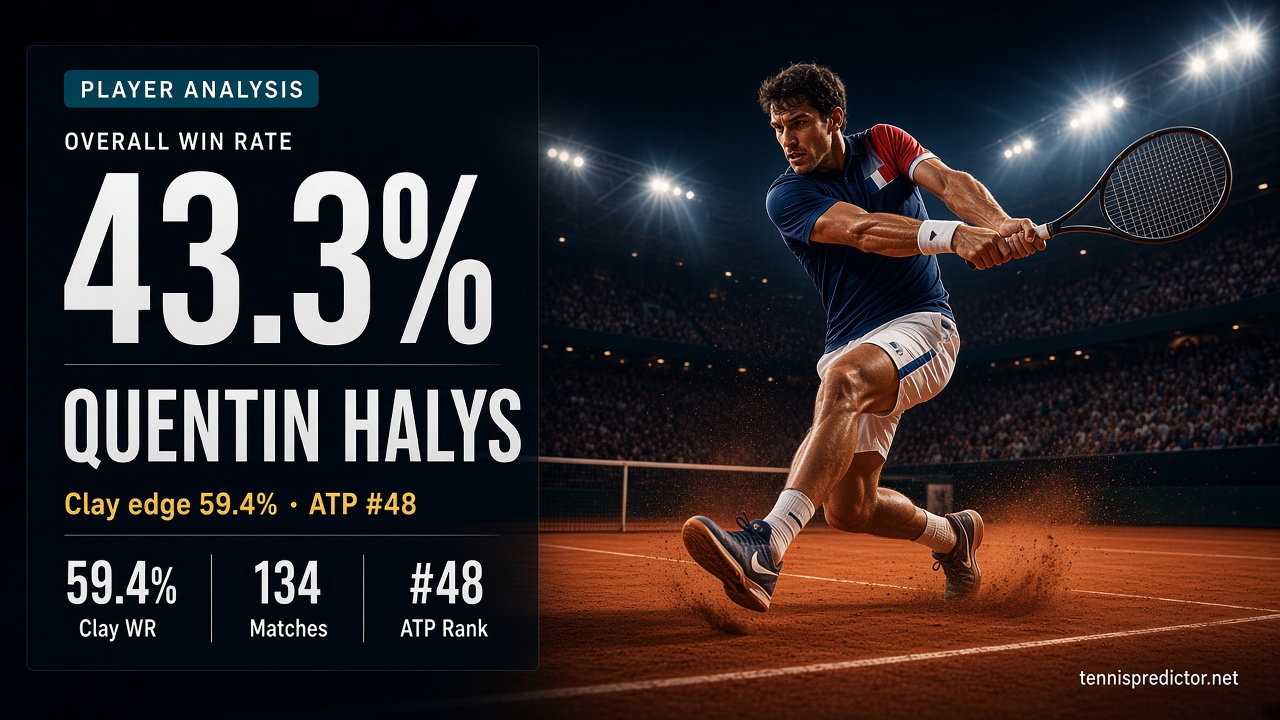
Quentin Halys: Clay specialist edge (59.4%) vs Indoors at 23.5%
Quentin Halys has played 134 ATP main-draw matches from 2022–2026 at a 43.3% overall win rate. The data story: Clay specialist edge (59.4%) vs Indoors at 23.5%.
October 17, 2026 · 11 min read
Luca Van Assche: Clay specialist edge (51.6%) vs Indoors at 14.3%
Luca Van Assche has played 65 ATP main-draw matches from 2022–2026 at a 38.5% overall win rate. The data story: Clay specialist edge (51.6%) vs Indoors at 14.3%.
October 17, 2026 · 11 min read
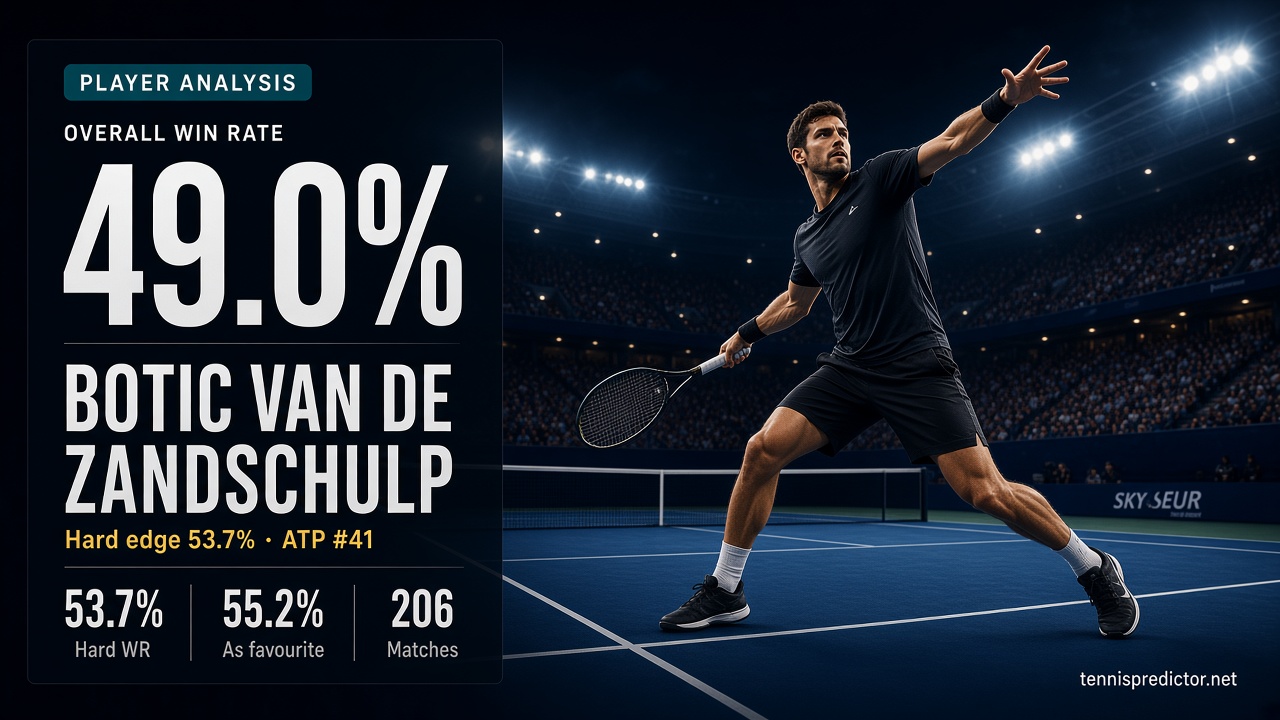
Botic van de Zandschulp: reliable favourite conversion at 66.7%
Botic van de Zandschulp has played 206 ATP main-draw matches from 2022–2026 at a 49.0% overall win rate. The data story: reliable favourite conversion at 66.7%.
October 17, 2026 · 11 min read
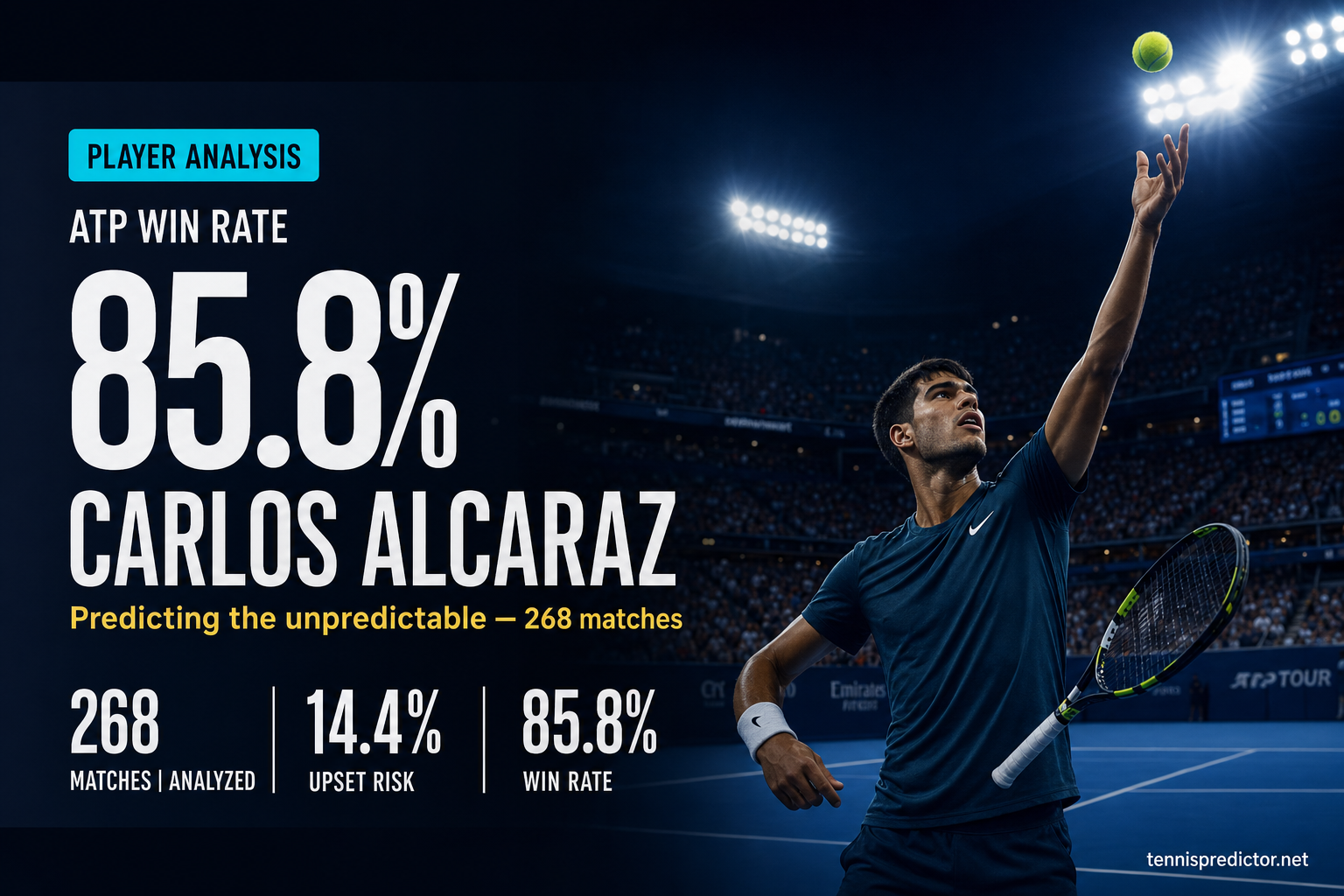
Carlos Alcaraz ATP analysis: predicting the unpredictable
Carlos Alcaraz has played 298 ATP main-draw matches from 2022–2026 at a 85.9% win rate. Data story: elite win rate with real favourite-upset risk that markets compress.
September 8, 2026 · 14 min read